
MONROVIA – For many Liberian and Sierra Leonean families, the SN Brussels flight is more than a ticket. Brussels Airlines, still called “SN” by most travelers here after the carrier it succeeded in 2007, is the plane that brings a mother home for Christmas, carries a student to a European campus and returns a trader with goods for a Waterside shop.
It is also, investigators in Monrovia and Brussels now say, a route drug networks have tried to exploit.
Caught at the carousel
On July 31, Belgian customs officers were checking passengers off a Brussels Airlines flight from Freetown when they stopped a 22-year-old woman from Anderlecht, according to the Halle-Vilvoorde prosecutor’s office and Belgian media. Her two suitcases held 51 kilograms of cocaine.
She had not been on the plane. Investigators believe she was sent only to collect the bags and are still trying to establish how she got into the baggage reclaim hall. A judge later moved her from detention to electronic monitoring.
Weeks earlier at Roberts International Airport (RIA), Liberian security officers flagged six cargo boxes labeled as Maggi cubes and lappa. Inside were 198 compressed plates of cocaine. The Liberia Drug Enforcement Agency (LDEA) said at the time the shipment, valued at US$19.2 million, was bound for Brussels Airlines’ Europe-bound operations. A Justice Ministry charge sheet later listed London as the final destination.
This week, those two scenes met in a single policy fight in Europe. And the people likely to feel it first are not the kingpins, but honest passengers queuing at RIA and Lungi.
‘Chubby Jos’ next door
The man at the center of Europe’s anger lives one border away. Jos Leijdekkers, known in the Netherlands as “Bolle Jos” (Chubby Jos), is that country’s most wanted criminal. Dutch media placed him in Sierra Leone in early 2025.
In the Netherlands he was sentenced to 24 years in prison for cocaine trafficking and an attempted assassination. In Belgium, his sentences across several cases total more than 100 years, Dutch public broadcaster NOS reported. In May, a court in Dendermonde, Belgium, sentenced him in absentia to eight years for his role in moving 11 tonnes of cocaine from Sierra Leone to the Port of Antwerp in October 2023, hidden in palm kernel meal. Twenty accomplices were also convicted.
The Economist’s 1843 magazine reported on September 18 that he lived in Sierra Leone under the name “Omar Sheriff,” posed as a wealthy investor and kept bodyguards from Ghana and South Africa.
Dutch media have reported that he has a relationship, and a child, with a daughter of President Julius Maada Bio. FrontPageAfrica has not independently confirmed this.
No treaty, no handover
The Netherlands and Sierra Leone have no extradition treaty. The Dutch formally delivered an extradition request anyway, and Freetown has yet to sign off on it. Van Weel said in June that Sierra Leone keeps telling him the procedures are under way.
That patience has run out. On X on Thursday morning, Van Weel announced that “the EU will no longer provide budget support to the authorities of Sierra Leone this year.” He told the Dutch daily De Telegraaf a day earlier that the suspension, about €18 million for 2026, was because Sierra Leone is not cooperating on the extradition. The Netherlands also wants a planned €22.5 million for next year held back.
The freeze hits money paid straight into the state budget. Development and humanitarian aid are excluded, so Europe is aiming at the government, not at Sierra Leoneans in need. Van Weel has called it bizarre that Europe should support a country sheltering one of the world’s biggest drug criminals.
Speaking to NOS in Luxembourg on Thursday, Van Weel welcomed the Commission’s decision. “It sends a very clear signal from the European Commission that Sierra Leone must stop harboring this criminal,” he said.
Asked whether the measure was too harsh on an impoverished country, Van Weel turned the question back on its government. Leijdekkers, he said, causes “immense destruction, including for the people of Sierra Leone.”
“They could resolve this within 24 hours by arresting and extraditing this man,” he said.
If the aid freeze does not work, Van Weel warned, “we will continue to increase the pressure through other channels.” He added: “We are fully committed to bringing this criminal to the Netherlands.”
The Dutch have also worked through Sierra Leone’s neighbors. Van Weel told De Telegraaf in July that Liberia and Ghana are aware of the risks and frustrated by Freetown’s refusal to act.
Ghana has already moved. In September, its Narcotics Control Commission arrested three men accused of representing Leijdekkers’ network there, after French customs seized nearly 3.9 tonnes of cocaine in Dunkirk. The drugs, valued at about €225 million, were hidden in a container of plastic waste shipped from Ghana.
The Economist estimates about a third of the cocaine reaching Europe now passes through West Africa. Liberia is on its route map.
Liberia’s own test
Liberia’s record this year shows how close the trade has come to home.
Police charged five men and the cargo firm Global Logistics Services (GLS) on July 4 over the June RIA seizure of about 237.6 kilograms. Among them was Michael U.S. Browne, whose release from prison after a 2024 drug charge the Senate has ordered investigated.
Prosecutors allege GLS operations manager Paul Jamaal King organized the shipment and then tried to recover it after it was flagged, including by offering money to airport security. King has pleaded not guilty and is presumed innocent. In July, the Monrovia City Court found probable cause and sent him and six co-defendants to Criminal Court “C” for trial. Days later, the case appeared stalled because certified records had not reached the court.
Investigators followed the airport leads to the VOA community on the RIA Highway. On July 22, joint security forces arrested two foreign nationals and uncovered a suspected cocaine cache officials valued at up to US$50 million.
When the guards are the thieves
On Tuesday, a jury in Kakata convicted two LDEA agents posted at RIA, Special Agent Joe Logan and Agent Lovette Flowers, along with Nigerian national Tony Obi. Judge Roosevelt Z. Willie of the 13th Judicial Circuit sentenced each to 20 years, the maximum.
Prosecutors said the agents took four of 14 seized plates of cocaine and sold them, and that the network paid about US$10,000 in bribes to LDEA officers. The case began in July 2025 with Quita Dolo Kosso, who landed at RIA from Thailand on a Kenya Airways flight with about 3.4 kilograms of cocaine. She pleaded guilty and is serving five years.
The lesson for travelers is uncomfortable. Drugs can be caught at the gate and still leak out the back door. Europe has noticed both.
Brussels takes aim
Van Weel is in Luxembourg, where EU justice and home affairs ministers meet Thursday and Friday. The agenda covers migration, the EU drugs strategic framework and how the geopolitical climate is affecting Europe’s security. He wrote on X that talks would include “the safety of Europe and the EU-sanctions regime for organized crime.”
He is urging ministers to adopt the regime swiftly, Politico Europe’s Playbook reported. He told Playbook the Bolle Jos case calls for measures against all organized criminals Europe cannot immediately detain, “not only against him,” and said he hopes the regime is concluded by year’s end.
An EU diplomat with the Dutch delegation told OCCRP that cross-border networks can be “very effective” when based in a third country whose authorities will not cooperate or extradite. “The standard criminal law approach isn’t achieving the results we want,” the diplomat said. “That is why there is a push to expand that toolkit.”
European Commission President Ursula von der Leyen announced the package in her 2025 State of the Union address, and the EU Council mandated work on it. On July 9, the Commission and the EU’s foreign policy chief proposed a regime covering drug trafficking, migrant smuggling, human and firearms trafficking and money laundering. It would freeze assets, impose trade restrictions and bar listed people from entering or transiting EU states.
It still has to be agreed, and adoption needs the backing of all 27 member states. Earlier efforts stalled because national police feared sanctions could tip off suspects and spoil investigations. Van Weel said support is stronger now.
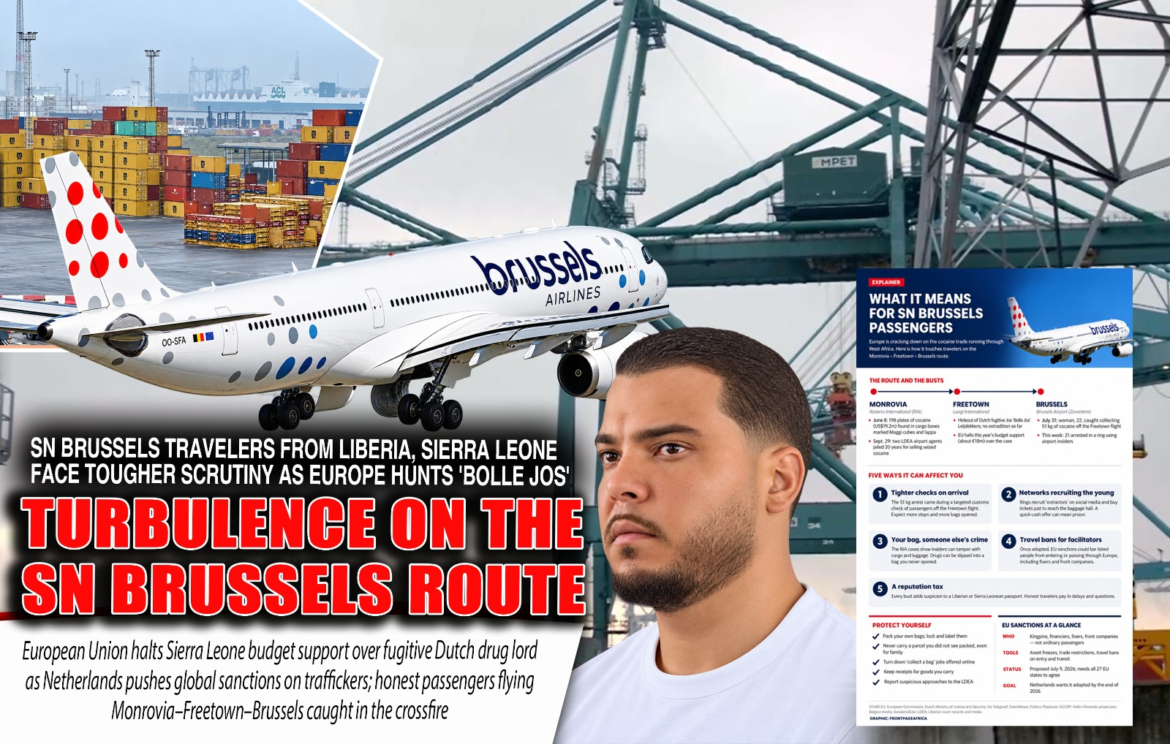
What it means for SN Brussels passengers
Sanctions target kingpins, their financiers and fixers, not ordinary travelers. But passengers on the Monrovia–Freetown–Brussels line already live with the side effects, and those are likely to grow.
Tighter checks on arrival. The 51-kilogram arrest came during a targeted customs check of passengers off the Freetown flight. Expect more of those, and more bags opened.
Networks recruiting the young. This week, Belgian and French authorities announced 21 arrests in a ring that used Brussels Airport. It recruited “extractors” through social media, bought tickets just to reach baggage halls and paid airport workers to pull drugs from suitcases before they reached the carousel.
Your bag, someone else’s crime.
The RIA cases show cargo and luggage can be tampered with by insiders. Lock and label bags, and refuse parcels from anyone, even relatives, without seeing what is inside.
Travel bans for facilitators. Once adopted, the EU regime could bar listed people from entering or passing through Europe. Anyone working for a front company, freight forwarder or fixer tied to a listed network risks being swept up.
A reputation tax. Every bust adds to the suspicion attached to a Liberian or Sierra Leonean passport at a European counter. Honest travelers pay that bill in delays and questions.
For now, the man Europe most wants sits a short flight from Monrovia, beyond reach. Van Weel insists Freetown could change that in a day. The question for Liberia is whether it is seen as part of the problem or part of the fix. The 20-year sentences handed down in Kakata this week were a start. The next test is the US$19.2 million trial.
See more Liberia News Network stories in Google Search by adding LNN as one of your Preferred Sources.
★ Add LNN as a Preferred Source