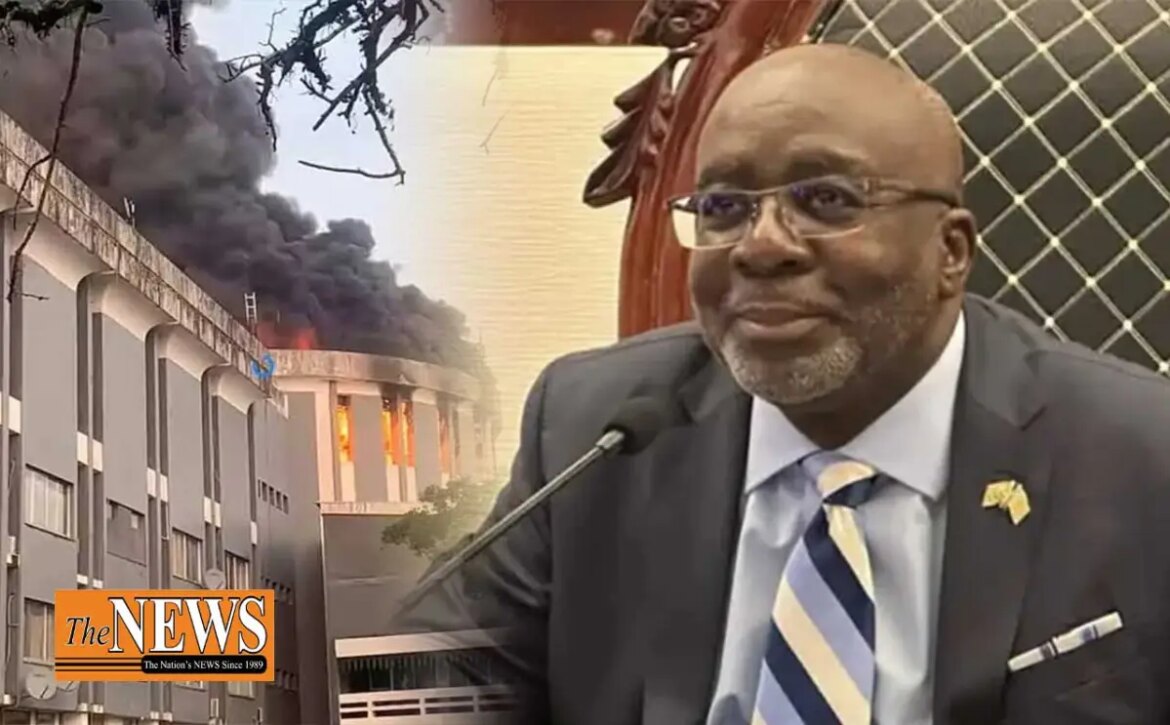
The Supreme Court of Liberia has cleared the way for the resumption of proceedings in the controversial Capitol Building arson case, rejecting a legal challenge filed by former Speaker of the House of Representatives J. Fonati Koffa and his co-defendants seeking to halt further proceedings in the trial.
In a judgment delivered on Friday, August 28, 2026, Chief Justice Yamie Quiqui Gbeisay, Sr. ruled that the defendants had employed the wrong legal remedy in challenging a decision by Criminal Court “A” Judge Roosevelt Z. Willie to disband the jury previously empaneled to hear the case and order a new trial. The Supreme Court’s decision did not address the guilt or innocence of Koffa and the other accused lawmakers. Rather, it centered on a fundamental procedural question, stating whether prohibition was the proper legal instrument for challenging Judge Willie’s interlocutory ruling.
Chief Justice Gbeisay explained that a writ of prohibition is intended to prevent an inferior court or tribunal from proceeding where it lacks jurisdiction or is acting beyond the limits of its lawful authority.
The Court distinguished prohibition from certiorari, which it identified as the appropriate remedy for reviewing an interlocutory ruling where the lower court possesses jurisdiction but is alleged to have committed an error of law, acted irregularly, or abused its discretion. According to the Supreme Court, even assuming that Judge Willie’s decision to disband the jury and order a new trial was legally erroneous, Criminal Court “A” Judge Willie had both personal jurisdiction over the defendants and subject-matter jurisdiction over the case.
The high court therefore determined that the defense should have pursued certiorari instead of prohibition. Consequently, the Supreme Court quashed the alternative writ, denied the peremptory writ and ordered its Clerk to issue a mandate to the lower court, directing it to resume jurisdiction and give effect to the judgment.
The ruling directly affects former House Speaker J. Fonati Koffa and Representatives Dixon W. Seboe, Abu B. Kamara and K. Jacob C. B. Debee, who are among defendants facing prosecution in connection with the December 2024 fire at the Capitol Building.
The lawmakers and other defendants were indicted by a Special Grand Jury following investigations into the blaze that occurred on December 18, 2024. The indictment contained a range of serious criminal allegations, including Arson, Criminal Conspiracy, Attempted Murder, Criminal Solicitation, Criminal Facilitation, and the Release of Destructive Forces.
The prosecution alleged that the defendants were involved in a scheme connected to the burning of the Capitol complex, allegations the accused have contested through their legal teams. The charges, however, remain allegations until proven beyond a reasonable doubt in court. The case stems from the devastating fire that engulfed portions of Liberia’s Capitol Building on December 18, 2024. The blaze caused extensive damage to the seat of the national legislature, including the entire joint chamber, legislative archives and other facilities.
The destruction was estimated at approximately US$8.6 million, adding significant financial weight to a case that has already generated intense political and public interest. The prosecution subsequently presented evidence to a Special Grand Jury, which returned an indictment against Koffa, Seboe, Kamara, Debee and other individuals.
What began as a criminal investigation has since developed into one of Liberia’s most politically sensitive trials, with the defendants’ status as serving or former lawmakers adding another layer of controversy to the proceedings. The latest Supreme Court intervention followed Judge Willie’s decision to disband the jury that had previously been empaneled to hear the case.
Defense lawyers challenged that decision, argued that Judge Willie had acted unlawfully and that the disbandment of the jury adversely affected their clients’ constitutional and procedural rights. Rather than allowing the challenge to proceed through the lower court process, the defense sought prohibition from the Supreme Court.
The Supreme Court, however, found that the defense had selected the wrong procedural. The Court’s reasoning effectively means that the question was not whether Judge Willie’s decision was necessarily correct, but whether the Supreme Court could review that decision through a writ of prohibition.
The court answer was no. The high court made clear that jurisdiction is central to prohibition. Where a lower court has lawful jurisdiction over both the parties and the subject matter, an alleged error in the exercise of that jurisdiction does not automatically transform the matter into one for prohibition. With the alternative writ quashed and the peremptory writ denied, the Supreme Court has effectively removed the procedural obstacle that had prevented the lower court from moving forward.
The mandate now returns the matter to Criminal Court “A,” leaving Judge Willie free to resume jurisdiction and proceed with the case under the new-trial arrangement. The ruling could therefore mark the beginning of another significant phase in the Capitol arson prosecution.
But the Supreme Court’s decision should not be interpreted as a victory for the prosecution on the merits of the criminal allegations. Koffa, Seboe, Kamara, Debee and their co-defendants have not been convicted by the Supreme Court.
The Court did not determine whether they participated in the alleged burning of the Capitol Building or whether the prosecution can prove the charges against them. Instead, the Court resolved a procedural dispute over the proper legal method for challenging Judge Willie’s decision. The substantive criminal case must still be determined by the trial court on the basis of evidence and applicable law.
For now, the Supreme Court has spoken on the procedural question and the message is clear that the Capitol arson case can return to the trial court, while the accused lawmakers must face the allegations through the ordinary judicial process.
See more Liberia News Network stories in Google Search by adding LNN as one of your Preferred Sources.
★ Add LNN as a Preferred Source