By Seltue Robert Karweaye Sr.
The arrest of the Comoros-flagged vessel IB Atlantic IV Moroni by the Ivorian Navy should be more than another security incident. For Liberia, it should be a national wake-up call about the serious weaknesses in our maritime security, territorial protection, and national-security preparedness.
The 41-year-old mini bulk carrier reportedly departed Bissau, Guinea-Bissau, on July 1, 2026, bound for Lomé, Togo. In mid-July, the vessel’s Automatic Identification System (AIS) ceased normal transmissions, effectively disappearing from routine maritime tracking.
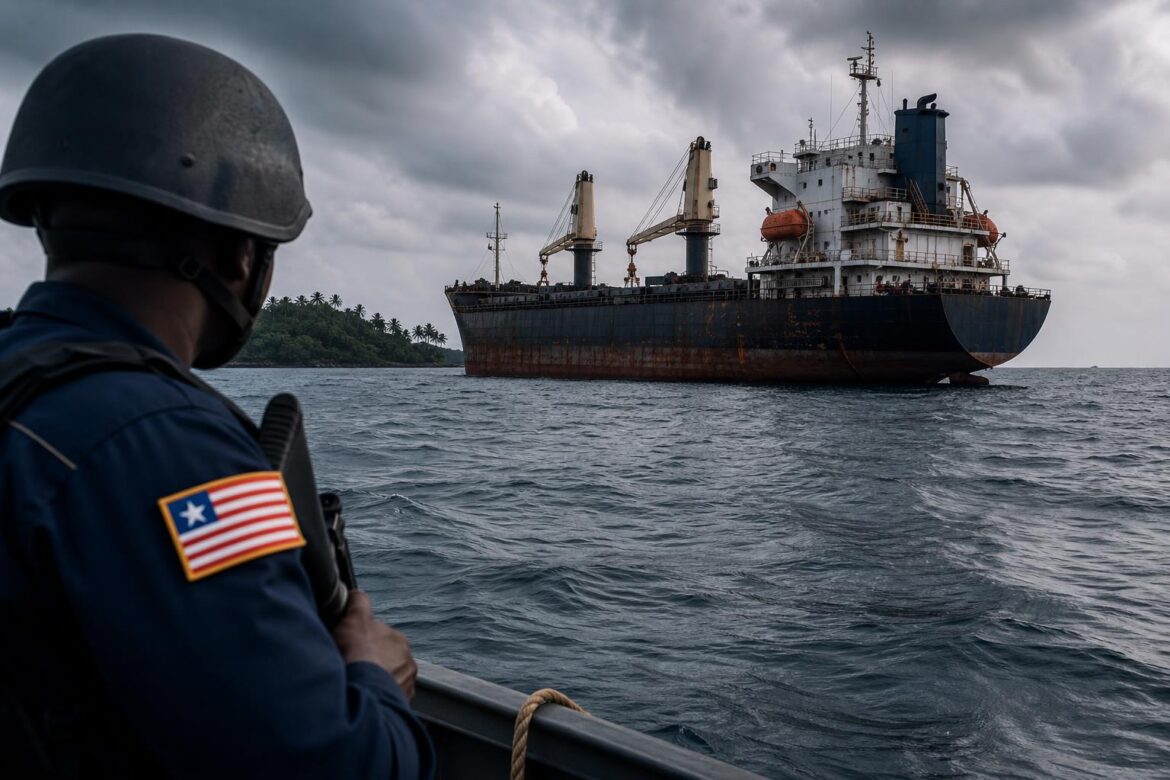
By late July, the vessel mysteriously reappeared, drifting or anchored near York Island in Tewor District, Grand Cape Mount County, within Liberia’s Exclusive Economic Zone. The apparent absence of visible crew and the lack of radio communication led local residents to describe it as a “ghost ship.”
On August 2, the Armed Forces of Liberia reportedly dispatched a 14-member tactical Coast Guard team aboard two boats to intercept and board the vessel. However, operational difficulties and poor weather reportedly allowed the ship to evade Liberian tracking. The vessel was subsequently intercepted and arrested by the Ivory Coast Navy in Ivorian waters.
That development should embarrass Liberia—but more importantly, it should force us to confront a fundamental question: Can Liberia effectively defend and monitor its own maritime territory?
If a vessel can enter or remain within our maritime domain, disappear from tracking, and evade our security personnel before eventually being apprehended by a neighboring country, then Liberia has a serious maritime-security vulnerability that cannot be ignored.
This is not simply about one vessel. It is about national sovereignty.
A sovereign state must have the capacity to monitor its territorial waters, identify suspicious vessels, respond rapidly to maritime threats, and enforce its laws. These responsibilities cannot exist merely on paper. They require trained personnel, functioning patrol vessels, communications equipment, surveillance systems, intelligence capabilities, fuel, maintenance, and adequate operational funding.
Unfortunately, Liberia appears to have a troubling imbalance in its national priorities.
We continue to spend enormous public resources maintaining expensive official convoys and vehicles for the President, Vice President, Speaker of the House of Representatives, President Pro Tempore of the Senate, legislators, ministers, deputy ministers, and other senior government officials. Yet when it comes to protecting the country’s territorial waters, we are confronted with reports of inadequate boats, limited maritime surveillance capacity, logistical constraints, and other operational deficiencies.
What kind of national priority system allows government officials to travel in expensive convoys while the country struggles to adequately patrol its own waters?
This is precisely the kind of question Liberians should be asking.
Government is not merely about constructing buildings, purchasing vehicles, or creating new positions. The fundamental responsibility of government is to protect the territorial integrity, security, and sovereignty of the Republic and to provide essential public services.
Liberia has an enormous coastline and a significant maritime economic zone. Our waters are connected to fisheries, shipping, ports, natural resources, offshore economic activities, and national security. Weak maritime surveillance therefore creates opportunities not only for illegal fishing, but potentially for drug trafficking, arms smuggling, human trafficking, illegal dumping, piracy, and other forms of transnational organized crime.
Given Liberia’s recent experience with major narcotics seizures, strengthening maritime security should be treated as an urgent national-security priority—not as an afterthought.
The successful intervention by the Ivory Coast Navy deserves recognition. But Liberians should not be satisfied simply by thanking Côte d’Ivoire. We should be asking why a neighboring country was able to successfully intercept the vessel after it had reportedly evaded Liberian tracking.
Côte d’Ivoire’s success should be Liberia’s lesson.
Rather than continuing to pour disproportionate resources into the privileges and conveniences of political officeholders, the government should redirect more public resources toward the institutions that protect the Liberian people.
Liberia needs a properly equipped and professionally trained Coast Guard. It needs modern patrol boats capable of operating in difficult weather conditions. It needs reliable maritime communications, coastal radar and surveillance capabilities, vessel-tracking systems, intelligence sharing, and sustained funding for fuel, maintenance, training, and operations.
Most importantly, Liberia needs a national-security strategy based on threats and national interests rather than political convenience.
For more than two decades, Liberian politics has been dominated by fierce competition between the Unity Party (UP) and the Coalition for Democratic Change (CDC), with political loyalty frequently overshadowing substantive national debate. But the “ghost ship” incident reminds us that political slogans cannot patrol our borders, political rallies cannot intercept suspicious vessels, and partisan arguments cannot protect our territorial waters.
Liberia cannot continue to spend heavily on the political class while underinvesting in the institutions responsible for protecting the state.
The government should therefore use this incident as an opportunity to conduct a comprehensive review of Liberia’s maritime-security capabilities. Parliament should demand a detailed assessment of the Coast Guard’s equipment, personnel, patrol capacity, communications systems, surveillance capabilities, operational budget, and readiness.
The objective should not be to embarrass the Armed Forces of Liberia or individual security officers. The objective should be to fix the system.
Liberia has limited resources. That makes prioritization even more important.
We cannot afford a government that has expensive vehicles for officials but inadequate patrol boats for the Coast Guard. We cannot afford sophisticated convoys for politicians while our maritime borders remain vulnerable. And we certainly cannot afford to discover our security weaknesses only after a suspicious vessel has already slipped through them.
The IB Atlantic IV should therefore become more than a headline.
It should become a wake-up call.
Liberia must begin spending more on the protection of the Republic and less on the privileges of those who temporarily occupy public office. National security is not a luxury. It is a constitutional and sovereign responsibility.
If this incident teaches Liberia anything, it should be this: A country that cannot effectively monitor and protect its own territory is a country that must urgently rethink its priorities.
About the Author
Seltue Robert Karweaye Sr. is a Liberian policy analyst, security expert, researcher, and prolific commentary writer with interests in governance, public finance, economic development, public policy, and national security. He can be contacted at seltuek@gmail.com.
See more Liberia News Network stories in Google Search by adding LNN as one of your Preferred Sources.
★ Add LNN as a Preferred Source