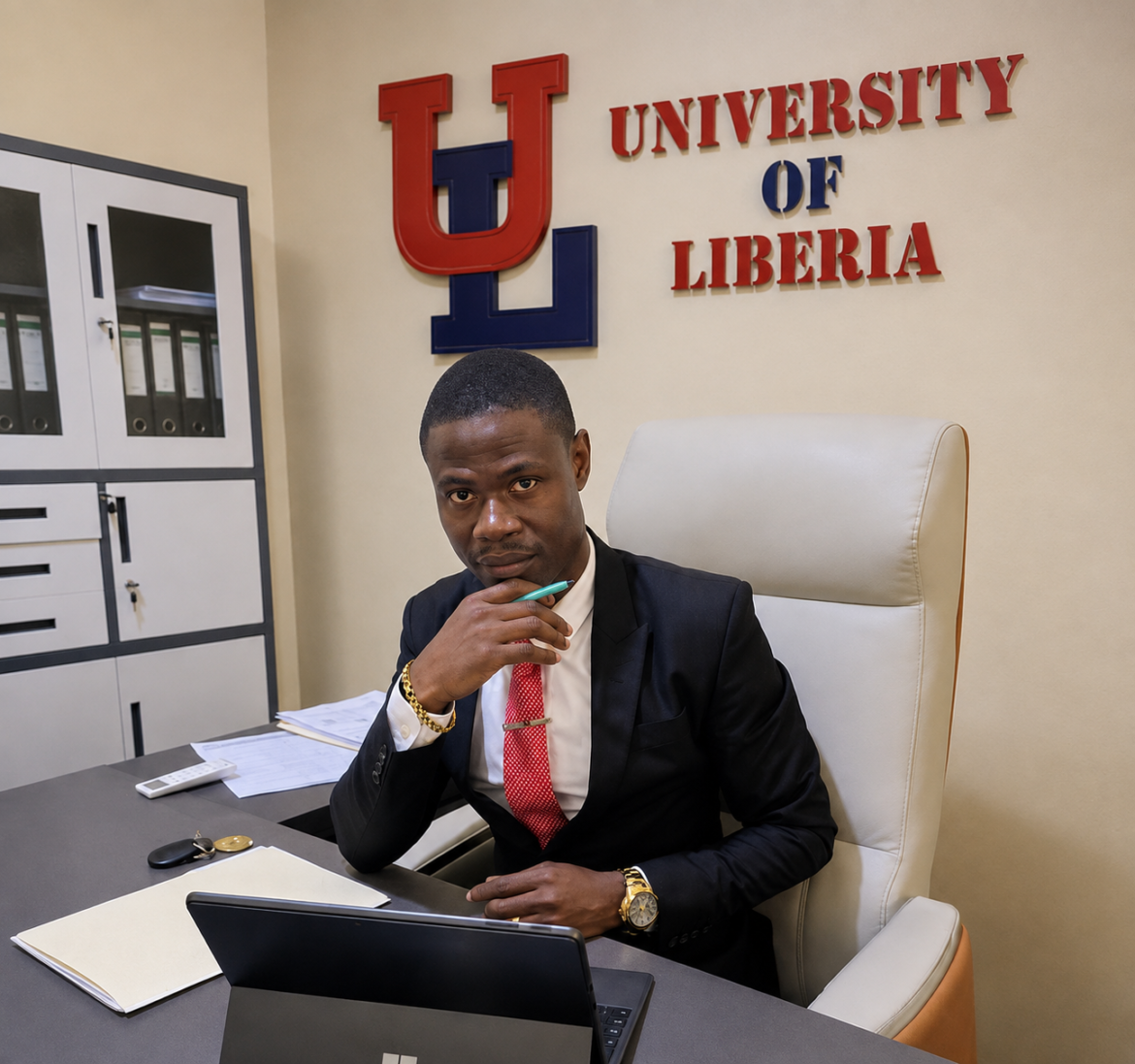
Monrovia — Former Assistant Minister for Mines, Mineral Resources Development and Conservation at the Ministry of Mines and Energy, Carlos E. Tingban Sr., has called on President Joseph Nyuma Boakai to make an urgent national intervention into the prolonged stalemate at the University of Liberia, warning that recurring disputes between university authorities and organized faculty and staff groups are threatening the institution’s academic mission.
In an open letter dated August 23, 2026, Tingban urged President Boakai to treat the situation at Liberia’s premier public university not simply as a labor disagreement, but as a broader national education and institutional crisis requiring decisive intervention, comprehensive reform and what he described as an institutional reset.
Tingban, who is also Chairman Emeritus of the Vanguard Student Unification Party/SUP and Executive Director of GeoMining and Environmental Consultancy Inc., acknowledged the rights of university workers to organize, negotiate and advocate for improved working conditions.
However, he argued that those rights must be balanced against the rights of students to receive uninterrupted education.
“No group should be allowed to hold the academic future of an entire generation hostage indefinitely,” Tingban said, stressing that prolonged disruptions affect not only university administrators but students, parents, families and the country’s broader development.
He said repeated academic delays, disagreements and work-related disruptions at the University of Liberia have created a pattern that should compel the government to examine the institution beyond individual administrations or university presidents.
Calls for Review of ULFA, ULSA
At the center of Tingban’s proposal is a comprehensive legal and institutional review of the University of Liberia Faculty Association (ULFA) and University of Liberia Staff Association (ULSA).
He called for an examination of the organizations’ mandates, structures, collective bargaining arrangements and relationship with the statutory authority of the university.
According to Tingban, if such a review determines that existing arrangements have become incompatible with the university’s ability to function effectively, the government should consider restructuring, replacing or dissolving those arrangements in accordance with Liberian law.
He emphasized that such reforms should preserve legitimate workers’ rights while preventing prolonged disruptions of academic activities.
Tingban stopped short of declaring that any particular conduct by university employees constitutes treason or another criminal offense, noting that such determinations belong to Liberia’s constitutional and legal authorities.
He nevertheless argued that deliberately or repeatedly disrupting higher education can cause serious national damage.
Performance Accountability for Faculty
Tingban also turned his attention to academic professionalism, calling for a stronger system of performance evaluation for lecturers and academic staff.
He proposed that faculty members be assessed annually against measurable standards, including classroom attendance and punctuality, course completion, teaching quality, student supervision, examination preparation and grading, research output, publications, professional development and service to the university.
He argued that university employment should be linked to measurable professional responsibilities and that lecturers who demonstrate exceptional teaching, research and academic leadership should be appropriately rewarded and promoted.
Tingban also raised concerns about reports of some lecturers allegedly spending excessive time in entertainment venues during periods when they should be engaged in teaching, research, preparation or student consultation.
He stressed that his position was not intended to regulate employees’ private lives, but to promote professional accountability during official working hours.
Pushes Removal of Bars, Entertainment Businesses
In one of his more sweeping recommendations, Tingban called for an immediate review of bars, drinking establishments, entertainment centers and other recreational businesses operating on University of Liberia property or within university-controlled facilities.
Where such establishments do not directly serve the university’s educational mission, he recommended their removal or abolition, subject to legal and contractual review.
Tingban said university property should primarily accommodate classrooms, lecture halls, laboratories, libraries, digital learning centers, innovation hubs, student study areas, faculty research offices, academic conference facilities, counseling services and legitimate student recreational activities.
He also called for a comprehensive review of businesses, concessions, leases and commercial activities operating on university property to determine whether they comply with contractual requirements and provide fair value to the institution.
Proposes Emergency University Reform Initiative
Tingban proposed that the Boakai administration establish a National University of Liberia Emergency Reform Initiative to address the institution’s longstanding challenges.
Among his recommendations are mechanisms to guarantee uninterrupted academic operations, an independent institutional, academic, financial, administrative and property audit, and a legal review of the status and operations of ULFA and ULSA.
He also proposed the creation of a rapid labor-dispute resolution mechanism that could resolve disagreements without automatically shutting down academic activities.
Other recommendations include strengthening research programs, modernizing infrastructure, improving laboratories and libraries, expanding digital learning, and developing a multi-year transformation plan for the university.
Calls for International Faculty Recruitment
Tingban further urged the government to recruit qualified international lecturers to address critical faculty shortages while simultaneously investing in the development of Liberian academics.
He suggested that, where legally and financially feasible, Liberia could recruit substantial numbers of qualified African and international academics, including potentially 300 to 400 Nigerian lecturers.
He cautioned, however, that foreign recruitment should serve as a bridge to local capacity development rather than become a permanent substitute for Liberian scholars.
He called for scholarships, postgraduate training, research fellowships and faculty-development programs to strengthen Liberia’s academic workforce.
One-Year Shutdown Not Ruled Out
Tingban also raised the possibility of temporarily suspending operations at the University of Liberia for a defined period—even up to one academic year—if an objective assessment concludes that such a step is necessary for comprehensive restructuring.
He argued that a carefully planned period of institutional reform could be preferable to years of recurring academic disruptions.
However, he stressed that any such decision would have to be legally grounded, carefully planned and accompanied by alternative academic arrangements to ensure students do not become victims of the reform process.
“Students Are Asking for Classrooms”
Tingban said the concerns expressed by students should remain at the center of any national response.
He argued that Liberian students are not demanding luxury but basic academic necessities—including functional classrooms, competent lecturers, laboratories, libraries, examinations, research opportunities and degrees earned on time.
“Every semester lost is more than a calendar entry,” he said, warning that repeated disruptions translate into delayed careers, increased financial burdens on families and lost opportunities for young Liberians.
He urged President Boakai to place the University of Liberia at the center of the government’s development agenda and ensure that the institution becomes a stronger engine of national intellectual and human-capital development.
“The Time for a Permanent Solution Is Now”
Tingban concluded by urging the president to treat the University of Liberia as a national institution requiring presidential attention rather than another government entity experiencing a routine labor dispute.
He said the government must protect the rights of workers while equally protecting the educational rights of students, parents and the Liberian public.
“The ARREST Agenda must not leave the University of Liberia behind,” Tingban said, calling on President Boakai to use the current crisis as an opportunity for a historic intervention aimed at strengthening the institution rather than targeting any particular group or individual.
“The time for another temporary solution has passed,” he declared. “The time for a permanent national solution is now.”
See more Liberia News Network stories in Google Search by adding LNN as one of your Preferred Sources.
★ Add LNN as a Preferred Source