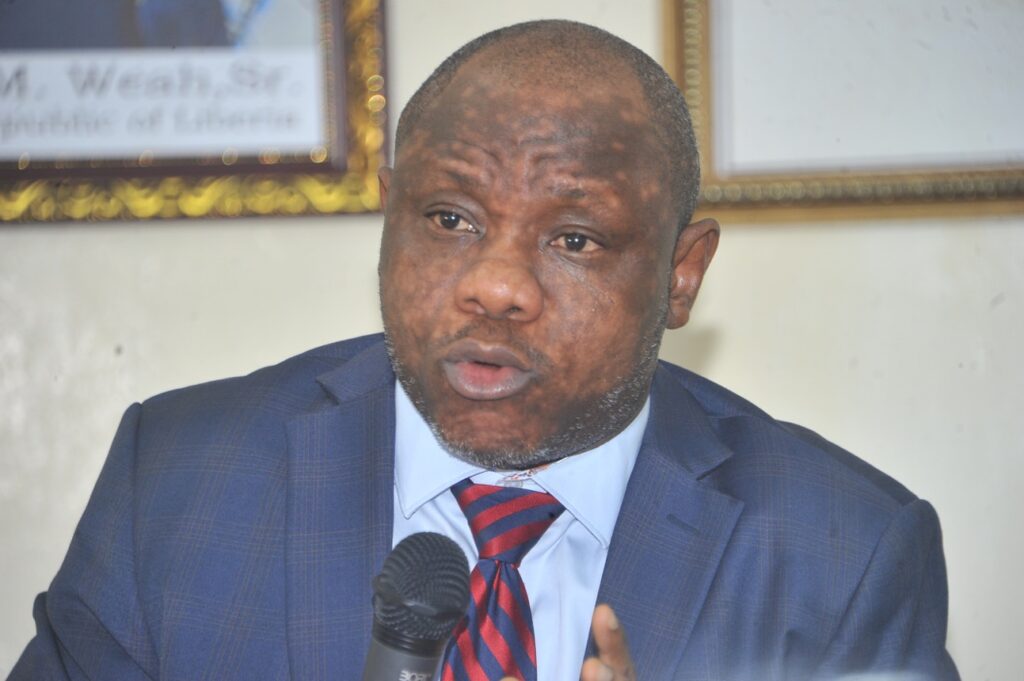
MONROVIA – Former Finance Minister Samuel D. Tweah has transformed Liberia’s ongoing debate over government audit performance into a broader political challenge to the Unity Party, warning that a Qualified Opinion from the General Auditing Commission will not be enough to secure the government’s political future.
In a lengthy defense of the former CDC administration, Tweah argued that the political significance of the current audit debate has been overstated by supporters of President Joseph Boakai’s government.
His central argument is straightforward: if the current administration points to a Qualified Opinion as evidence of improved governance, then the same standard must also be applied to the previous CDC administration, which he says achieved the same audit status in 2021 and 2022.
Tweah therefore believes the real measure of the government’s performance must extend beyond accounting classifications to the everyday economic and institutional conditions confronting Liberians.
“The UP will not be reelected because of Qualified Opinion,” Tweah declared.
Instead, he argued, the government’s prospects in 2029 will depend heavily on whether it can create jobs, improve economic opportunities and demonstrate respect for Liberia’s laws.
His intervention introduces a sharper political dimension to an issue that is often confined to public finance and auditing.
A Qualified Opinion generally indicates that an auditor has identified material issues or limitations in financial reporting, but that the financial statements as a whole are not sufficiently misstated to warrant an Adverse or Disclaimer Opinion.
Tweah’s argument, however, is that the political value of such an opinion cannot be separated from the history that produced it.
He said Liberia’s audit record before the CDC’s 2018 election victory was dominated by Disclaimer Opinions, which he characterized as evidence of severe weaknesses in government financial reporting.
According to Tweah, the CDC administration subsequently moved the country from Disclaimer to Adverse Opinion and later to Qualified Opinion in 2021 and 2022.
That history, he argues, undermines any attempt by the Unity Party to portray a Qualified Opinion as an achievement originating exclusively under the Boakai administration.
But Tweah’s criticism does not stop at the GAC.
He has also placed the Liberia Anti-Corruption Commission at the center of his defense of the former government, asserting that President Weah introduced reforms that strengthened the commission’s prosecutorial authority and provided greater protection for its commissioners from presidential removal.
The former minister portrayed those reforms as part of the CDC administration’s broader effort to strengthen accountability institutions.
He also raised an unverified concern about a possible legislative effort to reverse those protections.
Tweah said he had heard that a bill could potentially restore presidential authority over the removal of LACC commissioners, and he challenged the government to clarify whether such a measure exists or is being considered.
That allegation adds another layer to an already politically charged debate over the independence of Liberia’s anti-corruption institutions.
For Tweah, institutional independence is not simply a legal question. It is a test of whether Liberia’s governance reforms are becoming permanent or remain vulnerable to changes in political leadership.
The former minister also accused the Unity Party and its supporters of attempting to “Stalinize” the history of the CDC, using the historical example of Soviet-era efforts to manipulate public narratives and erase political figures from official records.
The provocative comparison underscores the intensity of the political battle over the legacy of the Weah administration.
Tweah is effectively arguing that the CDC’s record should be evaluated against measurable institutional developments rather than dismissed through political rhetoric.
At the same time, his intervention reveals the broader stakes for the opposition.
The CDC is seeking to position itself ahead of the 2029 presidential contest not simply as a former ruling party, but as a political movement capable of challenging the Unity Party’s claims to governance and institutional reform.
Tweah’s emphasis on jobs is particularly significant.
By shifting the debate from audit opinions to employment, he is attempting to frame the government’s performance around an issue likely to resonate more directly with citizens.
His warning is that by 2029, voters may ask a much simpler question than whether Liberia received a Qualified Opinion.
They may ask whether their economic circumstances improved.
Tweah argued that if the government fails to solve Liberia’s employment crisis, it will struggle to explain its performance to voters, regardless of improvements in government accounting.
The former minister also accused the administration of abusing the country’s laws, though he did not provide specific examples in the statement.
Those claims are likely to become part of the wider political contest as both the ruling Unity Party and opposition CDC increasingly seek to define their respective records.
The dispute over the GAC therefore appears to be evolving beyond a disagreement over audit terminology.
It is becoming a contest over political ownership of Liberia’s governance reforms, the independence of accountability institutions and the question of what ultimately constitutes successful leadership.
For the CDC, the argument is that the Weah administration left behind measurable institutional reforms that should not be erased from Liberia’s public record.
For the Unity Party, the challenge will be demonstrating that whatever progress is being recorded under its administration represents more than continuation of reforms inherited from its predecessor.
And for Liberian voters, the decisive measure may ultimately be neither the political rhetoric surrounding the GAC nor competing claims over past reforms, but whether government institutions become more transparent, corruption is effectively confronted and ordinary citizens experience tangible improvements in employment and economic opportunity.
That makes the audit debate potentially more consequential than the accounting language suggests. It is increasingly becoming part of the battle over Liberia’s political record and the foundation on which the 2029 election will be fought.
See more Liberia News Network stories in Google Search by adding LNN as one of your Preferred Sources.
★ Add LNN as a Preferred Source