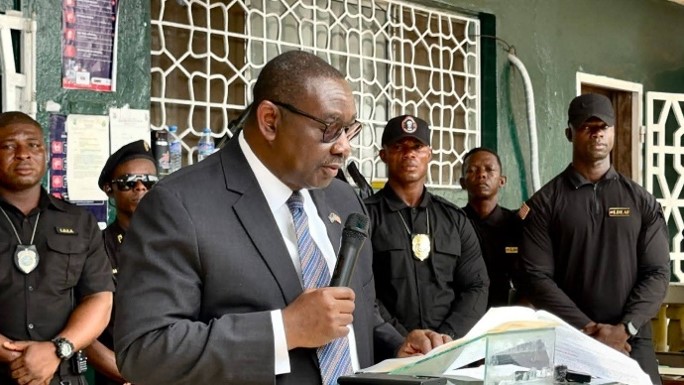
MONROVIA, Liberia, September 21, 2026 — Acting Defense Minister Cllr. N. Oswald Tweh has stressed civilian oversight of Liberia’s armed forces, saying civilian authorities should provide policy and strategic direction while military commanders retain responsibility for operational and tactical matters.
Tweh made the remarks during a formal turnover ceremony at the Ministry of National Defense at the Barclay Training Center in Monrovia, where he outlined priorities for his tenure and pledged to strengthen civil-military relations.
His comments come amid public discussion over his appointment to the Defense Ministry following his reassignment from the Ministry of Justice.
President Joseph Nyuma Boakai announced changes at the Justice Ministry earlier this month, replacing Tweh with Cllr. Betty M. Lamin-Blamo and indicating that Tweh would be reassigned within government.
Addressing the constitutional relationship between civilian authorities and the military, Tweh cited Article 50 of the 1986 Constitution, which vests executive power in the President and designates the President as Head of State, Head of Government and Commander-in-Chief of the Armed Forces of Liberia.
Tweh said the Ministry of National Defense serves as the civilian institution responsible for policy direction, strategic oversight, legal administration and resource management, while operational and tactical responsibilities remain within the military command structure.
“The Ministry of National Defense, therefore, serves as the civilian anchor,” Tweh said, stressing the need to maintain the professionalism of the Armed Forces of Liberia and keep the military insulated from partisan politics.
“As a legal professional, my commitment to this democratic principle of civilian oversight is absolute,” he added.
Civilian control of the military generally seeks to distinguish political and policy authority from professional military command, with civilian authorities establishing defense policy and military commanders carrying out operational responsibilities.
Tweh also reflected on his earlier involvement in discussions surrounding the restructuring of Liberia’s military following the civil conflict.
He recalled that in December 2007, while serving as President of the Liberian National Bar Association, the association invited then-Defense Minister Brownie Samukai to address issues involving the rule of law, human rights and procedures governing the newly restructured Armed Forces.
According to Tweh, Samukai informed the Bar that military recruits were receiving not only military training but also instruction in Liberian civics, constitutional authority and the principle of military subordination to civilian authority.
Tweh also recalled serving as guest speaker on August 29, 2008, at the graduation of the final Initial Entry Training class and activation of the 1st Infantry Battalion of the AFL’s 23rd Infantry Brigade at the Barclay Training Center.
“Now, 18 years later, the President has entrusted me to steer the affairs of the Ministry of Defense,” Tweh said.
The Acting Defense Minister outlined three immediate priorities, including implementation of the Ministry’s five-year strategic plan, improving the welfare of military personnel and strengthening relations between the AFL and the communities it serves.
He said the strategic plan envisions a broader role for the defense sector beyond territorial defense, including disaster resilience, humanitarian assistance and engineering support for national development.
Tweh also emphasized improving conditions for AFL personnel, including access to adequate equipment, healthcare and other support.
He said conditions of service should reflect the responsibilities and sacrifices associated with military service.
The Acting Defense Minister further pledged to strengthen relations between the AFL and Liberian communities through mutual respect, transparency and public accountability.
Describing the AFL as a “Force for Good,” Tweh said maintaining public confidence would require continued engagement between the military and the population it serves.
He also pledged to work with Liberia’s international partners to preserve the country’s peace, protect its sovereignty and strengthen national security.
See more Liberia News Network stories in Google Search by adding LNN as one of your Preferred Sources.
★ Add LNN as a Preferred Source