
The United States has called for the timely passage of legislation establishing a transparent and independently regulated multi-user railway system in Liberia, warning that predictable rules and fair access to infrastructure are critical to attracting long-term investments in the country’s mining and agricultural sectors.
U.S. Chargé d’Affaires to Liberia Kristin Gilmore said the proposed railway system was central to efforts to unlock opportunities in Liberia’s mineral and agricultural industries, as the country seeks to attract international investors, expand economic activities and create jobs.
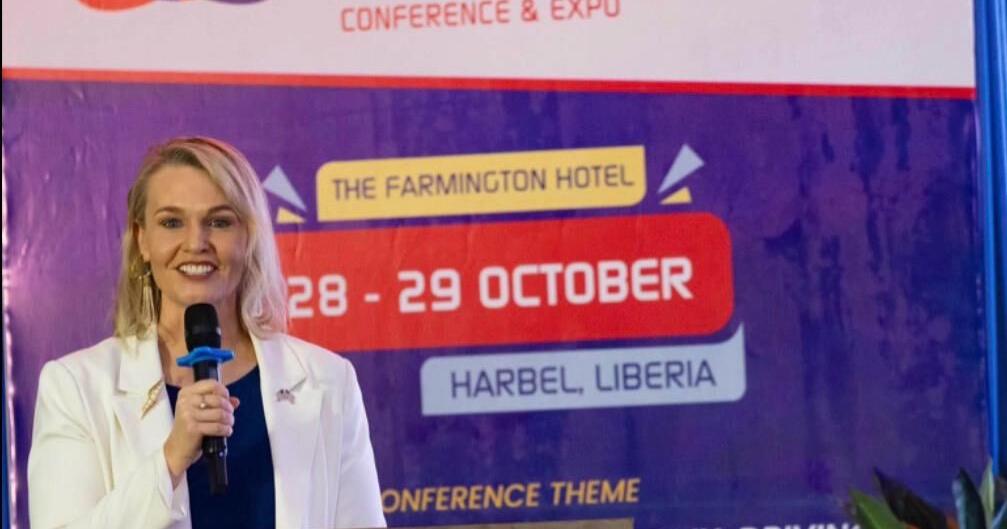
Speaking Wednesday at the Liberia International Mining and Energy Conference and Exhibition (LIMEC 2026) at the Farmington Hotel in Harbel, Margibi County, Gilmore disclosed that the U.S. Trade and Development Agency (USTDA) was finalizing a grant to assess the capacity of Liberia’s railway infrastructure in support of President Joseph Nyuma Boakai’s vision of a multi-user rail system.
“Also, the US Trade and Development Agency is finalizing a grant to assess the capacity of Liberia’s rail infrastructure in support of President Boakai’s vision of multi-user rail,” Gilmore said.
“Multi-user rail is key to unlocking opportunities in Liberia’s minerals and agricultural sectors.”
She welcomed the Liberian government’s commitment to developing the railway system but stressed that the initiative must be supported by legislation that ensures transparency and independent regulation.
“We welcome the government’s commitment to this vision and look forward to the timely passage of legislation establishing a transparent, independently regulated multi-user rail system,” she said.
Gilmore did not provide a timeline for the proposed legislation’s passage or disclose the financial value of the USTDA grant, which she said was being finalized.
The U.S. diplomat’s remarks placed railway access and regulation among the important considerations for investors seeking to participate in Liberia’s mining and agricultural sectors.
Rail transportation can provide an important link between production sites and export facilities, particularly for mining operations that must move large volumes of minerals over long distances. Agricultural producers can also benefit from more efficient transportation networks that connect farms and processing facilities to domestic and international markets.
A multi-user railway system is intended to provide access to railway infrastructure for multiple users rather than restricting its use to a single operator. Its effectiveness, however, depends on the rules governing access, operational arrangements, tariffs and the treatment of competing users.
Gilmore’s call for independent regulation highlights the importance of establishing a framework that provides investors with confidence that railway access will be governed by transparent and predictable rules.
Although she did not outline the specific provisions of the proposed legislation, her remarks emphasized that the regulatory structure must support fair access to infrastructure and help create conditions for long-term private investment.
For Liberia, where the development of mineral resources requires substantial investment in transportation and other supporting infrastructure, the proposed system could become an important component of efforts to expand economic activity.
Gilmore said the railway initiative was part of a broader effort to improve the investment environment in Liberia, particularly in mining and energy.
She disclosed that several U.S. private-sector delegations had visited Liberia in recent months, describing the visits as evidence of commercial interest in the country.
“In recent months, we have also seen multiple US private sector delegations pass through Liberia,” she said.
“The commercial interest is real and the momentum is real, and the momentum is real.”
However, Gilmore said the challenge was to ensure that expressions of interest translated into actual investments and long-term business operations.
“The question is no longer whether American businesses are considering Liberia. They are. The question is whether Liberia can attract them, and give them the confidence to stay, invest, and grow,” she said.
She added that U.S. companies could contribute to Liberia’s development through investment, skills transfer and partnerships with local businesses.
“US companies bring quality, commitment, skills transfer, and true partnership wherever they work, including right here in Liberia,” Gilmore said.
The diplomat emphasized that investors in mining and energy require confidence in the regulatory environment because their projects involve substantial capital and long development periods.
“Mining investments are long-term investments. According to S&P, it takes 18 years to bring a new mine online,” she said.
She added that energy infrastructure projects also require time before they begin generating returns.
“That is why the reforms I have discussed with President Boakai and senior government officials matter so much,” Gilmore said.
“Investors need transparent and predictable rules, fair access to infrastructure, and an electricity sector that welcomes private investment.”
Her remarks suggested that the development of railway infrastructure alone would not be sufficient to attract investment without complementary reforms to ensure predictable regulations, reliable electricity and fair access to essential infrastructure.
The United States is also supporting efforts to address investment constraints through the ongoing development of a Millennium Challenge Corporation (MCC) compact for Liberia.
Gilmore said the MCC reaffirmed Liberia’s eligibility for a compact in 2025 and that the programme under development was focused on mining and energy sector reforms.
“Last year, the Millennium Challenge Corporation reaffirmed Liberia’s eligibility for compact development, and its focus is on mining and energy sector reforms, two areas that are critical to unlocking private investment and supporting Liberia’s long-term economic growth,” she said.
She acknowledged the contributions of stakeholders who had provided input into the compact development process.
“Many of you have provided valuable insights for the ongoing compact development process,” she said.
The proposed compact and the USTDA-supported railway assessment represent separate areas of U.S.-Liberia cooperation, with the former focused on mining and energy reforms and the latter on evaluating railway infrastructure capacity in support of the government’s multi-user rail vision.
Gilmore did not announce a completion date for the compact or provide further details about the scope of the railway assessment.
The U.S. diplomat said the Liberian government had expressed its commitment to reforms intended to improve the investment climate, adding that Washington was prepared to work with the authorities to translate those commitments into practical results.
“Liberia’s leaders have expressed their commitment to these reforms, and the United States stands ready to work alongside them to turn that commitment into results,” she said.
She also identified the Liberia International Mining and Energy Conference and Exhibition as an opportunity for stakeholders to discuss how to develop the country’s mineral and energy resources, strengthen local skills and supply chains, expand infrastructure and improve access to global markets.
“Over the next few days, you will not only discuss mining and energy, which are essential, but also ways to scale to serve global markets, power remote areas, build local skills and supply chains, structure deals, and expand infrastructure and logistics,” Gilmore said.
She reaffirmed the United States’ commitment to supporting commercial cooperation between American and Liberian businesses.
“The United States is committed to being a strategic partner and advocate for both American and Liberian businesses,” she said, adding, “Because when Liberia’s economy grows, our strategic partnership deepens.”
Gilmore expressed hope that the conference would result in new investment agreements and commercial opportunities.
“I really look forward to seeing the new deals and investments that will come from this conference,” she said.
See more Liberia News Network stories in Google Search by adding LNN as one of your Preferred Sources.
★ Add LNN as a Preferred Source