By Kruah Thompson
MONROVIA, August 21, 2026 — The University of Liberia (UL) has secured additional international PhD scholarships for faculty members as the institution expands its faculty development program and intensifies efforts to rank among Africa’s top 300 universities.
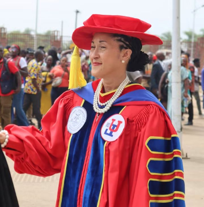
Speaking Thursday, August 20, at the Ministry of Information’s regular press briefing in Monrovia, UL President Dr. Layli Maparyan said the scholarships are part of efforts to increase the number of faculty members holding PhDs and other terminal degrees.
The announcement follows recent efforts by the university to send faculty members abroad for advanced studies.
On July 22, 2026, three instructors, Jankai Abdullah Sesay, Konah B. Ballah and Matthew Gonmah, from the Dr. Amos C. Sawyer College of Social Sciences and Humanities were sent to the University of Delhi on PhD scholarships funded by the Indian government.
Dr. Maparyan said three additional faculty members, all women, are expected to pursue studies at the University of Botswana, while another faculty member is pursuing a funded PhD at Duke University.
She disclosed that more than 15 faculty members are currently on study leave pursuing PhDs or are preparing to return to UL after completing their degrees.
Eight full-time employees of UL’s William Richard Tolbert College of Agriculture and Forestry have also received three-year scholarships from the Regional Universities Forum for Capacity Building in Agriculture (RUFORUM).
According to Dr. Maparyan, about 19 percent of UL faculty members currently hold PhDs, while the majority of the university’s approximately 800 full-time faculty members hold master’s degrees.
She said increasing the number of faculty with terminal degrees remains a major strategic priority of her administration.
Dr. Maparyan said UL’s study leave program, provided for under the university’s bylaws, has contributed significantly to rebuilding its professoriate over the past two decades.
She also emphasized increasing the number of women in the university’s faculty as part of efforts to promote gender equality.
“Taken together, these two sets of accomplishments, more PhDs and more women faculty,get us closer to top 300 in Africa status in fulfillment of the ARREST Agenda for Inclusive Development,” she said.
Dr. Maparyan also disclosed that UL recently added Cheikh Anta Diop University in Senegal to its network of partner universities through the facilitation of Liberia’s Ambassador to Senegal, Ali Silva.
She said UL intends to send faculty members to the Senegalese university as part of its continuing faculty development efforts.
However, Dr. Maparyan acknowledged that improving faculty qualifications alone would not be sufficient to achieve a top-300 ranking, saying the quality of UL’s infrastructure and facilities would also be critical to reaching that goal.
See more Liberia News Network stories in Google Search by adding LNN as one of your Preferred Sources.
★ Add LNN as a Preferred Source