
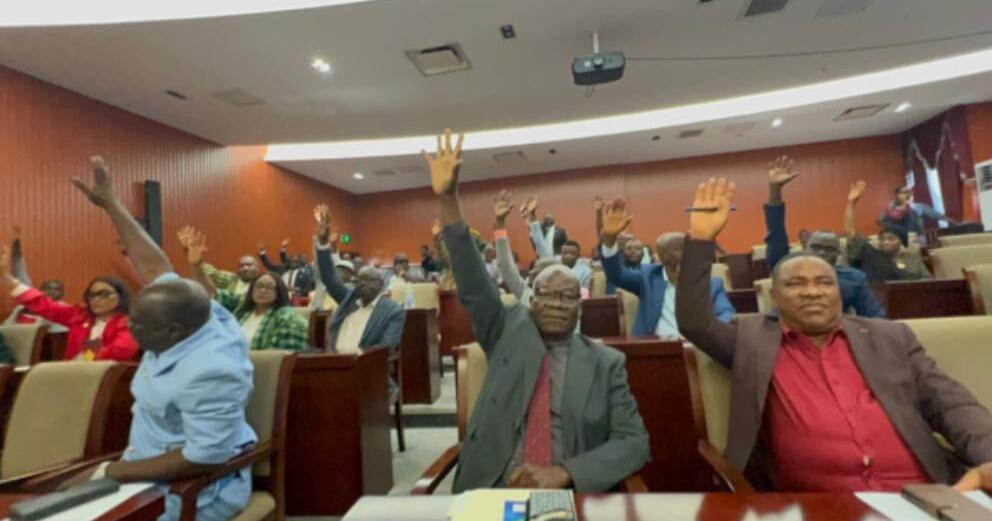
The Legislature has approved a US$53 million supplementary budget, concluding a fast-tracked special sitting marked by intense negotiations and shifting fiscal priorities. The measure, passed by both the House of Representatives and the Senate after extended deliberations late Thursday night, increases the national budget from approximately US$1.249 billion to US$1.302 billion—signaling the government’s attempt to respond to emerging funding gaps while sustaining key public services.
The passage reflects a balancing act between immediate national needs and broader fiscal discipline, as lawmakers seek to reinforce sectors such as health, education, security, and infrastructure in a challenging economic environment.
Originally proposed at US$45 million, the supplementary package was increased by US$8 million following additional revenue identification by the Legislature’s Joint Committee on Ways, Means, Finance and Development Planning, and Public Accounts.
Representative P. Mike Jury, who chairs the House committee, explained that the adjustment was driven by improved domestic revenue performance.
“We were able to source additional resources through enhanced revenue collection and administrative efficiency,” he noted, suggesting that gains in tax enforcement and compliance created room for expanded spending.
This expansion highlights a key fiscal trend: while Liberia continues to depend on external budget support, domestic revenue mobilization is increasingly becoming a critical buffer against financing shortfalls.
According to the Senate’s Ways, Means and Budget Committee, chaired by Prince Moye, the supplementary budget prioritizes both social services and state security.
Major allocations include the Security sector—Ministry of National Defense – US$3.5 million, and Liberia National Police – US$1 million. Education sector—volunteer teachers – US$1.5 million, University of Liberia buses – US$3 million, School feeding program – US$3.5 million and additional education support – US$1.7 million. Health sector—Volunteer health workers – US$1.2 million, and additional health funding – US$1.3 million. Local governance and infrastructure—local chiefs’ salaries – US$500,000, yellow machines for rural counties – US$5.9 million, Liberia Water and Sewer Corporation – US$500,000. Foreign obligations—Ministry of Foreign Affairs (UN obligations and embassy operations) – US$2 million
These allocations reflect a mix of immediate operational needs—such as paying frontline workers—and longer-term investments in infrastructure and governance systems.
Lawmakers say the supplementary budget is intended to address funding gaps caused partly by delayed external budget support. In response, the government leaned on stronger-than-expected domestic revenue performance to finance the package.
This approach underscores a structural challenge in Liberia’s fiscal framework—heavy reliance on donor funding. When external disbursements are delayed, government operations risk disruption, particularly in sectors like health and education.
By using domestic revenue gains to fill these gaps, the government is signaling a shift—albeit gradual—toward greater fiscal self-reliance.
However, economists caution that such gains must be sustainable. “Improved revenue collection is positive,” a lawmaker noted after the passage, “but the real question is whether this performance can be maintained without overburdening taxpayers or weakening economic activity.”
The significant allocation to the security sector—particularly the military and police—reflects growing concerns around national stability and law enforcement capacity.
At the same time, investments in school feeding, volunteer teachers, and health workers point to persistent social sector pressures.
This dual focus highlights a fundamental policy tension—governments must simultaneously ensure security and invest in human development.
In this case, the inclusion of volunteer workers in both health and education suggests a reliance on informal or semi-formal labor systems—raising questions about long-term sustainability and workforce stability.
The supplementary budget moved quickly through both chambers, with the Senate approving it after more than ten hours of closed-door deliberations.
Speaker Richard Nagbe Koon subsequently adjourned the House’s special sitting, noting that six pieces of legislation were passed during the 10-day session.
The speed of passage reflects both urgency and political consensus—but also raises concerns about transparency.
Rapid budget approvals can limit public scrutiny and reduce opportunities for detailed debate. While urgency may justify expedited action, governance experts argue that fiscal decisions of this scale require robust oversight to ensure accountability.
The passage of the supplementary budget comes amid broader institutional developments, including the Senate’s confirmation of Francis Sakila Nyumalin Sr. as the first Minister of the newly established Ministry of Local Government.
The ministry, rooted in the 2018 Local Government Act, is expected to advance decentralization—an agenda that could reshape how resources are allocated and managed at the local level.
The link between fiscal policy and decentralization is critical. If effectively implemented, decentralization could improve service delivery by bringing decision-making closer to communities. However, it also requires strong financial management systems to prevent inefficiencies and misuse of funds.
The US$53 million supplementary budget presents both opportunities and risks for Liberia’s economy.
Opportunities include strengthening critical sectors like health and education, supporting frontline workers and improving service delivery, and demonstrating improved domestic revenue capacity.
Risks include continued dependence on unpredictable external funding, potential fiscal pressure if revenue gains are not sustained and limited transparency due to expedited legislative processes.
The approval of the supplementary budget marks an important moment in Liberia’s fiscal year—one that reflects both the urgency of current needs and the structural challenges facing public finance.
While lawmakers have acted to stabilize key sectors, the real test lies ahead: whether the government can translate this spending into measurable improvements in service delivery, while maintaining fiscal discipline and transparency.
