
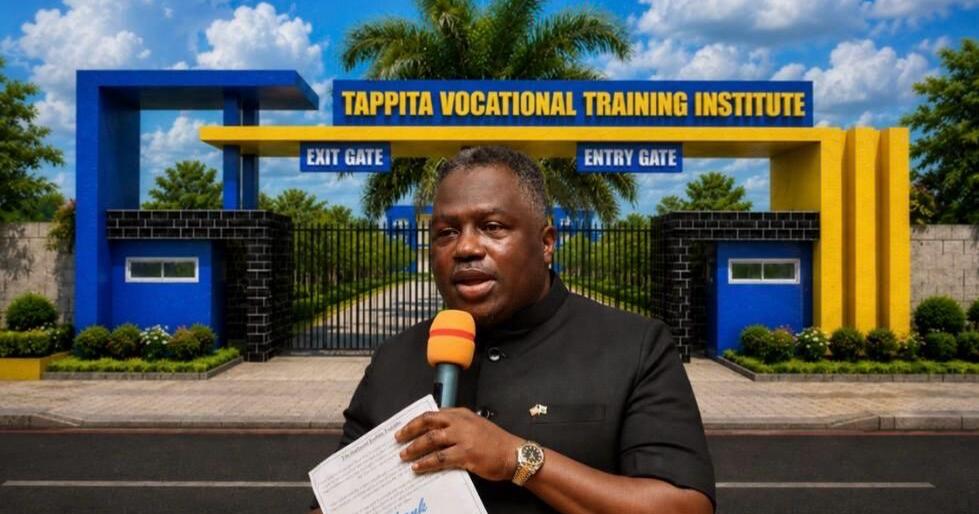
In the heart of rural Lower Nimba, anticipation is reaching a historic peak as residents prepare to welcome Vice President Jeremiah Kpan Koung for the groundbreaking of the Tappita Vocational Training Institute (TVTI)—a development many describe as a turning point in the region’s long struggle for access to technical and higher education.
The two-day ceremony, slated for June 5–6, is expected to draw a wide cross-section of national leadership, including cabinet officials, lawmakers, traditional authorities, development partners, and citizens from across Nimba County. For many in Tappita and surrounding towns, the moment represents more than a government event—it is the long-awaited arrival of opportunity.
For decades, communities in Lower Nimba have faced a persistent educational gap. While Liberia’s post-war recovery has seen gradual improvements in urban education infrastructure, rural districts like Tappita have continued to struggle with limited access to technical and vocational training.
Young people seeking skills in agriculture, construction, health sciences, and information technology have often been forced to migrate to Monrovia or cross borders into neighboring countries—an expensive and often unreachable path for many families.
The establishment of the Tappita Vocational Training Institute is therefore being widely interpreted as a corrective step toward decentralizing opportunity and rebuilding equity in Liberia’s education system.
“This is what development looks like when it reaches the grassroots,” one community leader said. “For years, our children had talent but no platform. Now that is changing.”
The TVTI project will be constructed on 50 acres of land in Tappita City, with an estimated investment of US$12.7 million. Its design reflects a modern approach to vocational and technical education, combining academic instruction with practical, industry-driven training.
Planned infrastructure includes academic lecture halls, technical and vocational workshops, student dormitories, agricultural demonstration farms, health sciences training facilities library and ICT center and administrative and multipurpose buildings.
What makes the project particularly significant is its strong foundation of local ownership. The land for the institute was donated by the Parent-Teacher Association of Tappeh Memorial High School—an act that underscores deep community commitment to education and development.
Vice President Koung, a native of Nimba County, is expected to serve as Chief Launcher of the project alongside Representative Dorwohn Twain Gleekia, who played a leading legislative role in establishing the institution.
Also expected at the ceremony are Chief Justice Yamie Quiqui Gbeisay, members of the Nimba Legislative Caucus, senior government officials, and local authorities.
For many residents, the presence of national leaders in Tappita symbolizes recognition that rural communities are central—not peripheral—to Liberia’s development agenda.
The groundbreaking activities will begin on June 5 with a community parade through Tappita City, followed by cultural performances and traditional ceremonies involving chiefs, elders, women’s groups, and youth organizations.
The official program will feature remarks from key stakeholders including TVTI Board Chairman Cyril Lurlay, Representative Gleekia, TVTI President and CEO Dr. Yar Donlah Gonway-Gono, and Chief Justice Gbeisay.
Government representatives are also expected to highlight how the institute aligns with President Joseph Nyuma Boakai’s broader human capital development agenda.
The highlight of the event will be the symbolic groundbreaking ceremony, where Vice President Koung and dignitaries will turn the first shovels of soil at the permanent campus site.
Day two will shift focus to a Partnership and Development Forum, designed to attract support from ministries, state-owned enterprises, and international partners for long-term sustainability.
The institute’s academic focus reflects Liberia’s growing demand for practical, employable skills. Initial programs will include agriculture and agribusiness, information and communication technology, construction and building technology, health sciences, entrepreneurship and business development and hospitality and tourism management.
Supporters believe that TVTI will play a strategic role in strengthening the Eastern Nimba economic corridor, a region with growing trade potential linking Liberia to Côte d’Ivoire.
By equipping young people with technical skills locally, the institute is expected to reduce rural-urban migration while strengthening local economies.
Beyond its physical structures, TVTI is being embraced as a symbol of restored hope for communities long left on the margins of development.
Nearly two decades after the end of Liberia’s civil conflict, the promise of peace has often been measured by the availability of opportunity. For many in Lower Nimba, that promise has remained incomplete—until now.
“This institution is not just concrete and classrooms,” one of the project organizers noted. “It is dignity. It is access. It is a future that young people can build without leaving home.”
As preparations intensify, Tappita is transforming into a focal point of national attention. The influx of government officials, educators, and development partners underscores the broader significance of the project beyond Nimba County.
Education experts view initiatives like TVTI as essential to addressing Liberia’s long-standing skills gap and building a workforce capable of supporting national development priorities.
If fully realized, the institute could become a model for rural vocational education across Liberia—demonstrating how decentralized investment can reshape opportunity structures outside the capital.
The people of Lower Nimba are focused on the moment at hand. After years of anticipation, what was once a distant aspiration is finally becoming reality.
A dream, as many residents now say, is no longer deferred.
