
MONROVIA – Liberia’s economy is growing, but more of its people are sinking into poverty. That is the World Bank’s uncomfortable verdict, delivered in Monrovia on Monday. Country Manager Georgia Wallen praised the Government’s macroeconomic discipline. Growth reached 5.1 percent, and the fiscal deficit narrowed. Yet extreme poverty climbed to 36.1 percent in two years. Her explanation strikes at the heart of Liberia’s growth model. Mining drives output but creates few jobs. Farmers, traders and small firms, where most Liberians work, are left behind. Wallen pointed to state-owned enterprises as a starting point. Policymakers, she noted, cannot see the full portfolio. The message is plain: statistics alone will not fill empty pots. THE ANALYST reports,
The World Bank Group Country Manager for Liberia, Georgia Wallen, has declared that Liberia’s economy is growing faster, but warned that the growth is not yet translating into better lives for most Liberians.
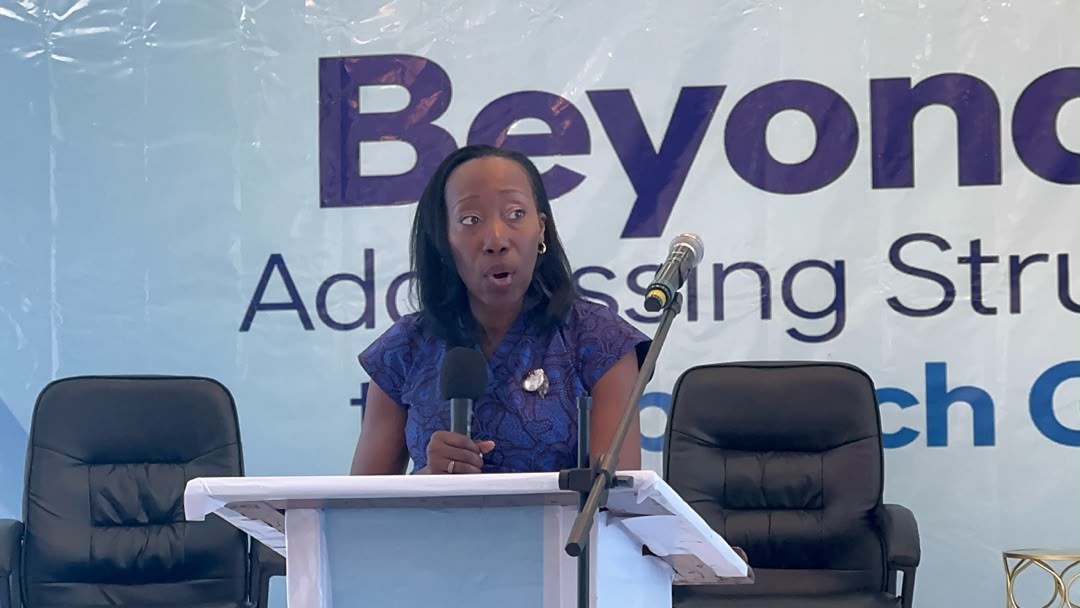
Wallen made the declaration in Monrovia on Monday, November 2, 2026, while delivering opening remarks at the launch of the seventh edition of the Liberia Economic Update (LEU), titled “Beyond Growth: Addressing Structural Constraints to Job-Rich Growth in Liberia.”
Addressing the Honorable Minister, excellencies, development partners, and representatives of the private sector, civil society and the media, Wallen thanked the audience for joining the launch. She stated that she wanted to start with “some very good news: Liberia’s economy is growing – faster.”
According to Wallen, real gross domestic product (GDP) growth rose to an estimated 5.1 percent in 2025, up from 4.0 percent the year before. She noted that inflation was contained in 2025 and that the fiscal deficit narrowed to 2.1 percent of GDP. “These results reflect disciplined macroeconomic management by the Government and the Central Bank of Liberia, and they deserve recognition,” Wallen stated.
Resilience Amid Global Fuel Shocks
Wallen observed that Liberia’s progress has also been tested and is showing resilience. She explained that maritime chokepoints and conflict have disrupted global energy markets and pushed up fuel prices, and that Liberia, like many import-dependent economies, felt those effects in early 2026. Yet, she noted, the country’s economy has remained resilient.
Policymakers, according to Wallen, have acted swiftly to address and contain key risks while keeping a prudent policy stance in place. “This discipline matters, because the global environment remains uncertain and there [is] no room for complacency,” she cautioned.
The Paradox of Rising Poverty
Wallen stated that the report probes hard questions about the extent to which economic growth is translating into development in Liberia. In other words, she asked, how are Liberians benefiting from growth, and what will it take for growth to deliver more and better jobs? She disclosed that despite strong recent growth, extreme poverty is estimated to have slightly risen in Liberia from 34.6 percent to 36.1 percent over the past two years.
“That is the paradox at the heart of this report. The economy is growing; yet more people are struggling to meet basic needs,” Wallen declared.
Explaining why this is the case, Wallen said it reflects the nature of Liberia’s recent growth, which has been largely driven by mining, a capital-intensive sector with limited spillovers in terms of jobs and local businesses.
Meanwhile, she noted, agriculture, manufacturing and small services, where most Liberians earn their living, have lagged. She disclosed that about 78 percent of Liberian workers are in vulnerable, informal employment, and nearly nine in 10 firms are single-person enterprises.
The findings, according to Wallen, suggest that more needs to be done to allow most Liberians to feel the benefits of the rising GDP. She cited the farmer facing high transport costs, the trader running a generator because the power is unreliable, and the entrepreneur struggling to make ends meet.
State Enterprises Under the Microscope
Wallen stated that the new edition looks at one important part of the answer, namely state-owned enterprises (SOEs). She explained that Liberia’s SOEs provide electricity, water, ports and fuel, services that determine what it costs to run a business and whether a household has light at night. They also carry fiscal risks for the budget, she added.
Yet the report finds that policymakers cannot fully see the SOE portfolio, Wallen revealed. Many entities do not submit financial reports, and where audits exist, most opinions are adverse. In this context, she described the recent establishment of the State-Owned Enterprises Authority of Liberia as “a significant and positive step – one that gives Liberia a real opportunity to strengthen oversight.”
Wallen clarified that the report does not claim that SOEs alone explain Liberia’s jobs challenge. However, she noted, it does propose that better information and accountability are a practical, achievable starting point to making SOEs work better for Liberians.
She outlined the report’s sequenced and realistic recommendations, which are to build a verified register of SOE entities, classify them by mandate, require minimum financial reporting, and focus audits where the risks are largest. The next steps, she stated, are to reconcile what the Government and the SOEs owe one another and to review entities that combine regulatory and commercial roles. “Most of these steps can be taken under existing law – they are doable,” Wallen asserted.
Two Trade-Offs, Three Thoughts
The World Bank official also reminded the audience of two trade-offs highlighted in the report. First, she noted, fiscal consolidation was achieved partly by cutting capital spending, from 8.5 to 5.7 percent of GDP. That has limits, she warned, because roads, power and other infrastructure are exactly what Liberian firms need to grow.
Second, Wallen stated, Liberia remains exposed. Gold, iron ore and rubber make up more than 90 percent of exports, so a fall in commodity prices would be felt quickly across the economy, she cautioned.
Closing with three thoughts, Wallen first stated that macroeconomic stability is an essential foundation. “Now is the time for takeoff: the goal is translating growth into development through jobs and rising incomes for all Liberians,” she declared.
Second, she said, the choices ahead are about quality as much as quantity, that is, the quality of public investment, the quality of services, and the quality of information for public decision-making. Third, Wallen stressed that none of this can be done by Government alone, noting that the private sector, civil society, and development partners all have a role. “The World Bank Group remains committed to supporting Liberia as a partner,” she affirmed.
Wallen thanked Government counterparts who engaged with the team, as well as Gweh, Waheed, Bonnie, and Parijat for producing what she described as excellent work, and all participants for attending. She expressed particular pleasure that Tracey Marie Lane, Practice Manager for the World Bank’s Governance team in West Africa, was present from Washington. “I hope this Update will be useful input to the national conversation on how to make growth work for every Liberian,” Wallen concluded.
See more Liberia News Network stories in Google Search by adding LNN as one of your Preferred Sources.
★ Add LNN as a Preferred Source