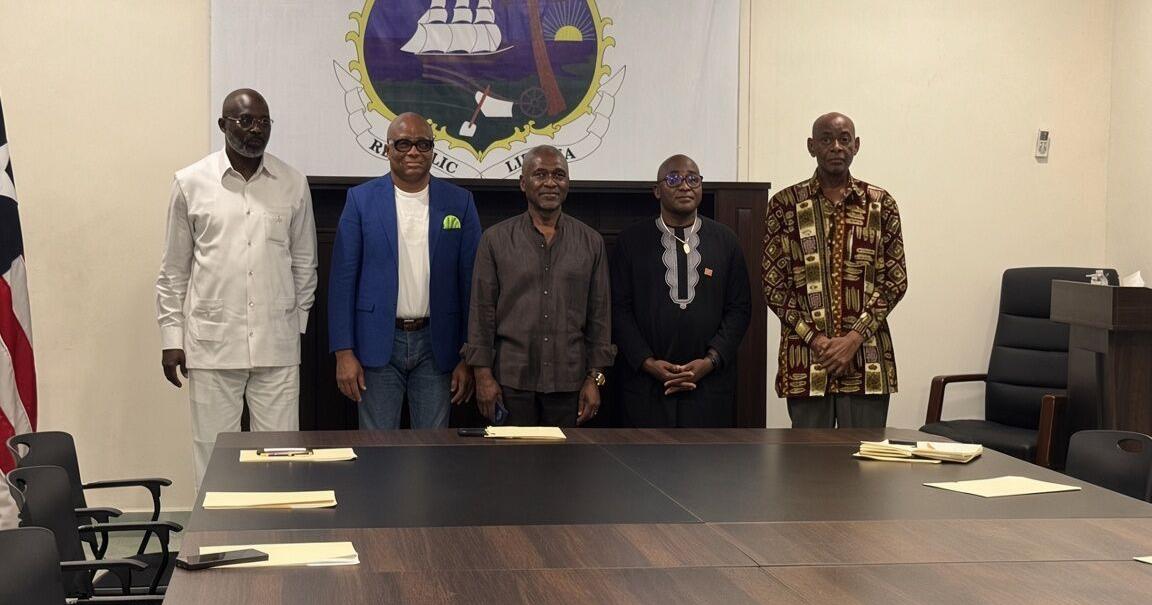
Former President George Manneh Weah, opposition leaders Alexander B. Cummings, Dee-Maxwell Saah Kemayah, Simeon C. M. Freeman and Jonathan A. Mason are set to meet Sunday in what could become a defining moment in the ongoing effort to forge greater cooperation among Liberia’s opposition political parties.
The high-level roundtable, scheduled for 3:00 p.m. at Sinkor Palace in Sinkor, will bring the opposition leaders together for further discussions on the structure, practical arrangements and mechanisms for sustaining their emerging cooperation.
The meeting is expected to culminate in the live signing of a Joint Communiqué, according to a statement issued Saturday by the Opposition Political Parties Joint Technical Committee.
The development comes less than three weeks after opposition political leaders met at a September 6 roundtable convened by former President Weah, where they agreed to establish a technical mechanism to develop a framework for sustained political cooperation.
Sunday’s gathering is therefore expected to move the process beyond broad political consultations and toward a more clearly defined structure.
Weah, Political Leader of the Coalition for Democratic Change (CDC) and former President of Liberia, will be joined by Cummings of the Alternative National Congress (ANC), Kemayah of the Movement for Economic Empowerment (MOVEE), Freeman of the Movement for Progressive Change (MPC), and Mason of the Union of Liberian Democrats Party (ULDP).
The organizers say the discussions are not being framed solely around an electoral alliance.
Instead, they say the opposition leaders intend to build a platform through which common national concerns can be examined and addressed collectively.
“The Opposition Political Leaders remain firmly committed to sustaining the foundation of opposition unity, not merely as a means towards an electoral alliance,” the Joint Technical Committee said.
The committee said the process is intended to create an opportunity to “rethink how Liberia’s national problems can be assessed and addressed through collective ideas, constructive engagement, and practical solutions in the interest of the Liberian people.”
The planned communiqué is expected to document the understandings reached by the participating leaders and establish a basis for continued consultation and cooperation.
But the Sunday meeting comes at a sensitive point in the opposition-unity process following the decision by the Citizens Movement for Change (CMC), led by Nimba County District #7 Representative Musa Hassan Bility, to withdraw from the emerging coalition process.
The CMC announced this week that it would not endorse the current draft communiqué or continue participating in the process in its present form.
The party said its leadership had reviewed the draft and concluded that the proposed arrangement did not sufficiently reflect the objectives for which the CMC was established.
CMC said it supports opposition cooperation but wants any such arrangement to be anchored in a clearly defined national reform program, including changes to the country’s system of government, institutions, laws and political culture.
Bility’s withdrawal introduces a significant issue for the opposition leaders as they attempt to establish a common framework while accommodating parties with different political identities and priorities.
The CMC has nevertheless said its decision does not completely close the door to cooperation with other opposition parties, maintaining that it remains willing to work with them on issues including electoral integrity, the rule of law and public accountability.
Sunday’s meeting will therefore take place against the backdrop of both renewed efforts at opposition coordination and disagreements over what that cooperation should ultimately represent.
The current process began with a broader opposition roundtable on September 5 involving individual stakeholders in the opposition community.
That was followed on September 6 by a gathering specifically involving political leaders of opposition parties.
At the September 6 meeting, participating parties agreed to establish a steering committee to develop a framework defining the principles, structure and mechanisms of their cooperation. At that stage, the leaders did not announce a presidential ticket or describe the arrangement as a finalized electoral coalition.
The decision to proceed with another roundtable suggests that the participating leaders are seeking to maintain momentum despite the differences that have emerged.
For Sunday’s participants, one of the immediate challenges will be determining how broad political commitments can be translated into an operational framework capable of sustaining cooperation beyond individual meetings.
The history of opposition alliances in Liberia provides a significant backdrop to the discussions.
The previous major opposition arrangement, the Collaborating Political Parties (CPP), brought together several major opposition parties ahead of the 2020 elections but eventually collapsed amid disputes over its structure and leadership.
The current participants are consequently facing the task of developing mechanisms that can accommodate differences while maintaining sufficient common ground for sustained cooperation.
Cummings, for his part, has indicated that the ANC remains open to opposition collaboration but has cautioned against repeating the problems that contributed to the collapse of the CPP.
The Sunday communiqué could therefore become an important test of whether the current opposition consultations can evolve into a more durable political framework.
The organizers insist, however, that the process should not be reduced to calculations surrounding the 2029 presidential election.
Instead, they say opposition unity should provide a platform for collective thinking on Liberia’s national challenges and encourage constructive engagement around practical solutions.
That distinction could prove important as the participating parties attempt to balance their individual political identities with the broader objective of cooperation.
The meeting is also likely to attract attention because of Weah’s central role in convening the opposition discussions and the participation of Cummings, Kemayah, Freeman and Mason, all of whom lead separate political organizations.
Their ability to agree on a common framework could shape the direction of opposition politics in the months ahead.
At the same time, the absence of the CMC from the Sunday process underscores that opposition unity remains a work in progress rather than a completed arrangement.
The Joint Technical Committee said the September 27 roundtable is intended specifically to strengthen the “technical foundation” of the emerging cooperation, including the practical arrangements, structures and mechanisms necessary to sustain it.
The live signing of the communiqué is expected to provide the clearest public indication yet of what the participating parties have been able to agree upon.
Whether the document will eventually develop into a broader electoral arrangement remains open, as the organizers have continued to emphasize that the present process is principally about cooperation and a common approach to national issues.
For now, the spotlight will be on Weah, Cummings, Kemayah, Freeman and Mason as they gather Sunday to determine the next step in an opposition-unity process that has generated both renewed political engagement and fresh disagreements.
The meeting begins at 3:00 p.m. at Sinkor Palace, with the Joint Technical Committee expected to facilitate the discussions and the signing of the communiqué.
See more Liberia News Network stories in Google Search by adding LNN as one of your Preferred Sources.
★ Add LNN as a Preferred Source