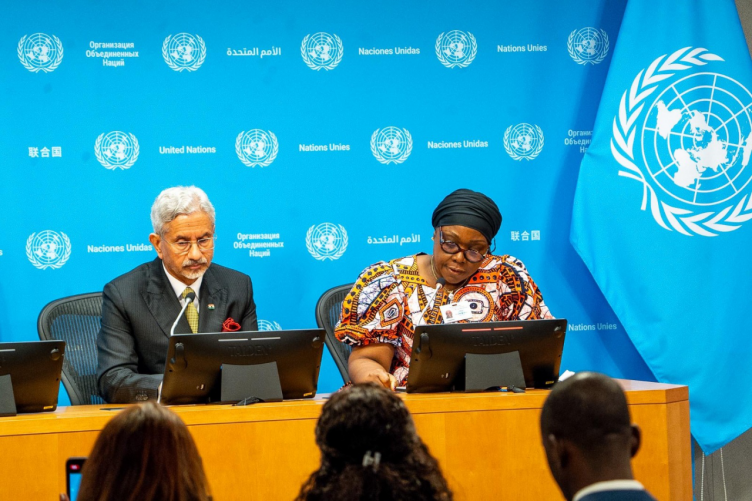
- Liberia and India launched the Group of Friends on Safety and Security of Shipping and Seafarers at the UN General Assembly in New York on Friday.
- The pairing unites the world’s largest ship registry by gross tonnage with one of its largest sources of seafarers.
- Foreign Minister Sara Beysolow Nyanti tied the initiative directly to Liberia’s revenue, coastal communities and economic interests.
- The group has no terms of reference yet, and whether it delivers practical protection for crews remains the key test.
New York – Somewhere tonight, on a tanker crossing the Red Sea or a bulk carrier waiting off a Gulf port, there is a sailor who has not seen his family in months. The ship he works on may be owned in Greece, managed in Singapore and crewed from Mumbai. But there is a good chance the flag flying from its stern is Liberia’s.
That quiet fact sits at the heart of a new diplomatic partnership launched Friday in New York. On the sidelines of the 81st session of the United Nations General Assembly, Liberia’s Foreign Minister Sara Beysolow Nyanti and India’s External Affairs Minister Dr. S. Jaishankar unveiled the Group of Friends on Safety and Security of Shipping and Seafarers, known by the shorthand GoF on S4.
On paper it is another UN coalition. In practice, it is a meeting of two countries whose stakes in global shipping are enormous but very different: one owns the flag, the other supplies the hands.
A Natural, If Unusual, Partnership
Liberia has for years run the world’s largest shipping registry by gross tonnage, a remarkable standing for a small West African nation still rebuilding after war. India, for its part, is one of the biggest sources of the people who actually sail those ships.
That makes the two countries natural allies at a time when the sea has become more dangerous. When a Liberian-flagged vessel is attacked, the crew on board is very often from South Asia. When Indian seafarers are stranded or harmed, the flag state is frequently Liberia. The new group formalizes a relationship that already existed on thousands of decks.
Nyanti called the launch a landmark diplomatic and maritime achievement. She reminded delegates that the global economy moves on the oceans, with more than 80 percent of the goods that sustain economies worldwide carried by sea.
The Danger on the Water
Jaishankar was blunt about why the group is needed now. He pointed to recent attacks on commercial ships in the Gulf, the Red Sea and the Black Sea, noting that such incidents have cost innocent lives, including those of Indian seafarers. Attacks on civilian shipping that disrupt trade and endanger lives, he said, are unacceptable.
For Liberia, those headlines are not abstract. Several Liberian-flagged vessels have been among the ships struck in Red Sea attacks in recent years, putting the country’s flag in the middle of conflicts it has no part in.
Beyond the missiles and pirates, Jaishankar described a quieter set of hardships: sailors confined aboard ships for months, crew changes and repatriation delayed, long separation from families and the psychological strain that follows. Nearly two million seafarers keep the world’s merchant fleets moving, he said, and they deserve stronger international protection.
Three Pillars, and a Promise Not to Duplicate
Nyanti laid out what the group is meant to stand on: safety of shipping, security of maritime transport and protection of seafarers.
On safety, she stressed strict technical standards, vessel compliance and environmental stewardship. On security, she spoke of protecting commercial sea lanes from piracy, armed attacks, regional instability and emerging asymmetric threats. On seafarers, she named crew abandonment, fair labor standards, rapid medical help and protection for crews passing through conflict zones.
She was also careful to say what the group is not. It is meant to be action-oriented and to complement, not duplicate, the work of the International Maritime Organization and the International Labour Organization. That is an important signal in a UN system already crowded with overlapping bodies.
India has brought ideas of its own. Jaishankar recalled New Delhi’s proposal at the recent BRICS Summit for a Seafarers Emergency Support Network that would link maritime authorities and embassies to handle distress alerts, medical help, family communication and evacuations. India also co-hosted, with Greece and the Philippines, a UN Arria Formula meeting on the protection of seafarers in November 2025.
What Is in It for Liberia
The most telling part of Nyanti’s remarks may have been the least nautical. She said Liberia will work with the Liberia Maritime Authority and international partners to secure safe corridors for goods, while safeguarding Liberia’s economic interests, domestic revenue generation, coastal communities and people.
That line speaks to an old tension at home. The maritime registry is one of Liberia’s most important sources of foreign revenue, yet many Liberians have long questioned how much of that global prestige reaches ordinary citizens. By placing revenue and coastal communities alongside sailors’ safety, the government is signaling that it wants maritime diplomacy to deliver at home, too.
There is also a reputational calculation. A flag that is seen as unsafe, or indifferent to the crews who serve under it, risks losing business to competitors. Being seen to lead on seafarer welfare strengthens the Liberian brand on the high seas.
The Hard Part Comes Next
For now, the group is a promise. India and Liberia say they will work with members to draft its modalities and terms of reference through a consultative process. There is no secretariat, no budget and no timetable yet.
The real test will be whether the coalition can do anything a stranded or endangered sailor would notice: speed up an evacuation, force action on an abandoned crew, or make a dangerous shipping lane even slightly safer. Diplomatic groups of friends often begin with strong speeches and fade into quiet annual meetings.
What makes this one worth watching is the combination at its core. A flag without crews has little moral weight; crews without a flag have little legal standing. Together, Liberia and India can speak for both the ship and the people on it.
For the sailor on the Red Sea tonight, that is still only words. Whether it becomes more will depend on what Monrovia and New Delhi do after the cameras leave New York.
See more Liberia News Network stories in Google Search by adding LNN as one of your Preferred Sources.
★ Add LNN as a Preferred Source