
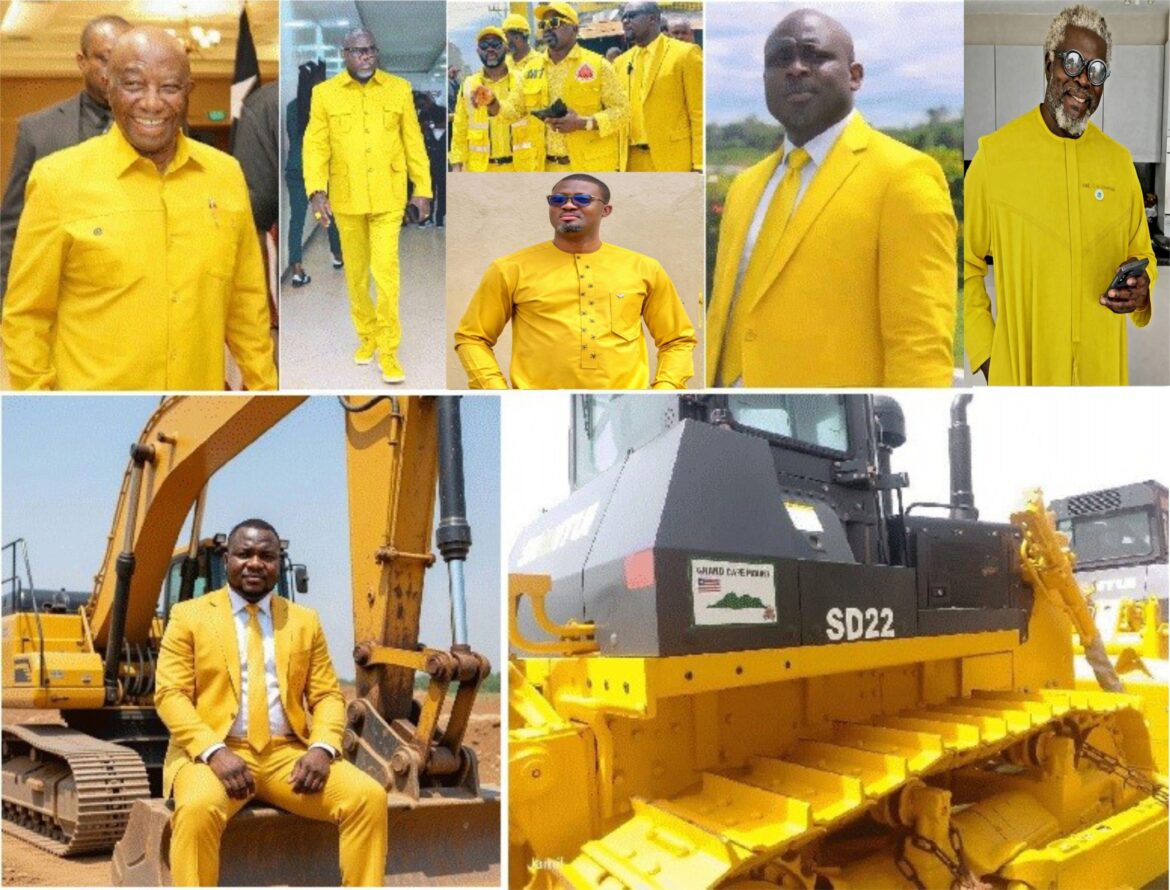
MONROVIA – The first 137 batch of the long awaited 285 heavy construction equipment popularly known in Liberia as yellow machines hit the Freeport of Monrovia yesterday Sunday amidst widespread public jubilation. This shipment includes excavators, bulldozers, graders, dump trucks, and auxiliary vehicles intended for use across the country’s road network and public works projects. The arrival marks a major milestone in the government’s promise to bolster Liberia’s infrastructure capacity after decades of limited progress. The Analyst reports.

Euphoria and Yellow Suits: Symbolism and Celebration
To underscore the perceived importance of this moment, government officials, supporters, and some renowned opposition members donned yellow outfits and suits during events surrounding the arrival — a visual and symbolic show of commitment and celebration. The color mirrors the signature hue of the machines themselves, typically associated with earth-moving and construction equipment worldwide, and was used intentionally to convey unity around the infrastructure initiative.
In many photos and clips shared on social media, officials were seen in bright yellow attire — from shirts to suits — alongside banners and signage that echoed the color and theme of the machines. To supporters, this was not just aesthetic but a public affirmation that the government is delivering on a long-promised development agenda.
The Roots of the “Yellow Machines” Initiative
The idea of a fleet of 285 yellow machines goes back to 2024, when the government publicly committed to acquiring these units to improve road construction and maintenance capacity nationwide. Liberia’s road network has long suffered from poor maintenance, deterioration during rainy seasons, and inadequate connectivity between rural and urban centers — challenges that significantly limit economic activity, trade, agriculture, and access to services.
The yellow machines are intended to give the Ministry of Public Works and county governments direct equipment to tackle maintenance and rehabilitation without having to rely solely on private contractors
Controversy and Public Debate
Despite the celebratory tone around the machines’ arrival, the journey has not been smooth.
The acquisition process became a major public debate in Liberia. Lawmakers, civil society groups, and transparency advocates raised questions about the transparency, compliance with procurement laws, and legislative oversight of contracts connected to the purchase of the machines. Some critics have described aspects of the transaction as irregular, warning that without full transparency, these machines could symbolize governance flaws rather than development.
Political Debate
Opposition voices and some civil society figures have challenged how the procurement was negotiated and whether the government followed legal and constitutional procedures, especially regarding financial commitments and legislative approval.
This friction hasn’t dampened local optimism entirely, but it has underscored why Liberia’s development story is not just about delivering machines — but also about ensuring that public trust and governance systems are strengthened alongside physical infrastructure.
What This Means for Liberia’s Development
Here’s why the yellow machines are widely seen as potentially transformative — and what they mean beyond the headlines.
Enhanced Road Connectivity
Liberia’s internal road network has historically ranked among the weakest in the region, with many rural roads deteriorating quickly during rainy seasons. Reliable, locally accessible equipment means counties could repair and maintain roads year-round, reducing travel times and boosting economic linkages.
Reduced Dependence on Contractors
Previously, Liberia had to rely mostly on external contractors for major earthworks and maintenance. Owning and operating this fleet directly could cut long-term costs, enable quicker responses to road damage, and give government institutions sustained operational capacity
Job Creation and Technical Training
Government officials have talked about plans to recruit and train operators, technicians, and support staff — potentially generating over a thousand jobs and building local technical capacity in heavy equipment management.
Boost to Agriculture and Trade
Improved transport routes reduce the cost of moving agricultural produce to markets, help farmers increase incomes, and make Liberia more attractive for business and investment — particularly in areas outside Monrovia.
Institutional Strengthening
If the machines are deployed transparently and managed responsibly, they could help build stronger county institutions and improve how public assets are tracked, maintained, and utilized.
A Turning Point — With Work Ahead
The arrival of the first batch of yellow machines is more than a ceremonial event — it’s a visible step toward tackling Liberia’s persistent infrastructure challenges.
However, the long-term impact — on jobs, economic activity, public trust, and institutional capacity — will depend on transparent governance, efficient deployment, and sustained upkeep of the equipment. As Liberians celebrate the machines’ arrival and wear the yellow of optimism, the real work ahead lies in turning these heavy machines into durable development gains.
Planned Deployment of Yellow Machines by County
According to government officials, the 285 pieces of heavy-duty equipment — excavators, bulldozers, graders, dump trucks, loaders and support vehicles — will be distributed nationwide to strengthen Liberia’s infrastructure capacity after the first 137 yellow machines arrived at the Freeport of Monrovia in February 2026.
Each of Liberia’s 15 counties is expected to receive a package of machines tailored to needs. The largest and most populous counties — such as Nimba, Bong, Grand Bassa and Lofa — will receive multiple operational sets (two or more full sets of machines).
Smaller counties will receive at least one full set of equipment.
A network of nineteen operational hubs is planned across the country. These hubs will host fuel depots, workshops, trained technicians and support staff to ensure machines remain functional year-round.
Before permanent deployment in counties, the machines will be assembled and tested at a central facility in Careysburg and operators, mechanics, and support staff will be recruited and trained.
As Liberia’s most populous county and a major agricultural and commercial hub, Nimba is slated to receive two full operational sets of machines. This will help rehabilitate major trunk roads linking Ganta, Sanniquellie, and other key towns — improving market access for agricultural produce.
Also scheduled for two full sets, machines in Bong will support rehabilitation of feeder and rural roads that connect farming areas to urban centers like Gbarnga. Better connectivity could lower transportation costs and enhance commodity flows.
Receiving two operational sets, Grand Bassa’s machines are expected to tackle coastal access roads and trunk links to central Liberia’s interior, supporting economic movement around Buchanan and neighboring towns.
With two sets due, machines here will be critical in maintaining rugged feeder routes and market access corridors — particularly connecting districts in the north to major commercial centers and border posts.
Each of these will receive at least one set, targeted to local maintenance needs such as rural road grading, culvert installation, drainage clearing, and route rehabilitation that has historically been inaccessible during rainy seasons.
