
By Socrates Smythe Saywon | Smart News Liberia
MONROVIA – Executive Director of the Witness Protection Agency (WPA), Atty. Teklo Maxwell Grigsby, has warned that Liberia’s fight against corruption cannot succeed unless witnesses and whistleblowers are adequately protected, arguing that fear of retaliation and weak implementation of existing laws continue to undermine successful prosecutions.
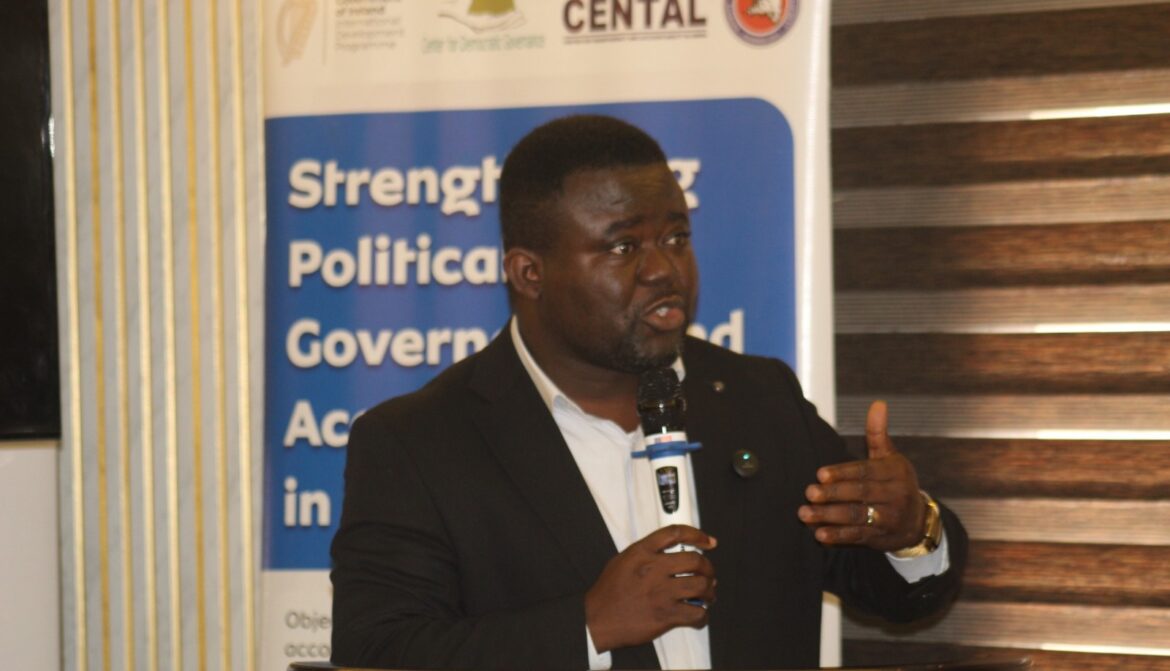
Speaking on behalf of Justice Minister and Attorney General Cllr. N. Oswald Tweh during the Center for Transparency and Accountability in Liberia (CENTAL) National Anti-Corruption Policy Dialogue held in Sinkor on Tuesday, June 30, 2026, Grigsby said strengthening witness protection must become a national priority if Liberia is serious about holding corrupt officials accountable.
The dialogue, organized by CENTAL in collaboration with its governance partners and integrity institutions, brought together government officials, development partners, civil society organizations, lawyers, students, youth representatives, and members of the media to build national consensus around the establishment of a Specialized National Anti-Corruption Court and broader governance reforms.
Addressing participants, Grigsby acknowledged that Liberia has made significant legislative progress in combating corruption but stressed that laws alone cannot produce convictions if citizens remain afraid to testify.
“We’ve made immense progress as a country from a prosecution standpoint,” Grigsby said. “But we must continue asking ourselves what we are doing differently to ensure that those who assist the justice system are fully protected.”
He described the enactment of Liberia’s Witness Protection Law as an important milestone, noting that the legislation now provides a legal framework for safeguarding witnesses whose testimony is essential to criminal prosecutions.
Despite that progress, Grigsby said fear continues to discourage many Liberians from cooperating with investigators.
“People often tell witnesses that Liberia is a small country and that once the case is over, they will be left on their own,” he said. “If people refuse to testify because they fear retaliation, there can be no justice.”
According to him, prosecutors bear the constitutional burden of proving criminal allegations beyond a reasonable doubt, making witness testimony one of the most critical elements in corruption cases.
“If the victim or the key witness cannot be located or is too afraid to testify, how can the government prove its case?” Grigsby asked. “Every reasonable doubt ultimately benefits the defendant.”
He stressed that defeating corruption requires a partnership between law enforcement institutions and ordinary citizens.
“It has to be a collaboration between prosecutors and citizens,” he said. “Without citizens willing to testify, justice cannot prevail.”
Grigsby also highlighted the direct connection between witness protection and anti-corruption enforcement, explaining that corruption schemes frequently involve multiple actors, some of whom are prepared to expose wrongdoing if adequate protections exist.
“Sometimes these individuals want to testify,” he noted. “But if government cannot guarantee their safety, they remain silent, and successful prosecution becomes extremely difficult.”
Turning to the Whistleblower Act of 2022, Grigsby criticized shortcomings in its implementation, arguing that several important provisions have yet to be effectively enforced.
He pointed to Section 16 of the law, which requires every employer in Liberia to publicly display the Whistleblower Law so employees understand their legal rights and protections. However, he observed that the legislation failed to impose penalties on employers who ignore the requirement.
“For many employers, publishing the law has become optional because there are no legal consequences for refusing to do so,” he said.
Grigsby further questioned government’s failure to implement provisions requiring financial rewards for whistleblowers whose information leads to successful corruption prosecutions.
According to him, the Liberia Anti-Corruption Commission has indicated that approximately 35 percent of the corruption cases it has prosecuted originated from whistleblower information. Nevertheless, many individuals who helped expose those cases have not received the five percent reward guaranteed under the law.
“If we fail to honor the law by rewarding those who expose corruption, how can we expect more people to come forward?” he asked.
He disclosed that the Witness Protection Agency intends to work closely with the Ministry of Justice, the Liberia Anti-Corruption Commission, and the Legislature to ensure adequate funding for whistleblower rewards is included in the 2027 National Budget.
“This is how we change our country,” Grigsby declared. “It is not enough to pass laws. We must implement them.”
Meanwhile, speaking during the Ministry of Information’s regular press briefing on Thursday, July 2, Grigsby announced that the government is preparing amendments to strengthen the Whistleblower Act by introducing tougher sanctions against employers who retaliate against workers for exposing corruption or misconduct.
The proposed reforms would establish criminal penalties for employers who fail to publicize the Whistleblower Law and create a blacklist mechanism that could permanently bar abusive public officials from future government service.
Grigsby said the amendments were informed by cases in which employees suffered reprisals after cooperating with corruption investigations.
He cited a case in Margibi County involving a government employee who served as a key witness in a major corruption investigation but was indefinitely suspended shortly after returning to work.
According to Grigsby, such retaliation sends a dangerous message to other potential witnesses and undermines national efforts to strengthen accountability.
He maintained that protecting witnesses and whistleblowers is not simply a legal obligation but a fundamental requirement for restoring public confidence in Liberia’s justice system and ensuring that corruption cases are successfully prosecuted.
The proposed legislative reforms are expected to be discussed with civil society organizations, media representatives, and other stakeholders during consultations in Monrovia as the government moves to strengthen Liberia’s anti-corruption framework and reinforce legal protections for those who expose wrongdoing.
