By Socrates Smythe Saywon | Smart News Liberia
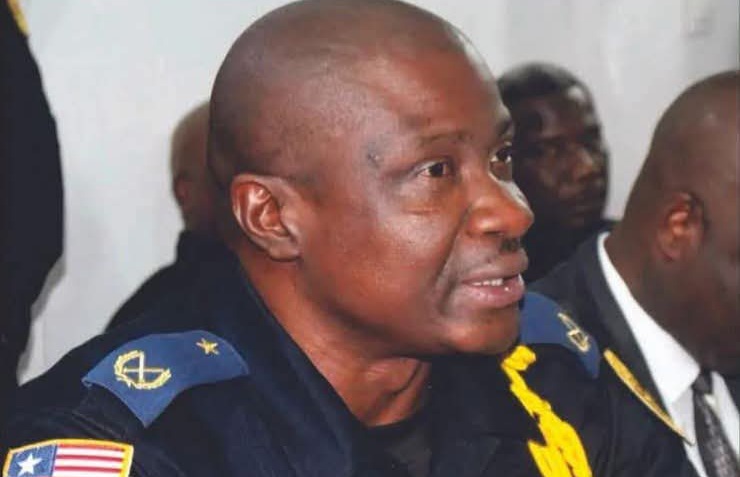
MONROVIA, LIBERIA — The intensifying fight against drug trafficking has taken a contentious turn after activist Martin K. N. Kollie challenged a denial by the Liberia Drug Enforcement Agency (LDEA) over allegations that its Officer-in-Charge, Deputy Commissioner of Police Fitzgerald T. M. Biago, received or used a Toyota pickup allegedly linked to a suspected drug trafficker.
The confrontation erupted Friday, August 7, 2026, after the LDEA issued a statement rejecting allegations circulating on social media and other platforms that Biago received a Toyota pickup from an individual alleged to be associated with drug trafficking.
The agency described the allegation as false and said it had not been supported by any verifiable evidence.
But Kollie has rejected the LDEA’s position, arguing that the agency’s response fails to address what he says is photographic and vehicle-registration evidence showing Biago in connection with the disputed pickup.
The controversy comes at a particularly sensitive moment for Liberia’s anti-narcotics campaign, following the seizure of approximately 237.6 kilograms of cocaine at Roberts International Airport in June and the subsequent seizure of approximately 3,971 kilograms in Duazon in July.
With the LDEA at the forefront of the country’s response to the cocaine trade, allegations involving its top operational leadership have immediately raised questions about institutional integrity, accountability and the agency’s ability to remain insulated from criminal influence.
In its Friday statement, the LDEA unequivocally rejected the allegation that Biago received a Toyota pickup from an individual allegedly connected to drug trafficking.
“The claim is false and has not been supported by any verifiable evidence,” the agency said.
According to the LDEA, Biago stated that he neither received nor accepted the vehicle described in the allegation and did not authorize anyone to receive it on his behalf.
The agency said it was aware of no credible record, documentation or evidence substantiating the claim.
At the same time, the LDEA acknowledged that public officials must remain open to legitimate scrutiny and encouraged anyone possessing credible evidence of misconduct to submit it to the appropriate investigative authority for independent and lawful review.
The agency warned that serious allegations should be tested through evidence and due process rather than repeated as fact without verification.
It also reaffirmed its zero-tolerance policy toward corruption, misconduct and collusion with criminal networks, stressing that the standard applies to every officer regardless of rank.
“Any substantiated violation will be addressed in accordance with law and established disciplinary procedures,” the LDEA said.
But Kollie’s response was uncompromising.
He accused the LDEA of attempting to narrowly frame the controversy around whether Biago personally received the vehicle instead of addressing what he claims is evidence that the LDEA chief used or rode in the pickup.
Kollie identified the disputed vehicle as a grey Toyota pickup bearing license plate A532084 and alleged that it is registered in the name of George Harris, also known as Leroy Harris, who has separately been charged by the government in connection with an alleged international cocaine trafficking operation.
Kollie’s claim about the vehicle’s registration and alleged use has not been independently established in the information available for this report, and the allegations against Harris remain subject to judicial proceedings.
But Kollie says photographs provide a basis for his challenge to the LDEA’s denial.
He alleges that photographs show Biago in front of the same grey pickup and that the vehicle has appeared in photographs connected to LDEA personnel and activities.
Kollie further alleged that images of the pickup appeared on the Facebook pages of individuals he identified as Biago’s Administrative Assistant Henry Seh, Personal Assistant Joletha Joe and Special Assistant Emmanuel Biago, claiming that some of the photographs were later removed.
He also pointed to what he described as photographs appearing on the official LDEA Facebook page.
Kollie went further, alleging that Biago used the same grey pickup approximately six weeks ago at a tournament held ahead of World Drug Day.
He maintains that the vehicle in those photographs bears the same license plate, A532084.
Those claims require independent verification, including authentication of the photographs, confirmation of their dates and locations, and official verification of the vehicle’s ownership and registration history.
The dispute has therefore shifted from a simple denial about whether Biago received a vehicle to a broader question about whether the pickup was ever used by Biago or the LDEA, under what circumstances and whether its ownership has any relevance to the agency’s ongoing drug investigations.
That distinction is central to the confrontation.
The LDEA says there is no verifiable evidence that Biago received or accepted the vehicle.
Kollie argues that the issue is not simply who formally received the pickup but whether the LDEA leadership used a vehicle allegedly connected to a person facing drug-related charges.
The competing claims cannot ultimately be settled through press statements or social-media exchanges. They require documentary verification, including vehicle-registration records, ownership information, photographs, official logs and any available evidence concerning the vehicle’s use.
The controversy could hardly have emerged at a more critical time for Liberia.
In June, approximately 237.6 kilograms of cocaine, valued at about US$19.2 million, was seized at Roberts International Airport. The seizure triggered a major national security investigation involving multiple Liberian security and law enforcement institutions.
The RIA case was followed by the seizure of approximately 3,971 kilograms of suspected cocaine in Duazon, Margibi County, with an estimated value of about US$317.68 million.
The two seizures have not been publicly established as part of the same trafficking operation, but together they have placed Liberia’s anti-drug institutions under unprecedented public scrutiny.
On July 30, approximately 4,208.6 kilograms of cocaine seized in the two operations were destroyed, with the combined estimated value placed at roughly US$336 million.
The destruction represented a major development in Liberia’s campaign against narcotics trafficking, but the more difficult task remains identifying and prosecuting the people and networks allegedly responsible for moving the drugs.
That is why the controversy surrounding Biago carries unusual weight.
The LDEA is one of Liberia’s principal institutions responsible for disrupting drug-trafficking networks. Its credibility depends not only on the quantity of narcotics seized but also on the integrity of its officers, investigations and evidence-handling procedures.
The agency has itself acknowledged the importance of internal accountability.
In previous cases, the LDEA has taken disciplinary and criminal action against officers accused of misconduct connected to drug investigations, demonstrating that allegations involving its personnel can have serious institutional consequences when supported by evidence.
The present dispute therefore presents the agency with an opportunity to apply the same standard it demands from others.
If the allegation is false, the documentary record should establish that clearly.
If the vehicle is unrelated to Biago or the LDEA, the circumstances should be explained.
If photographs being cited by Kollie are authentic, their context should be established.
And if credible evidence ultimately points to misconduct, the matter should be independently investigated regardless of the official’s rank.
Kollie has gone beyond challenging the LDEA’s denial. He has alleged that drug-trafficking networks have infiltrated portions of Liberia’s national security sector, particularly the LDEA and Liberia National Police.
He has called for Biago to resign or be dismissed and turned over for investigation and possible prosecution.
Those allegations remain unproven.
Kollie has also indicated that he intends to release additional information concerning what he describes as the cartel and its alleged accomplices.
The LDEA, meanwhile, has warned that unsupported allegations will not divert it from its operational mandate of disrupting drug-trafficking networks, protecting communities, preserving the integrity of investigations and enforcing the law without fear, favor or political influence.
That declaration now faces a test of public confidence.
Liberia’s recent cocaine seizures have already demonstrated the scale of the threat facing the country. The RIA and Duazon cases involved enormous quantities of cocaine and have raised questions about the logistical networks capable of moving such shipments through Liberia.
The country therefore cannot afford an anti-drug institution whose credibility is weakened by unresolved allegations involving its leadership.
At the same time, public accountability cannot mean treating accusations as convictions.
Kollie’s claims must be subjected to the same evidentiary standard that the LDEA says should govern every serious allegation.
The vehicle should be traced. Its ownership should be independently verified. Its registration history should be established. The photographs should be authenticated. Their dates and locations should be determined. The circumstances surrounding any alleged use should be explained.
If the evidence clears Biago, that finding should be made public.
If the evidence establishes misconduct, the consequences should follow.
Anything less risks leaving Liberia trapped in another cycle of accusation, denial and counter-accusation at a time when the country can least afford uncertainty in its fight against organized drug trafficking.
The confrontation between Kollie and the LDEA is therefore bigger than a disputed Toyota pickup.
It goes directly to the credibility of Liberia’s anti-drug campaign and the public’s confidence in the institution leading that fight.
The LDEA says the allegation is false and unsupported by verifiable evidence.
Kollie says the evidence is already visible and promises more.
See more Liberia News Network stories in Google Search by adding LNN as one of your Preferred Sources.
★ Add LNN as a Preferred Source