
MONROVIA – The Government of Liberia has entered a one-year arrangement to receive up to 1,200 people removed from the United States. The framework rests on an exchange of notes signed in September 2025, and carries clear operational and security stakes. A first group of 20 individuals is expected at Roberts International Airport on Thursday, August 20, 2026. Three ministers outlined the terms of the arrangement, dividing responsibility across reception, screening and asylum processing. Officials stressed that Liberia retains authority to reject individuals it deems undesirable. The transferees are described as nationals of African and Western Hemisphere countries, not Liberian citizens. The 1,200 figure is a ceiling rather than a guaranteed total, as THE ANALYST reports.
The Government announced the arrangement on Tuesday at the regular press briefing of the Ministry of Information (MOI). Three senior officials attended to present the terms and to answer questions on screening, security and Liberia’s migration structures.
Information Minister Jerolinmek Matthew Piah delivered the official statement. Justice Minister and Attorney General Cllr. N. Oswald Tweh addressed security screening and the Government’s ability to reject individuals, while Foreign Affairs Minister Sara Beysolow Nyanti explained the migration and asylum institutions involved.
According to Minister Piah, the arrangement rests on an exchange of notes between Liberia and the United States dated September 4 and September 10, 2025. Under the understanding, Liberia agreed to accept up to 1,200 persons within one year.
First twenty arrive Thursday

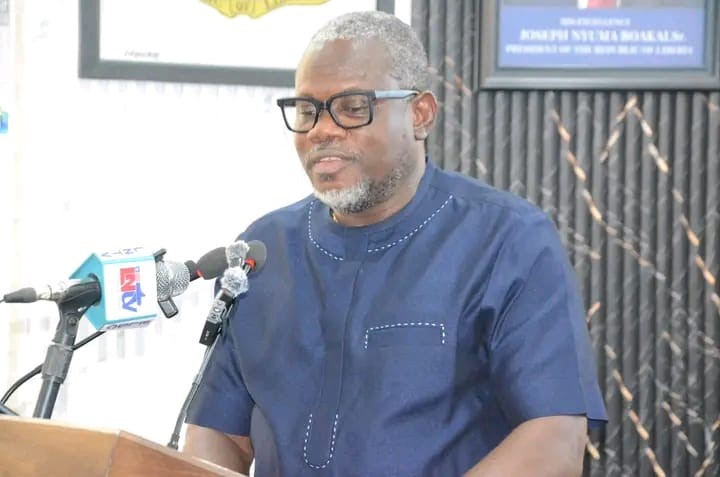
Justice Minister, Cllr N Oswald Tweh
The first 20 individuals are expected at Roberts International Airport on Thursday, August 20, 2026. Minister Piah said the Government has completed preparations for their reception and subsequent stay in the country.
He said those to be transferred are not necessarily Liberian citizens. They include nationals of African and Western Hemisphere countries who are medically cleared to travel and who are being removed from the United States.
A ceiling, not a total
Piah clarified that the figure of 1,200 is a maximum rather than a guaranteed number. He said the circumstances of individual cases would determine how many people ultimately arrive during the one-year period.
He gave the example of a year in which only 300 individuals are processed, noting that the framework does not oblige Liberia to receive the full 1,200. The nature of individual cases, he added, could also affect the totals.
Screening and rejection
Justice Minister Tweh said the United States will provide Liberia with information on each group before arrival. He said American authorities will supply a manifest, after which Liberian officials will conduct their own screening.
According to the minister, many of those expected to be transferred may have immigration violations rather than serious criminal records. He said Liberia retains the authority to reject any individual it considers undesirable or a concern to the country.
Asylum system to expand
Foreign Affairs Minister Sara Beysolow Nyanti said the arrangement will not require Liberia to build an entirely new system. She pointed to existing institutions, including the Liberia Refugee Repatriation and Resettlement Commission (LRRRC) that already handle migration matters.
She said Liberia already operates an asylum system for people seeking international protection. The existing framework, she added, will be expanded to accommodate the new category of arrivals.
Departure and asylum terms
Foreign Affairs Minister, Madam Sara Beysolow Nyanti
Piah said those transferred to Liberia will be free to leave when they wish, subject to applicable laws. Individuals who cannot safely return to their countries of origin may apply for asylum under Liberian law.
He said the Government intends to provide support to those seeking protection and to keep them safe during their stay. The arrangement, he added, will come with assistance to strengthen Liberia’s broader migration system.
No compensation, government says
Piah said the transfer is not a transaction and that Liberia has neither demanded nor received compensation for its participation. He said Liberia will instead receive support to manage the program and improve its migration system.
History invoked briefly
Piah linked Liberia’s participation to the country’s founding as a settlement for freed and formerly enslaved people and to its later role hosting African liberation figures. He named former South African President Nelson Mandela as among those he said resided in Liberia.
He called on Liberians and residents to receive the arrivals with courtesy. The Government, he said, will treat the process as a controlled one, with United States information reviewed by Liberian authorities.
First test in days
The first group’s arrival on August 20 will provide the initial test of the Government’s preparedness, including airport reception, screening, accommodation and access to asylum procedures. Officials have not indicated whether all 1,200 places will be used.
For now, the Government maintains that every person transferred will remain subject to Liberia’s immigration and security procedures. With the first group due within days, attention turns from the announcement to implementation.
