By Socrates Smythe Saywon | Smart News Liberia
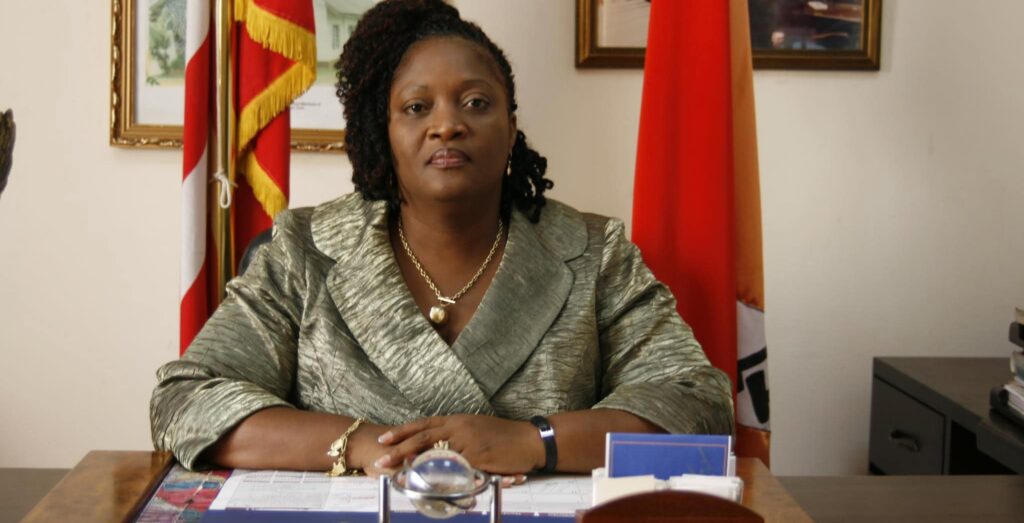
MONROVIA — Former Vice President Jewel Howard Taylor has been formally charged in connection with an alleged transnational narcotics trafficking network, marking a dramatic escalation in Liberia’s investigation into cocaine shipments valued at approximately US$336 million.
The charges were announced on Wednesday, August 19, 2026, by Attorney General and Minister of Justice Cllr. Oswald Tweh in a formal statement issued by the Ministry of Justice.
Taylor was earlier stopped from leaving Liberia at Roberts International Airport while preparing to travel to Accra, Ghana. She was subsequently directed to report to the headquarters of the Liberia National Police, where she appeared with members of her legal team.
According to the Ministry of Justice, Taylor was charged after investigators reviewed evidence presented by the Joint National Security Investigative Team.
The former vice president faces multiple charges under Liberia’s Controlled Drug and Substance Act of 2023, including alleged unlicensed importation, sale, transportation and distribution of controlled substances, as well as illicit trafficking of a controlled drug or substance.
She has also been charged under Chapter 10 of Liberia’s Penal Law with criminal solicitation, criminal facilitation and criminal conspiracy.
In addition, the government has charged Taylor under the Anti-Money Laundering and Terrorist Financing Law for alleged money laundering.
The charges represent a major new phase in an investigation that has expanded beyond the seizure of large quantities of suspected cocaine to questions surrounding the alleged organization, financing and protection of the drug network.
The Justice Ministry also announced charges in absentia against three foreign nationals allegedly connected to the same network.
They are Nikolai Ivancic and Mihovil Vrlovac, both Croatian nationals, and Tara Zaderieko, a Ukrainian national.
The government said it will pursue domestic and international legal measures to locate, apprehend and bring the three defendants before Liberian courts.
The case has therefore taken on an increasingly international character, with investigators examining alleged connections extending beyond Liberia.
The government has also brought another former senior security official into the investigation.
Former Deputy Director of the National Security Agency for Administration Gerald Smith has been called for questioning in connection with the same investigation, according to the Ministry of Justice.
The decision to question Smith comes as the government says it is seeking to identify the broader structure behind the alleged narcotics operation, including those responsible for financing, transportation, coordination and institutional protection.
The Justice Ministry said its investigation will not be limited to individuals allegedly involved in moving the drugs.
Instead, it intends to pursue what it described as the network’s leadership, financiers, facilitators, transporters, operational coordinators and institutional protectors.
The investigation has also attracted significant international attention, with personnel from three major United States security institutions reportedly assisting Liberia with the ongoing drug investigations.
Information available to Smart News Liberia indicates that agents from the U.S. Drug Enforcement Administration (DEA), Federal Bureau of Investigation (FBI) and Department of Homeland Security (DHS) are in Liberia and are meaningfully assisting with the investigations.
The reported involvement of the three U.S. agencies adds another significant dimension to a case that the Liberian government itself has characterized as transnational.
Their reported presence could enhance Liberia’s ability to trace international connections, financial transactions, communications, logistics and other evidence associated with the alleged narcotics network.
However, the precise nature and scope of the U.S. agencies’ involvement have not been publicly detailed, and it remains unclear which specific aspects of the investigation they are supporting.
The reported participation of U.S. investigators nevertheless underscores the seriousness and international dimensions of a case involving massive cocaine seizures, foreign nationals and allegations of possible institutional penetration.
The investigation follows two major cocaine seizures that have shaken Liberia.
The first involved approximately 237 kilograms of cocaine intercepted at Roberts International Airport, while the second involved nearly 3,971 kilograms of suspected cocaine seized in Duazon, Margibi County.
The combined shipments have been valued at approximately US$336 million.
The seizures have triggered intense public debate over the identities of those allegedly behind the shipments, the role of security personnel, the handling and preservation of evidence and whether individuals with access to state institutions may have facilitated the movement of the narcotics.
The latest charges against Taylor now bring a former senior government official directly into the expanding criminal investigation.
The Ministry of Justice has declared that no individual will be shielded from prosecution because of political influence, public office or nationality.
The government said it intends to follow the evidence wherever it leads and pursue anyone against whom credible and admissible evidence is established.
It described transnational narcotics trafficking as a direct threat to Liberia’s national security, economy, public institutions and young people.
The ministry said its objective is not merely to seize narcotics or prosecute low-level operatives but to dismantle the entire alleged criminal infrastructure supporting the trade.
That includes identifying those who allegedly finance the operation, provide logistical support, facilitate transportation or offer institutional protection.
The declaration places considerable pressure on investigators and prosecutors to demonstrate that the investigation can reach beyond individual arrests and seizures to establish the alleged command and financial structures behind the trafficking operation.
Despite the seriousness of the charges, the government stressed that they do not constitute a finding of guilt.
Taylor and the other defendants remain presumed innocent unless and until proven guilty before a court of competent jurisdiction.
They are also entitled to legal representation, due process and all constitutional and statutory protections guaranteed under Liberian law.
That distinction is particularly important given Taylor’s political profile as Liberia’s former vice president and the potential national implications of the charges.
The government has not publicly disclosed all of the evidence it says led to the charges against Taylor.
The Ministry of Justice said the investigation remains active and sensitive, involving multiple individuals and jurisdictions.
It warned that prematurely releasing investigative information could compromise ongoing operations, endanger cooperating individuals or prejudice future judicial proceedings.
The investigation now faces a critical test as investigators move from large-scale narcotics seizures toward establishing the alleged command structure, financial arrangements and institutional connections behind the shipments.
The reported involvement of U.S. agencies, combined with the charging of Taylor, three foreign nationals and the questioning of a former senior NSA official, suggests that the investigation is moving into a broader phase focused on the alleged network behind the seized drugs.
For prosecutors, the central challenge will be to transform allegations and investigative findings into admissible evidence capable of standing before a Liberian court.
For the public, the bigger question is whether the investigation will uncover the complete structure behind the alleged trafficking operation and determine whether any public officials, security personnel, businessmen or foreign nationals knowingly assisted it.
The government has pledged that there will be no selective justice, political protection or “sacred cows” in the investigation.
It has also urged the media, political actors and the public to avoid speculation, intimidation of witnesses and the circulation of unverified information that could interfere with the administration of justice.
As the investigation expands, the case involving Liberia’s largest reported cocaine seizures is increasingly becoming a test of the country’s ability to confront organized narcotics trafficking while protecting due process and ensuring that those ultimately charged are brought before the courts on the strength of credible evidence.
The Ministry of Justice said further information will be released when it is legally and operationally appropriate.
See more Liberia News Network stories in Google Search by adding LNN as one of your Preferred Sources.
★ Add LNN as a Preferred Source