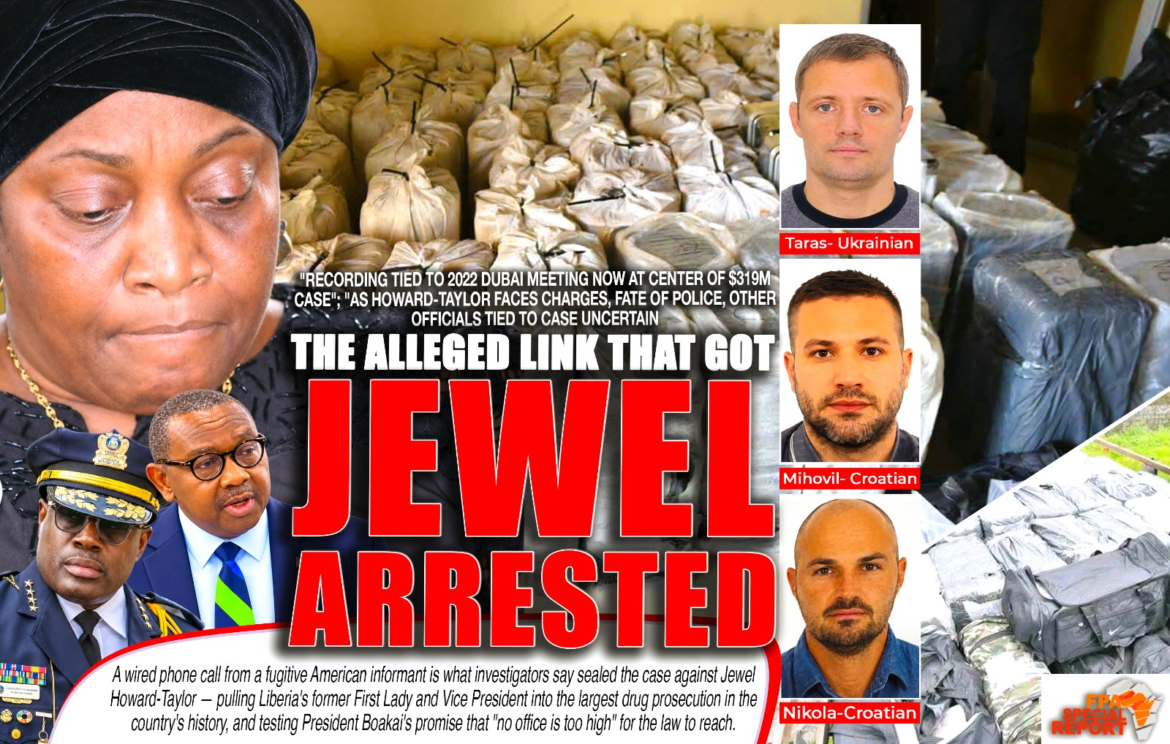
A wired phone call from a fugitive American informant is what investigators say sealed the case against Jewel Howard-Taylor — pulling Liberia’s former First Lady and Vice President into the largest drug prosecution in the country’s history, and testing President Boakai’s promise that “no office is too high” for the law to reach.
By Rodney D. Sieh | [email protected]
MONROVIA — Who introduced Jewel Howard-Taylor to Nikola Ivancic and Mihovil Vrovac, two Croatian nationals, and to Taras Zadereiko, a Ukrainian? Liberian government authorities are not saying. What they have stated, in an indictment laid out Wednesday by Justice Minister N. Oswald Tweh, is that the former First Lady and Vice President of Liberia is directly linked to an alleged transnational narcotics network operating within and beyond the Republic of Liberia — and that authorities have connected her to the US$317 million drug bust that has consumed the country’s attention for months. She has been charged under Liberia’s Controlled Drugs and Substances Act of 2023. Addressing a news conference Wednesday, Minister Tweh was careful to note that the charges remain allegations, and that Taylor is presumed innocent until proven guilty by a competent court of jurisdiction. Authorities have identified the Ukrainian and the two Croatians as the owners of the US$319 million in drugs seized from a stash house in Paynesville.
A Network Built in Plain Sight, Then Paused, Then Restarted
A member of the joint investigative team, speaking to FrontPageAfrica on condition of anonymity Wednesday, described a network that operated in Liberia for years before this summer’s headlines. The European trio, the source said, set up shop between 2021 and 2022, under the previous government of President George Weah, and continued operating until the end of 2023. “They suspended their operations and returned to Liberia in 2025,” the source said. “At that time, they had established local operators to provide security and protection. In addition to low-level government actors, they also had mid-level non-state actors operating cover businesses.” That timeline — a network built quietly under one administration, paused, and reactivated under the next — is itself part of what investigators are now trying to map: who among the people who worked with, protected, or simply looked away from this operation understood what it actually was.
The Dubai Meeting
FrontPageAfrica has been told that it was Sheikh Bassirou Kante who, in early 2022, introduced the then-Vice President to the Croatian-Ukrainian trio, telling her he knew of investors interested in putting US$250 million into the Liberian economy. According to sources familiar with the encounter, Taylor met the group in Dubai later that year and told them that if they wanted to invest, the Liberian economy needed the boost and they were welcome. It is a meeting Taylor’s office has, in one form or another, already had to answer for once before. Earlier in her political career, media reports raised questions about her relationship with Kante, often referred to as “Sheik” or “Sheikh” Kante. Her office explicitly denied ever recommending him for a diplomatic passport, while acknowledging that she had interacted with him — noting, in its own defense at the time, that public officials meet many people over the course of their careers and cannot be held responsible for the private, unverified conduct of acquaintances. That defense is about to be tested in a courtroom rather than a press statement.
Taylor Responds: “I Don’t Know Them”
Taylor herself pushed back directly on the central allegation in a message sent to FrontPageAfrica. Asked about her relationship with Ivancic, Vrovac and Zadereiko, the three foreign nationals authorities have identified as owners of the seized narcotics, she said flatly that she has no personal relationship with any of them. “I don’t know them,” she said, referring to the two Croatians and the Ukrainian named in the indictment. The only link she acknowledged is Kante. “I have met many persons though, but I don’t know them personally,” she said — a response that does not dispute meeting Kante, or the Dubai encounter sources have described, but draws a sharp distinction between having been introduced to the network’s principals and having any personal relationship with them. That distinction is likely to sit at the center of her defense: that an introduction, even one arranged in Dubai by a man now cooperating with prosecutors, is not the same as the direct link to a trafficking network that the charges against her allege.
The Recording That Investigators Say Sealed the Case
Sources tell FrontPageAfrica that Kante recently struck a deal with investigators: his own name removed from the probe, in exchange for evidence directly linking the former Vice President, or anyone from the Weah administration, to the current case. Wired with a recording device, Kante placed a call to Taylor, according to the source, telling her that the same group he had introduced her to in 2022 had sent her a “gift.” That recording, FrontPageAfrica has learned, formed the basis on which the former Vice President was arrested — stopped at Roberts International Airport as she attempted to leave the country, then taken to Liberia National Police headquarters for questioning under the Joint National Security Investigative Team’s procedures.
Who Is Sheikh Bassirou Kante?
The informant whose recorded call now sits at the center of Liberia’s biggest political prosecution in years is, by his own legal history, not a straightforward witness. Kante was arrested in Maryland in April 2022 on charges tied to a multimillion-dollar business email scam and money laundering, and separately faced investigation over an unauthorized diplomatic passport found in his possession at the time of his arrest. He pleaded guilty to federal charges later that year and was placed on supervised release. Federal authorities issued a warrant for his arrest after he went unaccounted for on October 23, 2024; the case remains active, with the U.S. Marshals Service still seeking information on his whereabouts. That a fugitive wanted on an active U.S. federal warrant is now the cooperating source behind a recorded call used to charge a former Liberian Vice President is likely to become a central line of any defense Taylor’s lawyers mount — and a detail Liberians will be right to weigh carefully as the case moves toward trial.
The Charges
According to the Ministry of Justice, Howard-Taylor faces the following charges. Under the Controlled Drug and Substance Act of 2023: unlicensed importation of a controlled drug or substance; unlicensed sale, trading, administration, dispensation, delivery, distribution, dispatch in transit and transportation of a controlled drug or substance; and illicit trafficking of a controlled drug or substance. Under Chapter 10 of the Penal Law of Liberia: criminal solicitation, criminal facilitation, and criminal conspiracy. Under the Anti-Money Laundering and Terrorist Financing Law: money laundering. The government says Ivancic, Vrovac and Zadereiko have been charged in absentia as alleged members and organizers of the same network, and that the Ministry of Justice will pursue “all lawful domestic and international measures necessary to locate, apprehend and bring these defendants before the courts of the Republic of Liberia.”
A Second Official Pulled In
Taylor is not the only figure connected to the state now facing scrutiny in this case. The Ministry of Justice confirmed that Gerald Smith, former Deputy Director of the National Security Agency for Administration, has been called in for questioning in connection with the same investigation — the latest in a string of government-linked figures, following the recusal of LDEA Officer-in-Charge Fitzgerald Biago and the dismissal of RIA official Mark Kuiah earlier this year, to be drawn into a case that keeps widening rather than narrowing.
“No Office Is Too High”
Minister Tweh’s remarks at Wednesday’s news conference were unusually direct for a Liberian government statement, and unmistakably aimed at answering the question Liberians have been asking all summer: whether this investigation would actually reach the country’s most powerful names, or stop just short of them.
The Ministry was equally direct about what the charges are not. “Criminal charges are accusations and do not constitute judgments of guilt,” the statement read, affirming that all defendants remain presumed innocent unless and until proven guilty before a court of competent jurisdiction, and are entitled to legal representation, due process and every constitutional and statutory protection guaranteed under Liberian law. The Ministry also cautioned the public, political actors and media institutions against speculation, witness intimidation, and the publication of unverified information that could compromise the investigation or prejudice judicial proceedings — a caution this newspaper takes seriously even as it continues reporting what its own sources have independently confirmed.
Where This Fits: Liberia’s Widening Drug Investigation
Wednesday’s charges did not emerge from nowhere. They are the latest, and by far the most consequential, development in a drug investigation that has been reshaping Liberia’s government since early summer. It began with a US$19.2 million seizure at Roberts International Airport in June, followed by the far larger Paynesville stash house bust now valued at US$317 million — reporting on the case has, at various points, cited a slightly different figure of US$317 million, but authorities’ own charging documents this week place the value at US$317 million. Alongside the seizures came the mystery vessel IB Atlantic IV, which sat off Liberia’s coast for the better part of a week this summer before AFL patrol boats too small to intercept it watched it slip back out to open water — a case that first exposed how little visibility Liberia’s port and maritime system had over what was moving through it, and that has hung over every port and security reform debate since. The investigation has already produced criminal charges against LDEA officer Moses Jallah and Paynesville bar owner George Harris, the recusal of LDEA Officer-in-Charge Fitzgerald Biago over an unresolved vehicle-gift allegation, and the dismissal of RIA official Mark Kuiah without, as of this writing, a single charge filed against him. Senator Amara Konneh has taken to calling the entire affair “Cocainegate.” President Boakai, at a commissioning ceremony earlier this summer, pledged that his administration would pursue the case with “no sacred cows.” Wednesday’s charges against a former Vice President are, in effect, the first real test of whether that pledge extends to the very top of Liberia’s political establishment — not simply to mid-level officers, bar owners and appointees, but to someone who once held the second-highest office in the country.
Critics Ask: What About the Officers Still in Uniform?
The speed and visibility of Taylor’s arrest — stopped at the airport, taken directly to Liberia National Police headquarters, charged within days — has drawn a pointed question from critics of the investigation: why has the same urgency not been applied to current government officials who, by multiple accounts circulating around the case, played a far more direct operational role. Critics point specifically to two police officers who are alleged to have escorted the drug shipment to the Paynesville stash house — an allegation that, if true, would place uniformed, currently serving members of the Liberia National Police inside the physical chain of custody of the very narcotics at the center of this case, a role considerably more direct than facilitating an introduction or accepting an investment pitch years earlier. The same critics have raised similar questions about National Security Agency personnel connected to the case. Gerald Smith’s questioning as former NSA Deputy Director for Administration has been publicly confirmed, but critics note that no serving NSA official has faced an arrest of the kind Taylor experienced this week, despite the agency’s central role in the country’s security apparatus and its proximity to a network investigators say relied on “institutional protectors” to operate. Neither the Ministry of Justice nor the Joint National Security Investigative Team has named the two police officers publicly or detailed what, if any, action has been taken against them or against NSA personnel beyond Smith’s questioning. That silence is precisely what critics say undercuts Minister Tweh’s promise that “no office is too high” and that there will be no “sacred cows” — a promise that, in their view, cannot be judged solely by how quickly a former Vice President was taken into custody, but by whether serving police and security officials allegedly caught in the same network are held to the identical standard, on the identical timeline.
What Happens Next
The Ministry of Justice has signaled that this stage of the case is not its final one. “These actions represent a decisive stage in the Government’s determination to expose and dismantle this network from its roots,” the Ministry said, adding that it intends to identify and pursue “its leadership, financiers, facilitators, transporters, operational coordinators, institutional protectors and every person who knowingly assisted its activities.” For Taylor, the immediate path runs through arraignment and the presentation of evidence — including, presumably, the recorded call at the center of the government’s case, and whatever scrutiny her legal team brings to the credibility of the fugitive informant who obtained it. For Ivancic, Vrovac and Zadereiko, charged in absentia, the path runs through whatever international cooperation Liberia can secure to locate and extradite three foreign nationals who, as of Wednesday, remain unaccounted for. And for Liberians watching a summer-long drug scandal reach a former Vice President, the path runs through a simple question this newspaper has asked in one form or another since the IB Atlantic IV first appeared off the coast in June: whether “no sacred cows” was ever more than a phrase, and whether this is the case that finally proves it.
See more Liberia News Network stories in Google Search by adding LNN as one of your Preferred Sources.
★ Add LNN as a Preferred Source