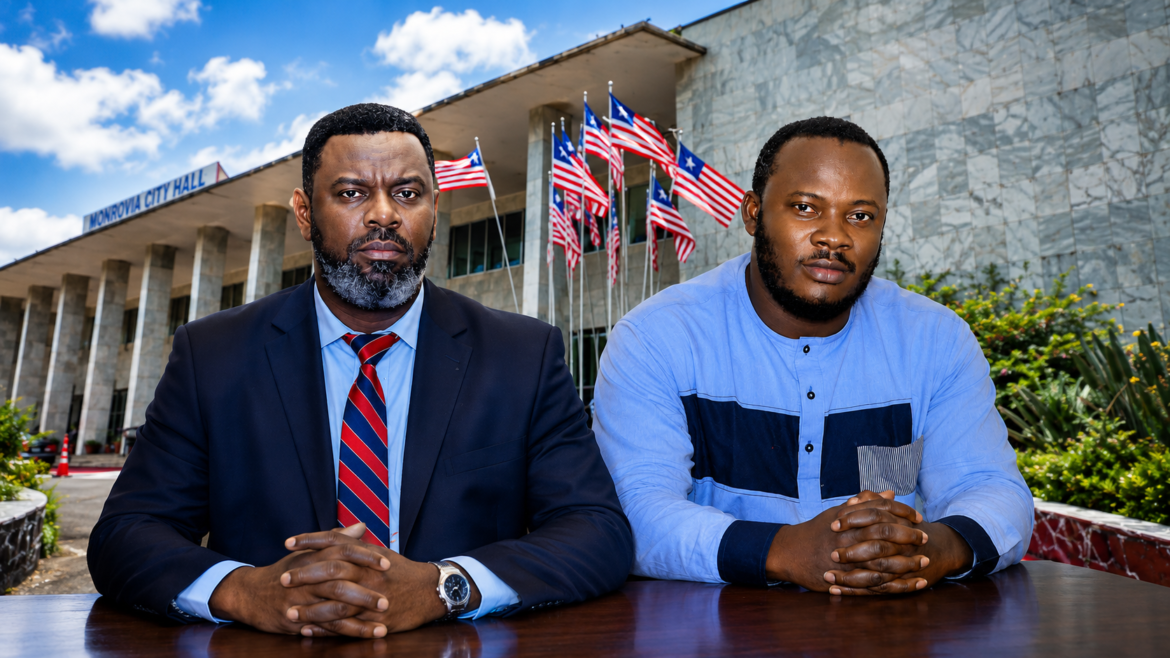
Monrovia — A deepening revenue-sharing dispute between the Monrovia City Corporation and several townships in Montserrado County has erupted into a major local-government crisis, with township commissioners accusing the city authority of collecting revenues from their communities while allegedly failing to remit the agreed shares.
By Willie N. Tokpah
The commissioners say the alleged non-remittance has gone beyond crippling their administrative operations.
They warn that the financial squeeze is now threatening public health, as some townships lack the resources to sustain garbage collection, clean drainage systems and respond adequately to sanitation problems confronting densely populated communities.
According to the commissioners, the failure to receive their agreed percentage of revenues has left township administrations financially incapacitated, forcing them to struggle with basic operations while residents face growing sanitation challenges.
The dispute has placed Liberia’s decentralization policy under renewed scrutiny and raised serious questions about transparency, accountability and control over revenues generated within local communities.
At the center of the controversy is a revenue-sharing arrangement under which the MCC collects municipal revenues within several townships and is expected to remit an agreed percentage to the respective township administrations.
But commissioners interviewed by FrontPageAfrica alleged that the MCC has failed to honor the arrangement for extended periods.
Some say they have received less than two percent of the revenues collected within their jurisdictions, while others allege receiving less than five percent despite agreements providing for substantially higher shares.
‘MCC Is Crippling the Townships’
Commissioner Edward H. Lahai of Oldest Congo Town is calling for an urgent intervention by the National Government, saying the existing arrangement is no longer serving the interests of the people.
Under the arrangement cited by Lahai, Oldest Congo Town is entitled to 45 percent of revenues collected within its jurisdiction.
Yet, he alleged that for more than two years, his township has received less than five percent of the total revenues collected.
“We cannot allow resources generated from our Township to not impact the lives of our people,” Lahai stressed. The commissioner said the alleged non-remittance has severely weakened the township administration and affected its ability to maintain office operations and provide services to residents. But the consequences, he warned, are increasingly moving beyond administrative inconvenience. Lahai said inadequate financial resources are making it difficult for township authorities to sustain community-development and sanitation initiatives, potentially creating conditions for worsening public-health problems.
Garbage Piles Up as Resources Dry Up
The commissioners say one of the most immediate casualties of the alleged revenue crisis is sanitation. With township administrations struggling to access their expected revenues, garbage collection activities have become increasingly difficult in some areas. Commissioners say the lack of resources affects their ability to maintain garbage-collection tricycles and trucks, hire or pay sanitation workers, and respond promptly to waste-management needs.
The result, they warn, could be increased accumulation of solid waste in communities already facing serious sanitation pressures.
The problem extends to drainage. Without adequate funds for routine cleaning and maintenance, clogged drains can remain unattended, increasing the risk of stagnant water, flooding and other environmental-health hazards, particularly during periods of heavy rainfall.
For township officials, this is no longer simply a question of accounting. They argue that failure to release revenues needed for sanitation can directly affect the health and safety of residents.
New Kru Town: Less Than Two Percent
Commissioner Robert B. Teah of New Kru Town said the situation has persisted for approximately a year since the MCC, according to him, stopped effectively implementing the revenue-sharing arrangement.
Teah said that since 2025, New Kru Town has received less than two percent of revenues collected within the township. He described the situation as a major challenge to his administration.
The commissioner said the lack of revenue has affected the township’s ability to maintain garbage-collection tricycles and trucks and implement pending community-development projects. He said sanitation services are among the areas suffering from the financial constraints. When sanitation equipment cannot be maintained, and garbage cannot be regularly collected, he said, residents ultimately bear the consequences.
Teah also disclosed that township employees are owed one month’s salary, despite government subsidy being provided to the township.
He wants the MCC to settle the revenues he says are owed to New Kru Town. Although he indicated that the outstanding amount is substantial, he declined to provide FrontPageAfrica with a definitive figure when asked to substantiate the exact arrears.
Garworlohn’s Revenue ‘Lifeline’ Withheld
For Rudolph S. Buima, Commissioner of Garworlohn Township, the situation is particularly alarming because his administration does not receive a government subsidy.
According to Buima, the revenue generated within Garworlohn is effectively the township’s financial lifeline.
Under the arrangement, Garworlohn was expected to receive 30 percent of revenues collected within the township.
But Buima said the township has received only a fraction of what it was supposed to receive since the arrangement took effect. He described the situation as disheartening, saying his administration is expected to serve residents without having access to the financial resources generated from the community.
“The revenue collected is what the Township depends on for its operations,” Buima said. He said the MCC collects the revenues, while the townships were expected to meet quarterly to discuss collections and the division of revenues. According to him, those mechanisms have failed to produce the expected results.
The consequence, he said, is an increasingly cash-strapped township administration struggling to meet its obligations.
Public Health Threat Looms
The commissioners’ concerns are particularly significant because sanitation deficiencies can quickly become public-health problems in densely populated urban communities.
When garbage collection is interrupted, waste can accumulate around homes, businesses, streets and public spaces. When drainage channels are not regularly cleaned, debris and solid waste can obstruct the flow of water.
The commissioners warn that the combination can create stagnant water, flooding and unsanitary conditions, increasing exposure to environmental-health hazards. They argued that township administrations need predictable revenue flows to prevent these conditions before they become emergencies.
For communities already struggling with inadequate sanitation infrastructure, they say, withholding or delaying local revenues can compound existing vulnerabilities.
Development Projects Also Suffocating
Beyond sanitation, commissioners say the alleged revenue crisis is affecting community-development projects.
Lahai cited Oldest Congo Town’s career-development and national examination programs for students, vocational training for women and girls, job-creation initiatives, support to schools and needy students, disaster response, drug-awareness programs and fire-safety education. He said such programs demonstrate what township administrations can achieve when they have access to resources. But he warned that continued revenue shortfalls threaten the sustainability of those initiatives.
“The non-remittance of revenues collected from the Township has left the office of the Commissioner struggling with office operations and increased service delivery to the people,” Lahai said.
A Direct Challenge to MCC
The commissioners are now demanding greater transparency from the MCC. They want detailed accounting of revenues collected from their respective townships, the amounts transferred, the balances outstanding and the basis for any deductions or delays. They also want the National Government to review the entire revenue-sharing arrangement.
For Lahai, the issue is fundamentally about fiscal decentralization. “True decentralization must go beyond policy discussions,” he maintained. “It must give local authorities the financial power, systems and capacity to make decisions and invest directly in the development of their people.”
The commissioners argue that it is contradictory to assign local authorities responsibility for sanitation, community development and other services while denying them access to predictable revenues generated within their own jurisdictions.
MCC Yet to Answer the Allegations
FrontPageAfrica repeatedly sought the MCC’s response to the allegations. The newspaper contacted MCC Communications Head Varney Diggs, who initially appealed for time to prepare a response. Diggs subsequently indicated that he would respond to FrontPageAfrica’s inquiries at 10 a.m. on Thursday, August 20. However, despite repeated calls, text messages and WhatsApp communications, Diggs ultimately did not provide a substantive response to the newspaper’s questions by publication time. As a result, the MCC’s position on the commissioners’ allegations remains unclear.
Among the questions awaiting answers are how much revenue has been collected from the affected townships, how much has been remitted, whether there are outstanding balances, and whether the MCC disputes the percentages and figures being cited by the commissioners.
The MCC has also not publicly explained whether delays in remittance are the result of accounting discrepancies, disagreements over the interpretation of the agreements, or other administrative considerations.
Boakai’s Decentralization Agenda Under Pressure
The controversy comes as President Joseph Nyuma Boakai continues to support decentralization and stronger local governance. Lahai welcomed the President’s position but challenged local-government officials to demand more meaningful fiscal authority. He said decentralization cannot remain confined to policy documents and public pronouncements.
For the commissioners, the current dispute provides a practical test. If local governments are to become engines of community development, they must have predictable access to the resources necessary to perform their responsibilities.
Lessons From China
Lahai made his comments while visiting the People’s Republic of China, including Litong District in Wuzhong and Ningxin Community, where he is observing local governance and community-development initiatives. He said the experience is providing useful lessons on how local authorities can be empowered to participate directly in development. He believes Liberia can strengthen its own system by giving local authorities greater financial capacity, stronger accountability mechanisms and clearer responsibility for community development.
A Crisis Bigger Than Revenue
What began as a disagreement over percentages and remittances has now evolved into a broader debate over the effectiveness of Liberia’s local-government system. For the commissioners, the issue is not merely how much money is owed. It is whether townships can continue to provide services when they allegedly cannot access the revenues generated from their own communities.
The consequences, they warn, are already being felt through weakened sanitation operations, difficulties maintaining garbage-collection equipment, unpaid workers, delayed development projects and inadequate drainage maintenance.
If these allegations are substantiated, the dispute could represent a serious failure of fiscal accountability within Liberia’s decentralization framework and as garbage collection becomes harder to sustain and drainage systems remain vulnerable to neglect, the commissioners warn that the cost of the revenue dispute could ultimately be paid not by government institutions, but by ordinary residents through deteriorating living conditions and growing public-health risks.
The Government now faces pressure to determine exactly how much revenue is being collected, where the money is going, what townships are owed and whether the existing arrangement is capable of delivering the decentralization Liberia has promised its citizens.
In Monrovia, the signs of a city struggling with sanitation are difficult to miss. Along busy streets and densely populated communities, heaps of garbage can become part of the urban landscape. Drainage channels are often overwhelmed by waste and silt. During heavy rainfall, blocked waterways can turn ordinary streets into stagnant pools, while residents in some communities contend with the consequences of inadequate waste collection and poor environmental management.
Behind the visible sanitation crisis, however, township commissioners say there is another problem receiving far less public attention: the money.
Three township commissioners are now accusing the Monrovia City Corporation (MCC) of failing to regularly remit agreed portions of revenues collected within their jurisdictions, leaving local administrations without the resources they say are necessary to manage their communities.
On the surface, it is a dispute over percentages, but beneath it lies a much bigger problem: who controls the money generated in Monrovia’s communities, who accounts for it, and who ultimately pays when that money does not reach the local authorities responsible for delivering services.
Workers and township operations face financial constraints. Development programs are being delayed. And local authorities say they are being asked to manage communities without reliable access to the revenues generated within those same communities. The commissioners are accusing the Monrovia City Corporation (MCC), headed by Mayor John Siafa, of failing to regularly remit agreed portions of revenues collected from their jurisdictions.
They want records.
From Revenue Dispute to Public Health
The stakes become even higher when sanitation enters the equation. A city’s waste-management system is a public-health system. When garbage is collected regularly, communities are safer. When drains are maintained, rainwater can move more efficiently. When waste is removed from public spaces, the risk of unhealthy environmental conditions is reduced.
But when local authorities cannot afford those services, the consequences can accumulate. Garbage may remain longer. Drains may go uncleared. Flooding risks may increase. Communities may become less healthy. The commissioners say that is why the MCC and the National Government should not treat the revenue-sharing dispute as a routine administrative disagreement. They believe it has direct consequences for the quality of life of residents.
Mayor Siafa’s MCC Under Pressure
The allegations place Mayor John Siafa and the MCC at the center of a growing accountability debate. The corporation is responsible for collecting revenues under the arrangements described by the commissioners. The townships, meanwhile, say they are entitled to agreed percentages. If the money is being collected, commissioners argue, there should be a clear and verifiable record showing where it goes.
If there are outstanding remittances, the reasons should be disclosed. And if the commissioners’ figures are incorrect, the MCC should publish the records necessary to correct them.
See more Liberia News Network stories in Google Search by adding LNN as one of your Preferred Sources.
★ Add LNN as a Preferred Source