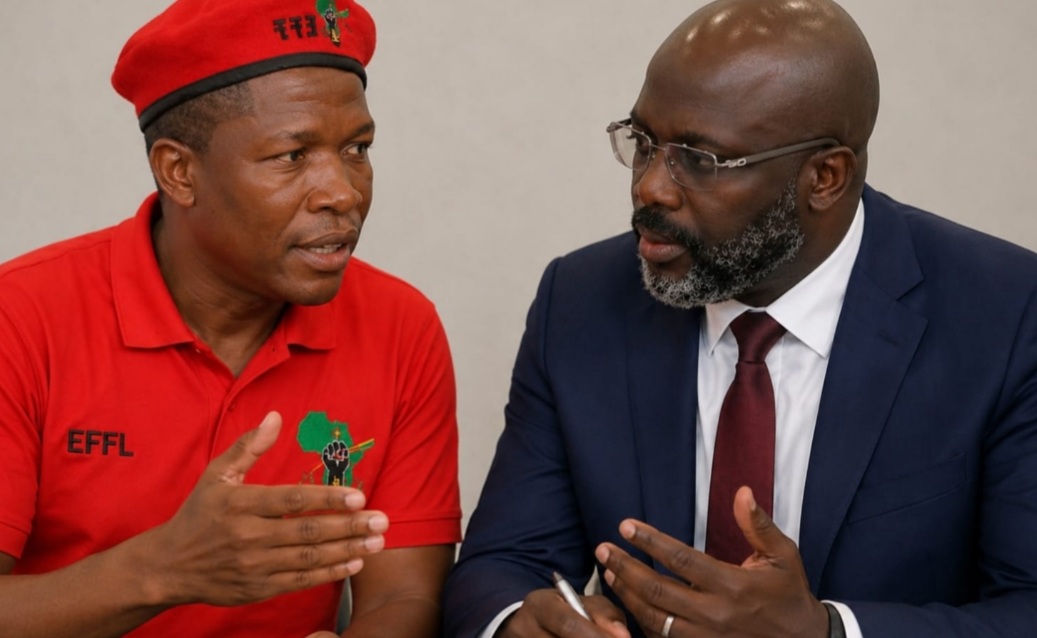
MONROVIA – A fresh political confrontation has emerged over Liberia’s escalating fight against illicit drugs, with former President George Manneh Weah calling for mass mobilization against what he describes as growing authoritarianism, while Economic Freedom Fighters of Liberia (EFFL) Commander-in-Chief Emmanuel Gonquoi is urging Liberians to reject any attempt to turn the drug investigation into a political battle.
The competing positions came after the detention of former Vice President Jewel Howard-Taylor on Wednesday, August 19, an action that has intensified an already heated national debate over the government’s handling of the country’s multimillion-dollar cocaine investigations.
Weah, political leader of the Coalition for Democratic Change (CDC), announced plans to return to Liberia and rally CDC supporters and other “well-meaning Liberians” to resist what he described as a “tyrannical attempt” by the Boakai administration to undermine Liberia’s democracy.
But in a statement on Thursday, August 20, Gonquoi sharply challenged the former president’s position, saying the fight against drugs should transcend political affiliations and personalities.
“As a mass-based, youth-driven political party, we are taking this fight very seriously because we believe that this is a way we defend our generation and generations to come,” Gonquoi said.
He argued that the impact of the drug crisis on young Liberians makes it dangerous for political leaders to treat the issue as an opportunity for partisan confrontation.
“Thousands of young people are dying, losing their lives, losing their future, sitting in the graves,” Gonquoi said, stressing that political organizations claiming to represent young people should support national efforts to combat drug trafficking.
He directly challenged Weah’s planned mobilization, saying that if the former president intends to organize supporters against the ongoing investigation, the EFFL would not remain silent.
“Just as you will be mobilizing to stop the government from fighting drugs, I too will be mobilizing to resist such protests,” Gonquoi said. “Young people are dying from drugs, and we can’t afford to be political about this fight.”
Gonquoi said Liberia’s current investigation should be allowed to proceed, particularly because international partners are now assisting national authorities.
He noted that Liberians, including political actors, had previously called for international investigators to participate in the drug probe because of concerns about the capacity of domestic institutions to handle an investigation involving international trafficking networks.
According to Gonquoi, the involvement of foreign law enforcement and technical experts should therefore be viewed as an opportunity to strengthen the credibility of the investigation rather than a reason for political confrontation.
“We need to allow the investigation to unfold,” he said.
Gonquoi pointed to the reported presence of U.S. law enforcement personnel and other international partners, saying their involvement could help Liberia establish the facts and identify those responsible for the movement of illicit drugs into the country.
He questioned why a former president would seek to mobilize citizens against an investigation that, in his view, could ultimately help determine whether the allegations being made are true or false.
“If a former president, whose vice president now is being implicated or linked, allegedly, to the drug cartel, is saying he’s going to mobilize the masses to resist, then I think something is fundamentally wrong,” Gonquoi said.
He stressed that the statement should not be interpreted as a declaration of guilt against anyone, but argued that all persons connected to the investigation should be allowed to face scrutiny where evidence warrants it.
Gonquoi also accused political actors of shifting their position after previously demanding stronger government action against the drug trade.
He said the CDC and other political forces had placed pressure on the government to demonstrate results in combating narcotics and questioned why that pressure should now turn into opposition to the investigative process.
“Now that the government is making progress, why do they want to change the goalposts by creating distractions in the investigation?” he asked.
The EFFL leader maintained that the drug investigation should not stop because of political disagreements, saying the country needs facts and evidence to emerge before conclusions are drawn.
He further argued that the fight against narcotics should become a national consensus involving political parties, religious institutions, civil society organizations, the media and ordinary citizens.
“This drug fight should not be political,” Gonquoi said.
He described the recent cocaine seizures, involving suspected narcotics valued at hundreds of millions of dollars, as a serious threat to Liberia’s young population and international reputation.
Gonquoi said the scale of the seizures demonstrates the urgency of the situation and requires Liberians to treat the drug crisis as a national emergency rather than a partisan issue.
He compared the challenge to other national crises in which Liberians have been compelled to put political differences aside and work together.
He also criticized the prospect of street demonstrations being used to interfere with the investigation, warning that his political movement would respond if efforts were made to obstruct the process.
“If anybody pulls out people in the street, we are not going to come in the streets?” he asked.
Gonquoi maintained that any response by his movement would be conducted within the bounds of the law.
His comments came in direct contrast to Weah’s Wednesday statement, in which the former president accused the Boakai administration of using state power against political opponents.
Weah said the detention of Howard-Taylor demonstrated what he described as a continuing decline in Liberia’s democracy and accused President Joseph Nyuma Boakai of employing “extrajudicial powers” against people who hold opposing political views.
The former president said Howard-Taylor had been prevented from traveling without prior notice and was subsequently detained, which he described as a violation of her constitutional right to freedom of movement.
Weah said he had spoken with Howard-Taylor following the incident and that she had strongly denied the allegations against her.
He characterized the allegations as politically motivated and accused the government of using the drug crisis to target members of the former administration.
While supporting legitimate efforts to combat Liberia’s drug problem, Weah said he opposed what he described as attempts to exploit the crisis for political purposes.
He also criticized the government’s explanation of the allegations against Howard-Taylor, arguing that authorities had failed to provide sufficient supporting information to explain how the accusations were established.
Weah further questioned why the government was focusing on individuals associated with his administration while, in his view, officials within the current government and security sector who had been named or accused in connection with the broader drug controversy remained free.
The former president said he had been communicating with regional and continental leaders about what he described as threats to Liberia’s democratic institutions and national stability.
He then announced his intention to return to Liberia and mobilize the CDC and other citizens to oppose what he called the government’s “tyrannical” conduct.
Weah said such resistance would be pursued through political and legal mechanisms guaranteed by Liberia’s Constitution.
Gonquoi, however, said Weah should use his influence to support the drug investigation rather than mobilize citizens against it.
He questioned what exactly the former president intends to resist while investigators are still attempting to establish the facts surrounding the cocaine cases.
The EFFL leader suggested that disrupting the investigation could make it more difficult for authorities to determine who was responsible for the alleged movement of narcotics into Liberia.
Those claims remain Gonquoi’s political assertions and have not been established by a court.
He urged Liberians to allow investigators to complete their work and said the truth should ultimately be determined through evidence and due process.
Gonquoi also called on citizens not to allow political loyalties to interfere with the national interest.
“The Liberian people should not listen to him,” he said of Weah, accusing the former president of seeking political relevance through the controversy.
He added that Weah does not have a monopoly on public mobilization and warned that the EFFL would be prepared to respond if demonstrations were organized to obstruct the drug investigation.
The escalating exchange between the two political figures reflects the widening political implications of Liberia’s drug investigations, which have already resulted in arrests, official probes and demands for international assistance.
At the heart of the dispute are two competing narratives.
Weah and the CDC are portraying the government’s actions against Howard-Taylor as evidence of political persecution and an erosion of constitutional rights, while Gonquoi and the EFFL argue that the investigation must be protected from political interference so that those responsible for the drug trade can be identified.
The disagreement is likely to intensify as investigators continue examining the cocaine seizures and alleged networks behind them.
For Gonquoi, the central issue is whether Liberia can maintain a united front against narcotics despite deep political divisions.
He argued that the country has reached a point where political parties and other influential groups must put aside partisan interests and support an investigation capable of establishing the truth.
The EFFL leader said the drug crisis affects every Liberian, particularly young people, and warned that failure to confront the problem decisively could have long-term consequences for the country’s social stability and future.
See more Liberia News Network stories in Google Search by adding LNN as one of your Preferred Sources.
★ Add LNN as a Preferred Source