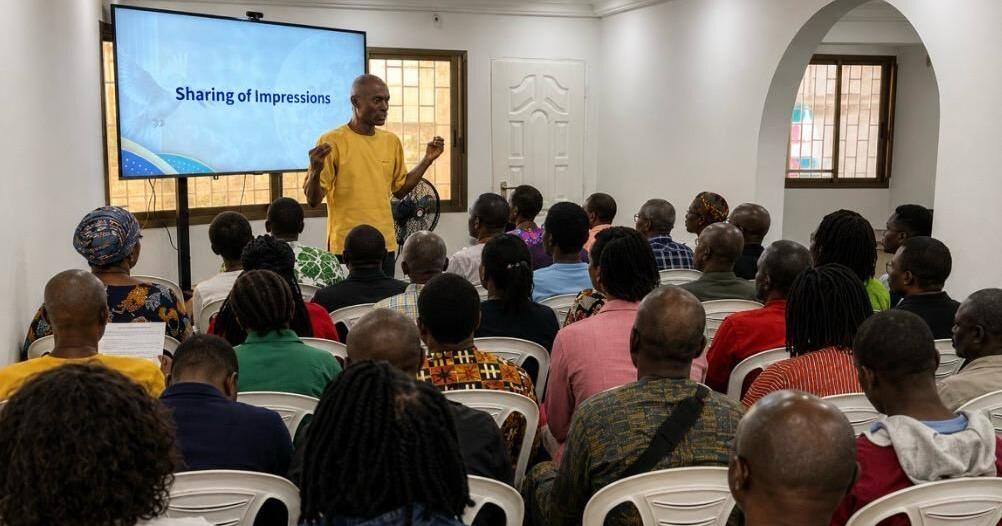
A group of Liberian pastors and Christian leaders has joined an international call for religious tolerance, judicial fairness and due process for 95-year-old South Korean religious leader Lee Man-hee, amid concerns raised by global pastors over what they describe as the growing influence of public opinion on judicial proceedings involving religious organizations in South Korea.
The Liberian intervention followed the First Joint Assembly of World Pastors, held on August 13, 2026, and co-hosted by seven Christian organizations from Korea and abroad. The assembly brought together about 3,000 pastors and Christian leaders, both physically and online, from Korea, Russia, Africa and other parts of the world.
At the center of the gathering was a broader debate about religious freedom, the separation of church and state and the treatment of religious minorities, with particular attention to the detention and prosecution of Lee Man-hee, chairman of Shincheonji.
For the Liberian pastors who participated in an online briefing following the assembly, however, the issue was framed less as a defense of one denomination and more as a question of whether age, religious belief or public hostility should influence the application of justice.
Liberian Pastors Echo International Appeal
Pastor David A. Stewart of Living Word Community Church was among the Liberian Christian leaders who called for greater protection of religious freedom.
“Religious belief must not be violated because to obtain salvation, it requires one’s will,” Stewart said after watching the presentation of the Joint Assembly of Global Pastors at the conference venue on Duport Road.
His argument goes to the heart of the controversy: the distinction between disagreement with a religious doctrine and the legal treatment of individuals who subscribe to that doctrine.
The Liberian chapter reportedly brought together 22 pastors, 17 assistant pastors, 21 evangelists and other church workers, with participants drawn from different denominations.
Two other Liberian Christian leaders — Abraham Z. Freeman of the Glorious Empowerment Church of God and Rev. Mother Josephine K. Toe of the House of Prayer Redeemer Ministry — separately joined Stewart in expressing support for religious tolerance in South Korea and calling for fairness for the elderly religious leader.
Their position broadly reflected the message emerging from the international assembly: that religious disagreement should not become a substitute for evidence in criminal proceedings.
One of the strongest arguments at the global assembly came from Rev. Vitaly Kirillovich Vlasenko, General Secretary of the Russian Evangelical Alliance.
Vlasenko challenged the idea that intense public opposition to a religious figure should influence judicial outcomes.
“Public opinion cannot be a verdict,” he declared, arguing that the legal standard applied to a religious leader should not change simply because the religion has become the target of widespread social hostility.
His comments are particularly significant because they distinguish between public accountability and judicial accountability.
Public opinion can generate scrutiny, demand explanations and expose concerns. But a criminal court operates under a different standard: evidence must be tested, charges must be proven and the accused must be given an opportunity to defend himself.
Vlasenko referred to the situation surrounding Shincheonji during the COVID-19 pandemic, when the organization became the subject of intense public criticism and petitions demanding its dissolution.
He noted that Lee was ultimately acquitted by South Korea’s Supreme Court of the charge of violating the Infectious Disease Control and Prevention Act, while some other convictions were upheld.
That distinction, he argued, demonstrates why courts must examine specific charges and specific evidence, rather than treating an individual as wholly guilty or innocent based on his public reputation.
“The stronger the social pressure, the fairer and more neutral the trial must be,” Vlasenko said.
The issue becomes even more complicated because Lee is 95 years old.
Bishop Elias Elijah Changa, founder and president of Zambia-based Missionary Ambassadors for Global Evangelism, brought a humanitarian dimension to the discussion.
Drawing on his prison-ministry experience, Changa argued that the administration of justice should be accompanied by protection of human dignity.
“The administration of justice and the protection of human dignity must go together,” he said.
Changa was careful to distinguish between demanding fairness and demanding immunity.
He acknowledged that Lee’s long involvement in peace-building and interfaith activities through the Heavenly Culture, World Peace, Restoration of Light (HWPL) did not, by itself, establish innocence or exempt him from the law.
But he argued that the allegations against Lee should be determined by courts based on law and evidence rather than disagreement with his religious beliefs.
His most direct concern involved detention.
“Age gives no one the right to stand above the law, but to protect life and humanity, I ask the competent authorities to carefully consider lawful alternatives such as bail, residence restriction, or medical accommodation,” Changa said.
Religious freedom, as emphasized by the pastors, does not mean religious organizations or their leaders should be beyond investigation when credible allegations of criminal conduct arise.
The global assembly itself acknowledged this distinction.
Rev. Im Young-woong, senior pastor of Saehimang Church of the Presbyterian Church of Korea, argued that allegations of wrongdoing should be investigated and proven crimes should result in accountability.
His concern was what happens when allegations against individuals are expanded into measures against entire religious communities.
“If there are allegations, they must be investigated, and if a crime is proven, one must be held accountable,” Young-woong said. But he warned against treating an entire religious community as responsible for alleged wrongdoing by particular individuals.
Young-woong cited Japan’s former Unification Church case, arguing that the dissolution of a religious corporation can have consequences extending beyond its formal legal status, including effects on assets and the organization’s ability to operate.
He questioned who determines whether a religious organization has acted against the “public interest” and what standards should govern such decisions.
Young-woong therefore invoked Article 18 of the International Covenant on Civil and Political Rights, emphasizing that religious freedom should not depend on whether a religion is popular, unpopular, old, new, majority or minority.
The Joint Assembly ultimately adopted a statement calling for an end to what organizers characterized as the use of particular religions for political conflict and suppression.
It also called for the judiciary to reject “trials by public opinion,” uphold the presumption of innocence and consider bail for the elderly religious leader.
The organizers said the issue should not be viewed solely as a dispute involving Shincheonji.
“What is happening in the Republic of Korea today is not the problem of one denomination or one country,” participants said, arguing that restrictions affecting one religious community could establish precedents affecting others.
That message appears to resonate with the local pastors, especially as it relates to a broader principle of democratic governance—religious liberty must coexist with accountability, but accountability itself must operate through evidence, due process and impartial institutions.
The appeal is ultimately, for the Liberian participants, a simple one—let the court decide, let evidence speak and let religious belief remain a matter of individual conscience rather than a basis for punishment.
See more Liberia News Network stories in Google Search by adding LNN as one of your Preferred Sources.
★ Add LNN as a Preferred Source