
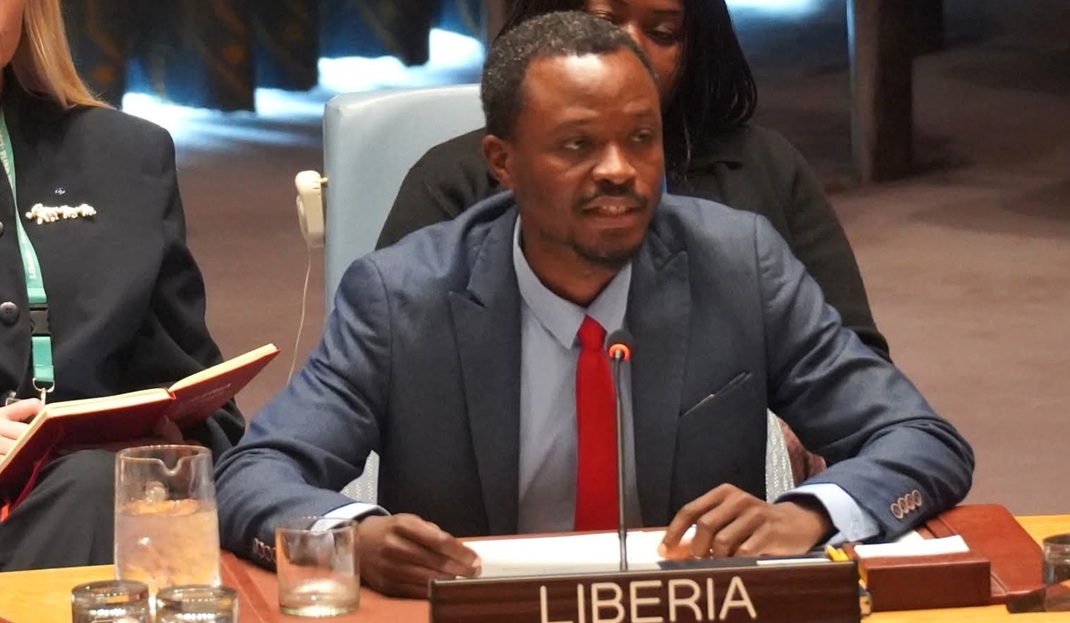
UNITED NATIONS, NEW YORK — Liberia has called for stronger international action to protect civilians caught in the Ukraine-Russia war, demanding full compliance with international humanitarian law and safe, rapid, and unhindered access for humanitarian assistance as the conflict continues to threaten lives, essential services, and civilian infrastructure.
Speaking during the United Nations Security Council’s 10,237th meeting on Friday, October 9, 2026, Prutus Sackie, Liberia’s Political Coordinator to the Council, stressed that protecting innocent people must remain an immediate priority, even as international diplomatic efforts continue to seek an end to the war.
Liberia’s intervention placed the humanitarian consequences of the conflict at the center of the Council’s deliberations, emphasizing that civilians must not be treated as acceptable casualties of military operations and that facilities essential to their survival must be respected and protected in accordance with international humanitarian law.
“We must strengthen the protection of civilians by ending attacks directed against civilians and civilian objects, ensuring full compliance with international humanitarian law, and facilitating safe, rapid, and unhindered humanitarian access to those in need,” Sackie told the Council.
The statement reflects Liberia’s position that the protection of human life cannot wait for a comprehensive political agreement between the parties to the conflict. While diplomatic negotiations remain essential to ending the war, the immediate needs of civilians require action regardless of the progress or setbacks of peace efforts.
Hospitals, schools, humanitarian personnel, and critical civilian infrastructure were among the facilities and groups specifically identified in Liberia’s appeal for protection. These services are essential to maintaining community life during armed conflict, particularly for people who depend on medical treatment, education, emergency assistance, and access to basic necessities.
Hospitals must remain capable of treating the wounded and sick, while humanitarian workers need safe conditions to deliver assistance to vulnerable communities. Schools and other civilian facilities also require protection from attacks that could endanger lives or deprive communities of essential services.
Liberia’s position emphasized that compliance with international humanitarian law is not optional. The rules governing armed conflict require parties to distinguish between civilians and combatants and between civilian objects and military objectives. They also establish protections for medical services and humanitarian activities, subject to the applicable legal conditions.
The demand for unhindered humanitarian access is equally important because assistance cannot meet urgent needs if relief workers are prevented from reaching affected populations or if the delivery of essential supplies is obstructed.
For civilians living amid continued hostilities, delays in humanitarian assistance can compound existing hardships. Access to food, water, medical supplies, shelter, and other necessities may become increasingly difficult when fighting disrupts transport routes, damages infrastructure, or forces families to leave their homes.
Liberia’s intervention therefore called for a response that addresses both the immediate protection of civilians and the larger diplomatic challenge of ending the conflict.
The country urged the Security Council to intensify diplomatic efforts toward an immediate ceasefire and a just, comprehensive, and lasting peace consistent with the UN Charter. It also reaffirmed support for all credible initiatives seeking to achieve a peaceful settlement.
The two priorities are closely connected. An end to hostilities could reduce immediate threats to civilians and create better conditions for humanitarian operations, while sustained diplomatic engagement could help establish the foundation for a more durable peace.
However, Liberia’s appeal makes clear that humanitarian protection must not be treated solely as a future benefit of negotiations. Civilians, hospitals, schools, humanitarian personnel, and essential infrastructure require protection while the conflict continues.
Sackie also emphasized that the urgency of ending the war must be matched by the determination to pursue peace. He noted that parties do not have to agree on every issue from the beginning for dialogue to become possible. The willingness to stop suffering, protect innocent lives, and create space for negotiations remains essential.
That argument is particularly relevant to humanitarian protection because civilians should not have to wait for the resolution of every political dispute before their immediate needs receive attention.
Liberia’s statement also comes amid concerns about the trajectory of the conflict. On September 23, United Nations Under-Secretary-General Rosemary DiCarlo warned that the war was entering a “dangerous new phase,” pointing to its growing human cost, the risk of escalation, and the consequences of miscalculation.
Such risks strengthen the need for restraint, compliance with international law, and continued efforts to prevent the conflict from producing further civilian suffering.
The Security Council’s responsibility extends beyond discussing the strategic dimensions of the war. Its deliberations also concern the protection of international peace and security, including the consequences of continued hostilities for civilians and the delivery of humanitarian assistance.
Liberia’s appeal brings these responsibilities into focus by linking the demand for a ceasefire with the immediate obligation to protect human life. It also reinforces the principle that humanitarian needs should not become secondary to military calculations or political disagreements.
For Liberia, the path forward requires renewed diplomatic commitment, respect for international humanitarian law, and practical measures to ensure that people affected by the war can receive assistance without unnecessary obstruction.
The country’s position rests on a straightforward principle, efforts to end the war and efforts to protect civilians must proceed together. A lasting political settlement remains essential, but the obligation to safeguard innocent lives exists throughout the conflict.
As the Security Council continues to address the situation in Ukraine, Liberia has urged its members and the parties involved to prioritize civilian protection, facilitate humanitarian assistance, and pursue a peaceful settlement in accordance with the UN Charter.
See more Liberia News Network stories in Google Search by adding LNN as one of your Preferred Sources.
★ Add LNN as a Preferred Source