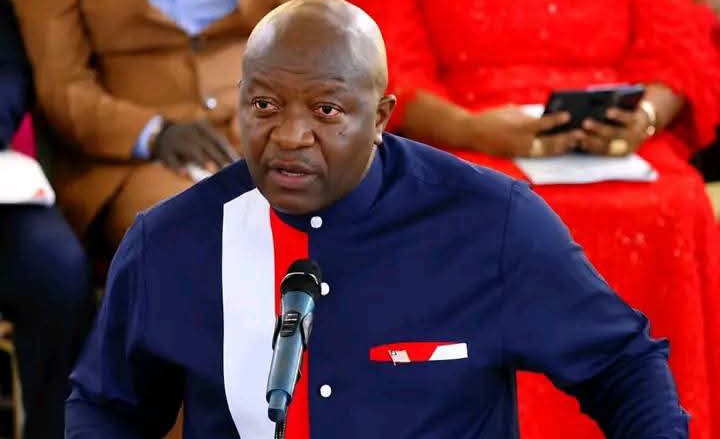
MONROVIA, LIBERIA – Finance and Development Planning Minister Augustine Kpehe Ngafuan has challenged Liberians to move beyond ceremonial expressions of patriotism and translate their love for country into integrity, responsible citizenship, public service and concrete contributions to national development.
Delivering the National Flag Day oration on Monday, August 24, 2026, under the theme “From Heritage to Hope: The Flag That Unites Us,” Ngafuan described Liberia’s Lone Star as more than a national emblem, saying it represents the country’s history, resilience, present responsibilities and aspirations for future generations.
Liberia on Monday observed the 179th anniversary of National Flag Day, commemorating August 24, 1847, when the Liberian flag was first hoisted, less than a month after the country declared independence on July 26, 1847.
The observance was later institutionalized as a national holiday following an Act of the Legislature approved on October 25, 1915.
Liberia’s flag consists of 11 alternating red and white stripes and a single white star on a blue field. Government records state that the 11 stripes represent the 11 signatories to the Declaration of Independence, while the Lone Star symbolized Liberia as the then-independent republic on the African continent. The flag was designed by a committee of Liberian women led by Susannah Lewis.
For Ngafuan, however, the meaning of the flag extends far beyond its historical origins.
“The flag has stood with us in our finest hours and our darkest days,” he said, describing it as a continuing symbol of Liberia’s identity and collective destiny.
He urged citizens to view the Lone Star as a reminder of the country they inherited and, more importantly, the Liberia they have a responsibility to build.
“It is history, but it must also be hope,” Ngafuan said.
The minister drew on a deeply personal memory from nearly five decades ago, recalling his experience as a first-grade student at Bolahun Public School in Wawoma Clan, Kolahun District, Lofa County, during National Flag Day celebrations in 1978.
He remembered hundreds of students gathering in Bolahun for the traditional parade, while parents, relatives and community residents lined the routes to watch children march and salute the national flag.
Ngafuan said that childhood experience has remained with him and continues to shape his understanding of what national symbols can mean to young people.
Nearly 50 years later, he challenged Liberia to create a society in which every child, regardless of county, family background or circumstances of birth, can look at the Lone Star and believe that his or her future is not predetermined by poverty or social circumstances.
“That is the Liberia we must build,” he declared.
A major component of Ngafuan’s message centered on national unity. He argued that unity should not mean forcing Liberians to abandon their political, ethnic, religious, county or professional identities.
Instead, he said those identities must exist within a larger and stronger national identity.
“We can disagree and still be Liberians,” Ngafuan said.
He warned that county loyalty must never become more important than loyalty to Liberia, recalling an argument he made in 2010 during the induction of officers of the Federation of Lofa Associations in the Americas.
The minister also applied the principle to Liberia’s political environment, cautioning citizens against allowing party loyalty to overwhelm national interest.
“Our party-centricity must never undermine our country-centricity,” he said.
Ngafuan urged Liberians to stop judging individuals primarily by their political affiliations, counties, tribes, religions or institutional associations.
Instead, he called for citizens to judge one another by character, conduct, values and contributions to the national interest.
He said patriotism must also be measured by actions rather than ceremonies.
“Patriotism is not only what we say about Liberia. Patriotism is what we do for Liberia,” he said.
According to Ngafuan, a government official who protects public resources, a teacher who prepares adequately for class, a health worker who responsibly treats patients, a security officer who applies the law fairly, a businessperson who pays legitimate taxes, a journalist who responsibly seeks the truth and a citizen who rejects corruption are all participating in an act of raising the national flag.
He therefore challenged Liberians to redefine patriotism as everyday service to the country.
“Think Liberia. Love Liberia. Build Liberia,” he urged.
The Finance Minister said public officials, in particular, should not regard the national flag displayed in government offices as merely decorative.
Instead, he said the flag should serve as a daily reminder that public office is a responsibility entrusted to individuals by the Liberian people.
Ngafuan described Liberia as a common national enterprise in which every citizen is a shareholder.
Holding public office, he said, does not make an official a greater owner of the Republic. Rather, it increases that individual’s responsibility to the country.
He also broadened the meaning of national leadership beyond elected and appointed government officials.
Pastors, imams, teachers, political leaders, journalists, radio talk-show hosts, business executives, community leaders, health professionals, sports administrators, trade leaders and social-media influencers, he said, all possess influence.
“And influence creates responsibility,” Ngafuan declared.
The minister connected national unity directly to Liberia’s economic development, arguing that infrastructure and public services can help strengthen national cohesion when citizens see development as something that belongs to everyone.
Roads, electricity, schools, health facilities and employment opportunities, he said, can become practical expressions of national unity because their benefits should not be limited by political affiliation or county of origin.
He cited the government’s ARREST Agenda for Inclusive Development as part of efforts to translate national aspirations into projects and measurable improvements in the lives of Liberians.
Liberia has also continued to pursue financing for major infrastructure projects, including a US$30 million BADEA financing agreement signed in January 2026 for the 50-kilometer Salayea-Konia road in Lofa County, alongside a US$700,000 grant aimed at supporting health-service improvements along the Gbarnga-Voinjama corridor.
Ngafuan also pointed to Liberia’s expanding fiscal capacity.
The Ministry of Finance and Development Planning has listed the approved FY2026 national budget at approximately US$1.249 billion, while a supplementary budget process has sought to raise total spending to about US$1.29 billion.
He described Liberia’s progress toward a historic US$1 billion-plus budget milestone as an opportunity to finance roads, schools, electricity, health services, jobs and stronger institutions.
But he warned that the size of the national budget should never become an end in itself.
Its true measure, he said, must be whether government resources produce tangible improvements in the lives of ordinary citizens.
Ngafuan also invoked the economic concept known as the “tragedy of the commons” to warn against behaviors that weaken national development.
He cited illegal dumping, tax evasion, selective demands for accountability and the defense of wrongdoing when committed by political allies, relatives or members of one’s community.
He called on Liberians to apply the same standards of accountability to friends and opponents.
The national interest, he emphasized, must take precedence over political, ethnic, religious and personal loyalties.
The minister also appealed for political tolerance as Liberia moves toward another period of political competition.
He warned against treating political opponents as enemies and urged Liberians to reject a political culture in which one side considers the destruction of the other necessary for political success.
“We can compete politically without hating one another,” he said. “We can disagree without becoming enemies.”
Ngafuan proposed what he called a minimum “Patriotic Covenant” based on principles that should transcend political parties and social divisions.
Among those principles, he said, Liberia must come first; political power must be pursued peacefully; public resources belong to the people; corruption is wrong regardless of who commits it; truth and responsible public discourse matter; differences must never become justification for hatred; constitutional government and the rule of law must prevail over personalities; no political victory is worth destroying Liberia; and every generation has a responsibility to leave the country stronger for those who follow.
“These should not be government values or opposition values,” he said. “They should be Liberian values.”
The minister further cautioned that Liberia must never take peace for granted.
He reminded citizens that the country emerged from years of civil conflict marked by enormous loss of life, displacement and destruction.
Political leaders, journalists, religious leaders and social-media users, he said, must therefore recognize the power of their words.
“A microphone can educate or inflame,” Ngafuan said. “A radio program can inform or divide. A political platform can inspire or incite. A social-media post can build bridges or deepen fractures.”
He urged Liberians to use their platforms to strengthen rather than weaken national cohesion.
In one of the speech’s most striking reflections, Ngafuan asked citizens to reverse the traditional question of what they see when they look at the Liberian flag.
Instead, he asked what the flag would see if it could look back at Liberia.
Would it see leaders placing national interest above personal interest?
Would it see young people receiving education, skills and opportunities?
Would it see political opponents disagreeing without hatred?
Would it see public resources transformed into roads, schools, hospitals, electricity and jobs?
Would it see integrity becoming stronger than corruption?
And would it see hope becoming stronger than despair?
Ngafuan said the answers could not be supplied through speeches or ceremonies.
They must come through the daily actions of Liberians.
“The flag cannot raise itself,” he said.
“We raise the flag when we raise our standards. We raise the flag when we raise our integrity. We raise the flag when we raise our children with knowledge, discipline and hope. We raise the flag when we raise one another.”
He ended his oration with a call for Liberians to transform national pride into practical service.
“Not merely to wave the flag, but to live the flag. Not merely to salute Liberia, but to serve Liberia. Not merely to hope for a better Liberia, but to build one,” Ngafuan said.
The 179th National Flag Day celebration consequently became more than a commemoration of the first hoisting of Liberia’s Lone Star.
It served as a call for citizens to turn the country’s history into a foundation for national unity, responsible citizenship, economic development and a more hopeful future.
See more Liberia News Network stories in Google Search by adding LNN as one of your Preferred Sources.
★ Add LNN as a Preferred Source