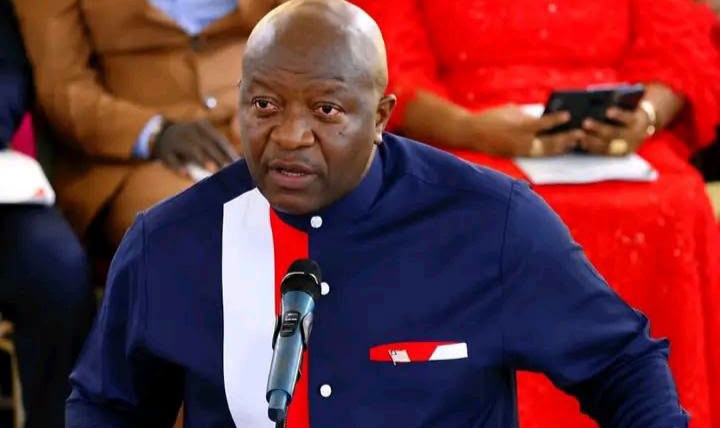
MONROVIA, LIBERIA — Finance and Development Planning Minister Augustine Kpehe Ngafuan has challenged Liberians to move beyond ceremonial patriotism and demonstrate their love for country through integrity, responsible citizenship, and service to the national good.
Delivering Liberia’s 179th National Flag Day oration Monday on the theme “From Heritage to Hope: The Flag that Unites Us,” Ngafuan said the Lone Star should not be merely waved, saluted or displayed, but should inspire Liberians to build a more united, peaceful, and prosperous Liberia.
“Patriotism is not only what we say about Liberia. Patriotism is what we do for Liberia,” Ngafuan declared.
He said wearing national colors, singing the national anthem, and waving the Liberian flag are easy expressions of patriotism, while the harder task is living according to the responsibilities the flag represents.
“A citizen who refuses corruption even when nobody is watching, is raising the flag,” he said, listing public officials who protect resources, teachers who educate diligently, health workers who care for patients, security officers who enforce the law fairly, businesspeople who pay legitimate taxes, and journalists who responsibly pursue the truth.
‘Above all those uniforms flies one flag’
Ngafuan used the symbolism of the national flag to make a forceful appeal for unity across Liberia’s political, county, tribal, religious, and social divisions.
He said Liberians may belong to different groups and hold sharply different political views, but their differences should never eclipse their shared national identity.
“We can disagree and still be Liberians,” he said, adding that, “Our party-centricity must never undermine our country-centricity.”
“There must always be something above everything else,” Ngafuan stated, adding, “That something is Liberia.”
The finance minister also urged Liberians to stop stereotyping people based on their political, tribal, county or religious affiliations, arguing that people should instead be judged by their character, actions, and contribution to the common good.
Public office means greater responsibility
Ngafuan noted that holding public office does not give anyone greater ownership of Liberia. Rather, it places a greater responsibility on the officeholder to serve the country.
Describing Liberia as a “common enterprise” in which every citizen is a shareholder, he said the ballot gives every voter equal ownership of the Republic.
“Public office therefore does not increase one’s ownership of Liberia. It increases one’s responsibility to Liberia,” he emphasized.
He then extended that responsibility beyond government, saying, pastors, imams, teachers, political leaders, journalists, influencers, business executives, health professionals, and community leaders all wield influence and must therefore exercise it responsibly.
“Wherever influence exists, responsibility follows,” Ngafuan noted.
Development as force for unity
Ngafuan linked national unity directly to economic and social development, arguing that roads, electricity, schools, and healthcare can bring Liberians together in ways political rhetoric cannot.
“One of the effective ways to unite a country, is to develop the country,” he stated.
He cited government’s efforts under President Joseph Boakai to expand roads, electricity, education, healthcare, jobs and economic opportunities, stating that the government is working to expand the fiscal space needed to finance national development.
Ngafuan further announced that Liberia is expected to reach a US$1 billion domestic revenue milestone in September, describing it as the first time in the country’s history.
He cautioned, however, that a larger budget has value only if it produces tangible improvements in citizens’ lives.
‘We can win without hatred’
Ngafuan also delivered a pointed message on Liberia’s political culture, calling on political actors to compete without treating opponents as enemies.
“We can compete politically without hating one another,” he stated, adding, “We can disagree without becoming enemies.”
He rejected politics built around the idea that one Liberian must lose for another to succeed, warning that hatred ultimately damages the entire country.
He then proposed a “Patriotic Covenant” centered on values including putting Liberia first, pursuing political power peacefully, protecting public resources, rejecting corruption regardless of who commits it, respecting truth, and upholding the Constitution and the rule of law.
“These should not be government values or opposition values,” he stated, indicating, “They should be Liberian values.”
‘What would the flag see’
Near the close of his oration, Ngafuan turned the symbolism of Flag Day to a challenge to the nation.
Rather than asking what Liberians see when they look at the flag, he asked what the flag would see if it could look back at them.
Would it see national leaders putting national interest above personal gain? Citizens protecting public resources? Political opponents disagreeing without hatred? Young people equipped with opportunity? And would it see hope becoming stronger than despair?
“Those questions cannot be answered by this speech,” Ngafuan noted, pointing out that, “They will be answered by our actions.”
He closed with perhaps the clearest message of his address: Liberia’s flag was inherited from previous generations, but the country beneath it must be built by the present generation.
“The flag cannot raise itself,” he said, adding, “We raise the flag when we raise our standards. We raise the flag when we raise our integrity.”
Ngafuan then urged Liberians to “live the flag,” serve Liberia rather than merely salute it, and put country above self.
“May the Lone Star forever unite us,” he concluded.
See more Liberia News Network stories in Google Search by adding LNN as one of your Preferred Sources.
★ Add LNN as a Preferred Source