
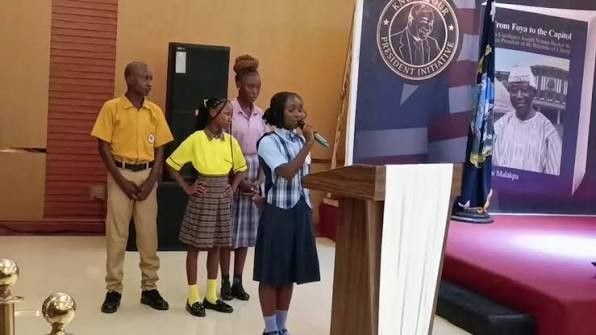
MONROVIA – The real test of a president’s biography may lie not on its pages but in young minds. At the relaunch of From Foya to the Capitol, four young students became the unexpected heart of the program. Each drew a lesson from President Joseph Nyuma Boakai’s climb from rural Foya. Their reflections offered the clearest evidence yet for a bolder idea. Organizers want presidential life stories folded into Liberia’s school curriculum as tools of character formation. The students cited service, resilience, education, and patriotism over power. Whether such lessons can survive translation into a national program remains untested. For now, the initiative rests largely on the enthusiasm of a few teenagers. THE ANALYST reports.
The story of President Joseph Nyuma Boakai’s journey from humble beginnings in Foya, Lofa County, to the presidency of Liberia is emerging as a powerful source of inspiration for young Liberians, with students who read his biography saying the experience has strengthened their commitment to education, hard work, honesty, patriotism and service.
The students made the revelation during the relaunch of From Foya to the Capitol, a biography of President Boakai authored by Dr. Sakui Malakpa, where four young participants of the Emerging Leaders Mentorship Fellowship Program presented reflections on what they learned from the President’s life.
Their testimonies provided perhaps the clearest demonstration of the educational potential of the “Know Your President” initiative, a program designed to expose Liberian students to the lives, experiences and values of the country’s presidents and use those stories as sources of inspiration and leadership lessons.
For the students, President Boakai’s story was not simply the biography of a man who eventually occupied Liberia’s highest office. It was a lesson that one’s circumstances do not have to determine one’s destiny.
Brenda S. Morris, a student of Damifa School in the Barnesville area, captured that message when she told the gathering that President Boakai’s journey had taught her and her fellow young people that where a person begins does not necessarily determine where that person will end.
“We are young people with dreams, questions, and a deep desire to understand the story of the country we call home,” Morris said.
She explained that the biography exposed students to the President’s beginnings, challenges, experiences and eventual rise to national leadership.
“For us as young people, this story is more than the biography of one man. It is a reminder that where he begins does not have to determine where you end,” she said.
Morris said the President’s life demonstrates that circumstances can shape an individual but should not become a permanent barrier to achievement.
Her reflection underscored what organizers believe is one of the central objectives of the “Know Your President” initiative—to move the stories of national leaders beyond historical records and make them relevant to the dreams and aspirations of young Liberians.
Leadership Is About Service
For Abraham B. Kollie Jr., a student of Christian Academy School of Excellence, the most important lesson from President Boakai’s life was that leadership should be measured by service rather than power or position.
Kollie said the biography showed him a President who, despite advancing from various positions in public service to the vice presidency and ultimately the presidency, remained humble and committed to serving others.
“Three things I learned from the President are: serve where you are, stay humble and be faithful,” Kollie said.
“What inspired me about the President is he showed greatness is based on service, not power. That is the leader I want to become.”
Kollie’s reflection suggests that the biography is achieving something beyond simply informing students about the President’s past—it is prompting them to think about the kind of leaders they themselves want to become.
The lesson of service, he suggested, is applicable not only to those who eventually occupy political office but to every young person seeking to contribute meaningfully to society.
Education as a Pathway to Transformation
Another powerful theme that emerged from the students’ testimonies was the transformative power of education.
Jamestina, an 11th-grade student of Miracle Academy International in Paynesville, said President Boakai’s determination to pursue education despite difficult circumstances was one of the aspects of his life that affected her most.
She recalled the President’s early schooling in rural Foya and the challenges he faced, including limited resources and the long distances associated with obtaining an education.
For Jamestina, those experiences demonstrate that poverty and difficult circumstances do not have to prevent a young person from achieving his or her dreams.
“What inspired me most from his life story is his resilience in hardship,” she said.
She described education as “a bridge from village to vision,” pointing to the President’s eventual movement from Lofa County to Monrovia in pursuit of higher education and his subsequent rise through public service.
“Education was indeed the tool that moved him from Foya to the Capitol Building,” she declared.
The student said the President’s story had reinforced her belief that determination to learn could transform an individual’s life, regardless of background.
She also highlighted the values of faith, honesty and resilience as important elements of the President’s journey.
Determination in the Face of Adversity
A separate student reflection focused specifically on determination, emphasizing the importance of persistence when pursuing one’s dreams.
The student said President Boakai’s life demonstrated that success requires patience, commitment and the willingness to continue even when circumstances become difficult.
“Where you start does not decide where you will end,” the student said, drawing a direct lesson from the President’s journey.
The student identified three personal commitments inspired by the biography: remaining determined in pursuing education and dreams, exercising patience and using whatever achievements are attained to help others.
The testimony suggested that the biography has the potential to encourage young people to view success not merely as personal advancement but as an opportunity to contribute to society.
Patriotism and Love for Liberia
Catherine J. Mahn, a ninth-grade student of Best Brain Academy, focused her reflection on what she described as President Boakai’s unconditional love for Liberia.
She said his journey reflects decades of commitment to the country, beginning with his early life and continuing through his service as Minister of Agriculture, Vice President and now President.
According to Mahn, the President’s life demonstrates that patriotism should be expressed through action and service rather than words alone.
She said his example encourages young Liberians to work hard, remain committed to their dreams and recognize that every citizen has a role to play in improving Liberia.
The lesson she drew was particularly relevant to the broader objective of the “Know Your President” initiative: leadership should not be viewed solely as occupying an official position, but as the willingness to serve others and make a meaningful contribution to society.
“True leadership is not about exerting dominance. It’s about helping others and making a meaningful difference,” Mahn said.
From Biography to Character Building
Taken together, the students’ testimonies reveal a common thread: President Boakai’s biography resonated with them because it presented leadership through the lens of character.
The students repeatedly returned to values such as hard work, education, resilience, humility, faith, honesty, patriotism and service.
That response provides a compelling argument for expanding the “Know Your President” initiative, particularly its proposed incorporation of abridged presidential biographies into educational materials.
Director of Cabinet Nathaniel Kwabo said the broader objective is to ensure that Liberian students can learn from the lives of those who have occupied the highest office in the country.
He said biographies of former presidents could eventually be abridged, translated into accessible versions and incorporated into the Liberian curriculum so that students can study how national leaders emerged from different backgrounds, overcame challenges and contributed to society.
The approach effectively turns history into a tool for character formation.
Rather than presenting leadership as something distant from ordinary citizens, the initiative seeks to show young people that leaders also began as students, faced hardship, made choices and had to overcome obstacles before reaching positions of influence.
A Message for Liberia’s Emerging Leaders
For the young people who participated in the program, President Boakai’s story appears to have moved from the pages of a book into a personal challenge.
The students did not merely recount events from his life. They interpreted those events through their own aspirations. One saw the power of service. Another saw education as a pathway out of limitation. Another drew strength from resilience and determination. And another saw patriotism and love for Liberia as values that should guide the next generation.
That convergence may ultimately become the greatest value of the “Know Your President” initiative.
If the stories of Liberia’s leaders can encourage students to work harder, remain honest, pursue education, respect others, serve their communities and develop a deeper commitment to Liberia, then presidential biographies can become more than historical documents—they can become instruments for shaping responsible citizens.
President Boakai himself has repeatedly emphasized the importance of collective national responsibility, urging Liberians to “Think Liberia, Love Liberia and Build Liberia.”
For the students who reflected on his life, that message appears to have found a receptive audience.
Their testimonies suggest that From Foya to the Capitol is not simply telling young Liberians where President Boakai came from. It is challenging them to consider where they can go—and what kind of citizens and leaders they can become along the way.
