
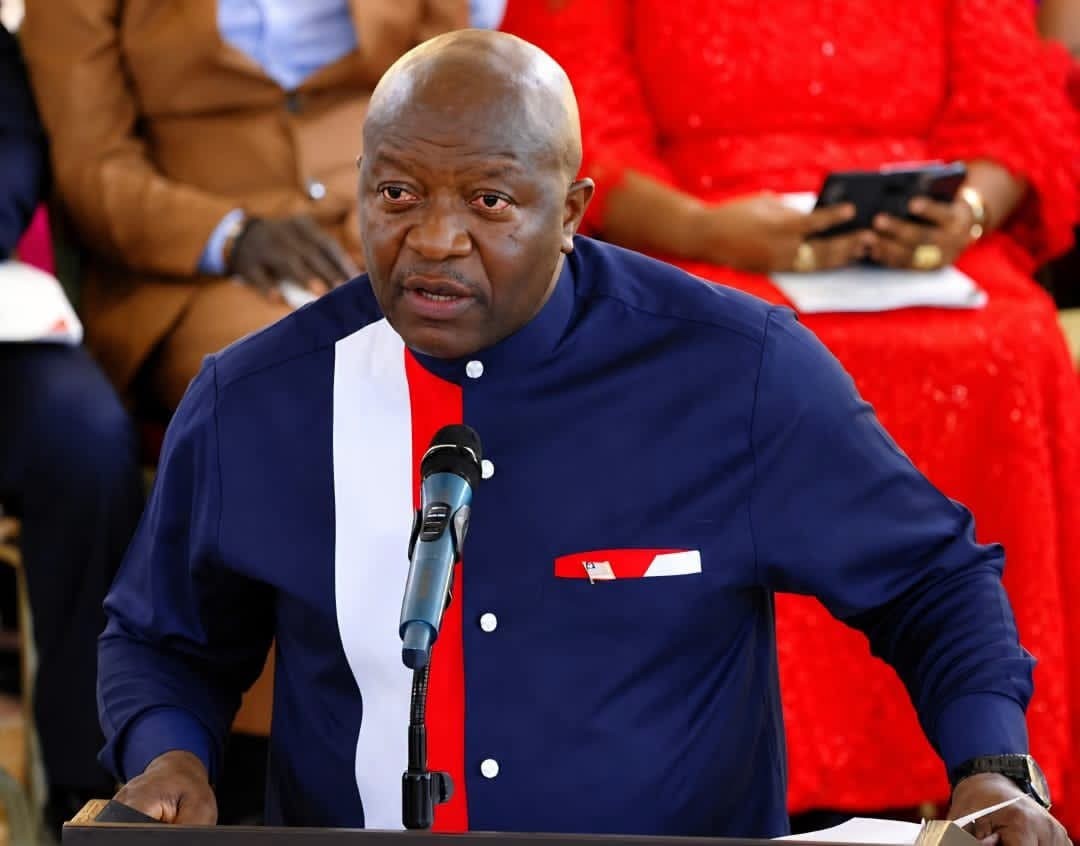
MONROVIA – Finance Minister Augustine Kpehe Ngafuan used Liberia’s 179th National Flag Day to confront the gap between patriotic display and national duty. His proposed ‘Patriotic Covenant’ framed the Lone Star as a test of conduct: whether leaders and citizens can place Liberia above party, tribe, county and private advantage; protect resources; reject political hatred; and judge wrongdoing by one standard. The speech also tied unity to material results, arguing that roads, electricity, schools, healthcare and opportunity give citizens a stake in the republic. Its central warning was unmistakable: ceremonies cannot sustain hope where office becomes privilege, accountability changes with political loyalty, public influence is abused and peace is treated as permanent, THE ANALYST reports.
A National Symbol, A Civic Test
Delivering the national oration on Monday, August 24, 2026, under the theme ‘From Heritage to Hope: The Flag That Unites Us,’ Ngafuan said the flag must be understood as more than cloth, color or inherited history. He described it as a reminder of Liberia’s past, a marker of its shared identity and a promise that the present generation owes to those still to come.
The eleven alternating red and white stripes and the lone white star on a blue field, he said, have flown through political transitions, civil war, national mourning, public-health emergencies and reconstruction. Their endurance, however, does not by itself settle the question of national unity; the meaning of the flag must be demonstrated through how Liberians govern, disagree, work and protect the common good.
From Bolahun To The National Podium
Ngafuan grounded that argument in a personal memory from August 24, 1978, when he was a first grader at Bolahun Public School in Wawoma Clan, Kolahun District, Lofa County. Wearing a white shirt and green short trousers, he marched with other pupils as students from surrounding village schools converged on Bolahun and families lined the paths to cheer drill teams saluting the flag.
Nearly five decades later, he said, the child who marched in Bolahun could not have imagined becoming the country’s Flag Day orator. He turned that experience into a broader claim about citizenship: the opportunity to rise beyond the circumstances of birth should not be exceptional, but part of a Liberian promise available to every child, wherever that child begins life.
‘My country sees me. The circumstances of my birth do not determine the boundaries of my possibilities. My dreams matter,’ he said, presenting those words as the assurance every Liberian child should be able to draw from the Lone Star. For Ngafuan, the flag’s credibility therefore depends partly on whether national institutions make that promise real through education, opportunity and inclusion.
Unity Without Uniformity
The minister rejected the idea that national unity requires identical views or loyalties. Pointing to students in different uniforms and formations saluting one flag during the day’s parade, he said Liberia can contain political, county, ethnic, religious and professional differences without permitting those identities to outrank the republic.
He recalled an argument he made in 2010 before the Federation of Lofa Associations in the Americas: county-centered loyalty must never undermine loyalty to Liberia. Extending that warning to present politics, he declared that party-centered loyalty must likewise yield whenever it conflicts with the national interest, because ‘there must always be something above everything else,’ and that something must be Liberia.
Ngafuan also urged citizens to ‘individuate’ — to judge people by their conduct, values and contribution rather than treat membership in a government, party, county, tribe or religion as proof of virtue or guilt. Every institution, he argued, contains its good, bad and ugly because each is populated by imperfect people; neither service in government nor life outside it automatically establishes a person’s character.
Patriotism Must Become Practice
Ngafuan welcomed the growing enthusiasm with which Liberians at home and abroad wear national colors and celebrate Independence Day. But he warned that patriotic emotion is incomplete when it does not produce responsible conduct, saying the harder duty is not to display the flag but to live by what it demands.
He defined patriotism through daily choices: a public official protecting state resources, a prepared teacher entering the classroom, a health worker caring faithfully for patients, a security officer rejecting drug money, a business paying legitimate taxes, a journalist pursuing truth responsibly and a citizen refusing corruption even when no one is watching. Each act, he said, amounts to raising the flag because love of country without responsibility to country is unfinished.
The flag displayed in public offices, he added, should never be treated as decoration. It represents millions of Liberians and should remind every official that government space is not a private platform for personal enrichment, but a public trust in which the republic is watching and counting on those temporarily seated beside its symbol.
Influence Creates Responsibility
Comparing Liberia to a common enterprise in which every citizen is a shareholder, Ngafuan said officeholders do not own a larger portion of the country than ordinary citizens. On election day, he observed, the president and a fisherman in West Point each hold one ballot; office therefore enlarges responsibility, not ownership.
He broadened the meaning of leadership beyond government to include pastors, imams, teachers, party officials, talk-show hosts, journalists, bloggers, businesspeople, union officials, health professionals, sports figures and community organizers. Wherever a person can influence what others believe or how they behave, he said, responsibility follows — whether that influence comes from a microphone, pulpit, classroom, political platform or social-media audience.
The Tragedy Of Common Ownership
The minister warned that shared ownership can produce a destructive contradiction: because Liberia belongs to everyone, citizens sometimes behave as though it belongs to no one. Invoking the economic idea of the ‘tragedy of the commons,’ he said private convenience and group loyalty repeatedly weaken the public interest.
He cited citizens who demand clean cities while throwing garbage from vehicles, call for a larger national budget while evading taxes, or demand law enforcement until a friend or relative is arrested. He also challenged those who denounce corruption in opponents but excuse it when the accused belongs to their party, county, tribe, church, family or circle of friends.
Protecting the flag, he argued, means accepting personal responsibility for property, institutions and standards that belong collectively to Liberians. The republic cannot be preserved by abstract affection if individual conduct continually transfers public costs onto everyone else.
Development As An Instrument Of Hope
Moving from heritage to hope, Ngafuan said national hope cannot remain a wish; it must be planned, financed and protected by institutions, discipline, sacrifice, hard work, innovation and what he called Liberia’s ‘thinking equity.’ He presented the Boakai administration’s ARREST Agenda for Inclusive Development as the government’s framework for translating aspirations into projects and measurable improvements.
The finance minister said the administration is working to expand roads, electricity, schools, healthcare, jobs and institutional capacity. He predicted that, within a few years, Liberians would be able to travel on paved roads from Monrovia to Harper and from Gbarnga through Zorzor, Voinjama, Kolahun and Foya toward Mendikorma on the Sierra Leone border — routes he characterized as long-standing national dreams.
He also referred to electricity expansion in Monrovia, Buchanan, Voinjama and other communities, improvements to health facilities and plans to rehabilitate or construct more than 100 schools for foundational learning. Inclusive development, he argued, can unify because roads, electricity, hospitals and classrooms serve people without asking for their party, tribe, county or voting history.
Ngafuan further announced that Liberia was expected to reach a historic billion-dollar national budget in September, which he said would be the first time since the country’s founding. He cautioned that the size of the budget is not an achievement by itself; its value must be measured by roads built, electricity expanded, schools and healthcare improved, jobs created, institutions strengthened and lives changed.
Competition Without Hatred
Development will not unite Liberia if politics continually tears it apart, Ngafuan warned. He rejected zero-sum politics in which one person’s rise requires another’s destruction, saying Liberians must learn to compete vigorously without cruelty and to pursue victory without treating opponents as enemies.
A political office, he noted, belongs to the Liberian people rather than to those competing for it. When hatred becomes the organizing principle of public life, the damage eventually reaches every side, eroding the peace and institutional stability required for any government’s program to succeed.
A Minimum Patriotic Covenant
At the center of the address was Ngafuan’s proposal for a minimum Patriotic Covenant: a shared set of national values that government and opposition, Christians and Muslims, young and old, and rich and poor could accept regardless of their other disagreements. The proposal sought to define a floor beneath political competition — principles that no legitimate contest for power should be permitted to break.
He said such a covenant should affirm that Liberia comes first; political power must be pursued peacefully; public resources belong to the people; corruption is wrong regardless of the offender; truth matters; differences cannot justify hatred; the Constitution and rule of law must prevail over personalities; and no political victory is worth destroying the country. Each generation, he added, has a duty to leave the republic stronger than it inherited it.
These, he stressed, should not be classified as government values or opposition values, but as Liberian values. The analytical force of the proposal lies in its demand for consistency: a principle ceases to be national when citizens invoke it only against adversaries and suspend it for allies.
Peace, Speech And The Flag’s Verdict
Ngafuan closed by warning that peace must never be treated as self-sustaining. Liberia’s history, he said, shows that division can destroy in a few years what generations struggled to build, making responsible speech essential on political platforms, radio programs, pulpits, at community meetings and online.
A microphone can educate or inflame, a radio program can inform or divide, and a social-media post can build bridges or deepen fractures, he said. Liberian children, he argued, deserve to inherit the country’s progress rather than the divisions, hatred and anger of the present generation.
He then reversed the traditional Flag Day question, asking not what citizens see when they look at the flag, but what the flag would see if it could look back: leaders placing national interest above self, young people equipped with opportunity, opponents disagreeing without hatred, public resources becoming services and integrity growing stronger than despair. Those questions, he said, will be answered not by speeches but by conduct.
‘The flag cannot raise itself,’ Ngafuan declared, urging Liberians to raise it by raising their standards, integrity, children and one another. He ended with a call to move beyond waving and saluting the Lone Star toward serving the republic and building the better Liberia that the flag is supposed to represent.
