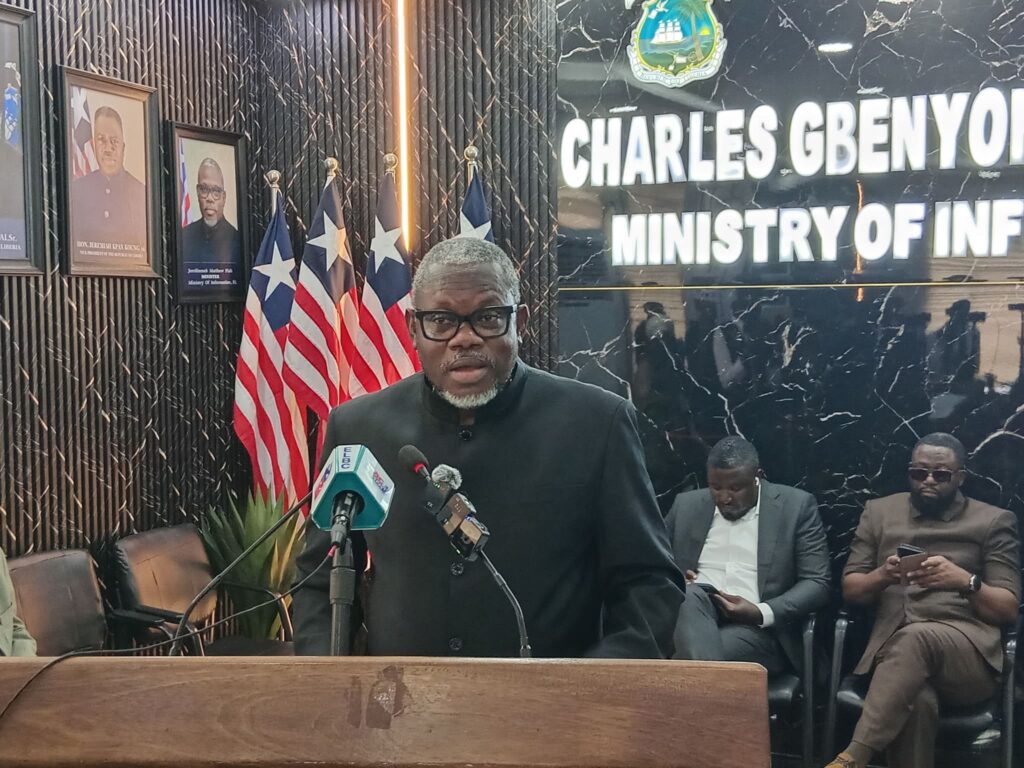
MONROVIA, LIBERIA – Information Minister Jerolinmek M. Piah has strongly rejected claims that Liberia is sliding into tyranny following the criminal proceedings against former Vice President Jewel Howard-Taylor, insisting that the government’s handling of the case reflects the operation of the country’s judicial system rather than political persecution.
Piah made the assertion Tuesday, August 25, 2026, during the Ministry of Information press briefing as he addressed mounting political controversy surrounding the former vice president’s arrest, detention, medical emergency and subsequent arraignment on drug-related charges.
His comments came after a former Liberian leader characterized the legal proceedings involving Howard-Taylor as evidence that Liberia was moving toward tyranny.
Piah dismissed that characterization, arguing that the existence of a legal proceeding cannot, by itself, constitute tyranny when authorities are relying on established judicial procedures.
“We believe that when individuals are in conflict with the law and the law is being used to seek redress, it’s far from tyranny,” Piah said.
He argued that individuals facing criminal allegations should be encouraged to submit themselves to due process rather than obstructing legal proceedings.
Piah’s defense of the government’s position comes as Howard-Taylor faces serious allegations under Liberia’s drug laws.
He said the former vice president had been arraigned at the Monrovia City Court, meaning the case had formally moved under the jurisdiction of the judiciary.
Piah explained that arraignment represents an important stage in the criminal process because the accused is formally informed of the charges by the court, advised of her rights and given an opportunity to enter a plea.
He said the accused may plead guilty or not guilty and that, where applicable, issues surrounding bail would be addressed through the court.
According to Piah, once an accused person has been placed under judicial jurisdiction, decisions concerning the continuation of the proceedings are no longer simply matters for the executive branch.
He emphasized that Liberia’s constitutional structure provides for three separate branches of government and argued that the judiciary must be allowed to perform its responsibilities without political interference.
Piah also addressed concerns surrounding Howard-Taylor’s detention, particularly after she reportedly experienced a health emergency and was allowed to receive medical treatment.
He said the government had allowed her to seek medical attention and that her subsequent appearance before court represented another stage of the legal process.
The Minister nevertheless acknowledged the sensitivity of the case and used the opportunity to criticize what he described as hypocrisy in public discussions about criminal proceedings.
He questioned why some critics demand different treatment for individuals because of their political status while accepting harsher treatment of other accused persons in previous administrations.
Piah specifically recalled the treatment of a former chief justice who, according to his account, was handcuffed and transported in the trunk of a pickup truck after being accused of murder.
He contrasted that episode with the government’s handling of Howard-Taylor, arguing that the current administration has sought to ensure that accused persons are treated through lawful procedures rather than humiliation or excessive force.
“We disagree with those kinds of treatment and how we do it differently,” Piah said.
He maintained that an individual accused of a crime should be presumed innocent until proven guilty, while simultaneously insisting that the criminal justice system must be permitted to determine the truth through trial.
Piah warned against what he described as attempts to incite the public against ongoing judicial proceedings.
He argued that political leaders have a responsibility to respect the law and avoid statements that could undermine public confidence in the judiciary.
The Minister also offered his definition of tyranny, arguing that it should be associated with abuses of state power rather than the lawful prosecution of criminal allegations.
He cited extrajudicial killings, the alleged brutalization of ordinary citizens by public officials and the misuse of state institutions as examples of conduct that, in his view, would more appropriately constitute authoritarian abuse.
Piah also accused previous leadership of allowing impunity and referred to alleged incidents involving the Central Bank and public funds, as well as the prolonged absence of a former national leader from the country.
His remarks turned the debate from the Howard-Taylor case itself toward the broader question of how Liberia’s governments have historically treated people accused of crimes.
The Minister’s central argument was that Liberia cannot claim to be governed by the rule of law while simultaneously demanding that certain individuals be exempted from legal proceedings because of their political status.
He said Howard-Taylor’s former position as vice president should not place her beyond the reach of the law.
At the same time, Piah stressed that the ongoing case should be resolved through the courts rather than political statements.
See more Liberia News Network stories in Google Search by adding LNN as one of your Preferred Sources.
★ Add LNN as a Preferred Source