
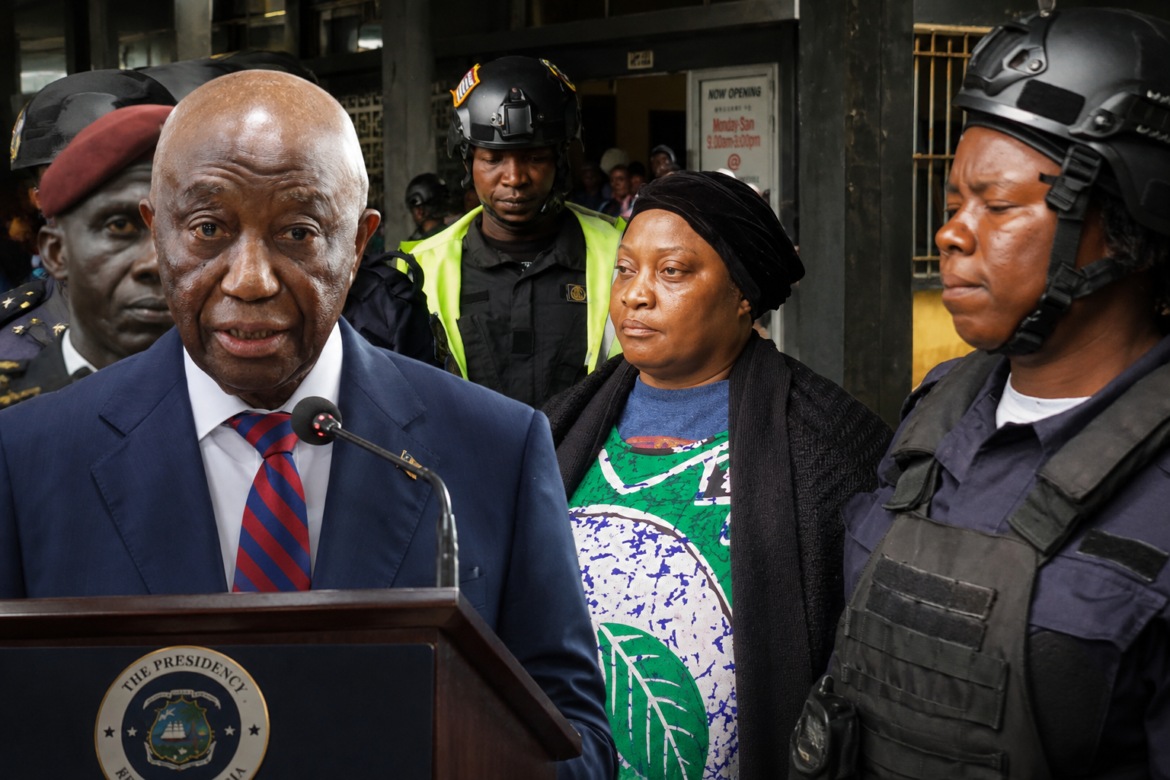
President Joseph Boakai told the nation Wednesday that his drug war spares no one. The record so far tells a more complicated story — and the former First Lady’s rough road from hospital bed to prison cell is only the latest chapter.
SUMMARY: In his national address, President Boakai insisted his anti-narcotics campaign follows the law “without fear or favor” and targets conduct, not politics. But eight months into Liberia’s biggest drug scandal, the pattern on the ground looks uneven: junior airport clerks and mid-level officers have faced swift punishment, while questions about who financed and protected the trade at the top remain largely unanswered. Jewel Howard-Taylor’s fall — from VIP passenger to prison inmate within a week — has become the flashpoint for a question opposition leaders, civil society, and now even a member of the president’s own political family are asking out loud: is this justice, or is it selective?
By Rodney D. Sieh, [email protected]
MONROVIA — President Boakai told the nation this week that his government would enforce the law “without fear or favor,” that no one is too powerful to face it, and that his crackdown on narcotics is not a hunt for political enemies. It is a line he has repeated since the scandal broke: no sacred cows.
Liberians have heard that promise before. What they are watching now is whether it holds.
A tale of two treatments
The clearest test case sits in a cell at Monrovia Central Prison. Jewel Howard-Taylor — Liberia’s First Lady during Charles Taylor’s presidency and, decades later, Vice President under George Weah — was stopped at Roberts International Airport on August 19 as she tried to board a flight out of the country. Within a week she had been charged on a seven-count indictment alleging she took more than $135,000 from figures tied to a cocaine cartel, hospitalized under guard for asthma and high blood pressure, denied compassionate release by a judge who said only the Justice Ministry could grant it, and moved into general population at South Beach.
Her party, the Coalition for Democratic Change, has called the process degrading and accused the government of weaponizing the justice system against a political rival. The opposition Alternative National Congress went further, telling the administration directly that it appears eager to “cast a wider net” that catches CDC-aligned figures while leaving others untouched.
Compare that trajectory to the pace of accountability elsewhere in the same investigation. When Boakai purged security officials over the record $317 million cocaine seizure in July, the dismissals fell on an airport security director, a deputy police commissioner, NSA deputies, and Drug Enforcement Agency officers — the operational layer of the scandal. An earlier allAfrica analysis of the case put the concern plainly: charges have concentrated on lower-level figures in the cargo and screening chain, while whoever financed and protected the operation at a more senior level has not been touched. If the investigation stops there, the analysis warned, it would confirm the very pattern of selective accountability that Boakai was elected to end.
He was elected on exactly that promise. That is what makes the gap between rhetoric and result politically dangerous for him.
The president is not the only one asking the question
What makes this moment different from ordinary opposition griping is who else is asking it. Dr. Clarence Moniba of the Liberian National Union — not a CDC figure — this week publicly challenged Boakai to prove the drug probe is free of political favoritism, calling for an independent three-member panel to review whether cases are being pursued consistently. His test for the president was direct: does the campaign actually show that no one, regardless of office or connections, sits beyond the law’s reach?
Even a party sympathetic to the administration’s anti-corruption push, the RNC, coupled its praise for the $317 million probe with an explicit warning against selective justice and a call to fight corruption equally across the political spectrum.
That is a notable chorus. It is not just Howard-Taylor’s allies complaining about her treatment — it is a broader, cross-partisan unease about whether the people closest to power, or with the right friends inside it, are being handled more gently than a former official from a rival camp.
What “no sacred cows” would actually require
Boakai’s own government has, to be fair, produced real numbers: a dozen officials sacked in a single sweep, NSA and airport personnel referred for prosecution, U.S. and Rwandan investigators brought in to internationalize the probe. That is more institutional accountability than Liberia saw during the previous administration’s own cocaine scandal, which collapsed in court amid accusations of a cover-up.
But numbers of dismissals are not the same as evenness of consequence. The unresolved question — the one Moniba is asking, the one the ANC is asking, the one hanging over Howard-Taylor’s prison cell — is whether the people with the money and the protection at the top of the network will face the same swiftness the mid-level operators already have. Until an indictment reaches that level, “no sacred cows” remains a promise made in a speech rather than a fact on the ground.
For a president who staked his legitimacy on breaking Liberia’s old habit of selective justice, that is the standard his own words have set. His government does not get to grade its own homework on it.
Support Independent Journalism
Your support helps FrontPage Africa continue delivering independent, credible, and impactful journalism. Every contribution strengthens our ability to investigate, inform, and hold power accountable while keeping quality journalism accessible to our readers.
Support our journalism or subscribe to receive the latest FrontPage Africa stories and updates.
