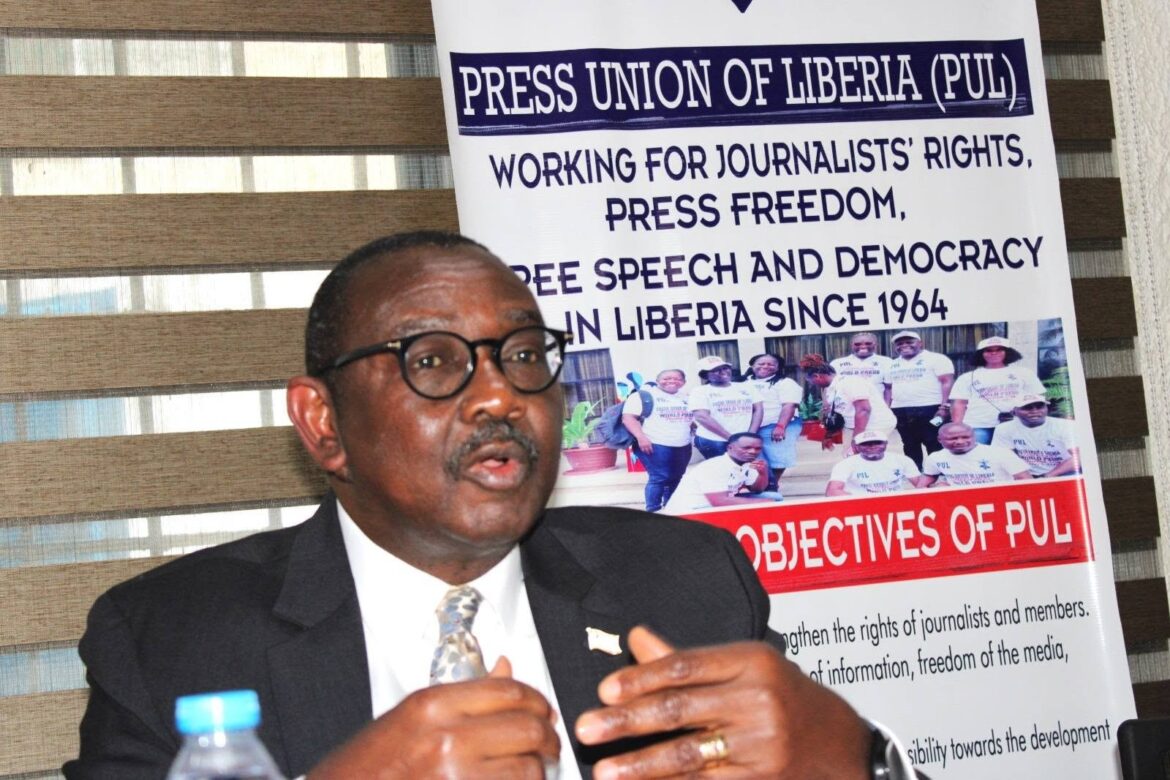
Justice Minister N. Oswald Tweh has declared an offensive against drug trafficking, but his address also conceded the institutional weakness at the centre of Liberia’s cocaine crisis: seizures demonstrate enforcement success while simultaneously revealing that narcotics penetrated chains of handling, screening and transportation. Defending the Boakai administration against accusations of inaction, Tweh cited seizures, hundreds of arrests and cooperation, yet said celebration must give way to evidence capable of reaching financiers, facilitators, politicians, businesspeople and compromised security officers. His promise is sweeping and measurable. If prosecution stops with couriers while powerful enablers escape, the government’s battlefield rhetoric will collide with the selective justice and institutional failure it says it intends to defeat, as THE ANALYST reports.
State Draws Battle Line
MONROVIA: Justice Minister and Attorney General Cllr. N. Oswald Tweh has declared that Liberia will not surrender to drug traffickers, promising that the government will pursue criminal networks wherever credible evidence leads while keeping prosecutions within the boundaries of due process and the rule of law.
Cllr. Tweh said the administration’s response to Liberia’s expanding drug crisis had moved beyond political speeches. He pointed to major narcotics seizures, hundreds of arrests and coordinated investigations as evidence that the state had begun confronting traffickers with determination.
The Attorney General delivered the remarks Wednesday, August 26, 2026, during the relaunch of the Edward Wilmot Blyden Intellectual Discourse at the Press Union of Liberia headquarters on Warner Avenue in Sinkor.
The discourse was held under the theme, “Confronting Drug Trafficking: Strengthening Institutions, Advancing Accountability, and Safeguarding the Rule of Law.” Government officials, lawmakers, lawyers, journalists and civil-society representatives attended the event.
Drug Money Threatens Freedom
Tweh said the forum’s theme addressed one of Liberia’s defining struggles. Narcotics trafficking, institutional corruption and organized crime, he argued, threaten the freedom, security and future of the Liberian people.
The Justice Minister warned that narcotics do more than violate the country’s criminal laws. Drugs destroy young people, weaken families, finance organized criminal networks, corrupt public institutions and undermine the state’s capacity to govern.
“A country that allows drugs and drug money to capture its communities and institutions cannot claim to be fully free,” Tweh said. He presented the campaign against drugs as a struggle to prevent criminal wealth from acquiring influence over public authority.
His warning came amid continuing public anxiety over massive cocaine seizures and allegations that persons connected to Liberia’s security apparatus may have facilitated or protected drug-trafficking operations.
Those allegations have shifted the national discussion beyond the narcotics recovered. Public attention is now concentrated on how such enormous consignments entered Liberia, who financed their movement and whether state institutions were compromised.
Government Lists Enforcement Record
Tweh cited several law-enforcement operations to defend the government against claims that it had failed to respond decisively. During the first quarter of 2026, he said, the Liberia Drug Enforcement Agency seized more than 400 kilograms of illegal narcotics and arrested over 200 suspects.
He also referred to the interception of approximately 237 kilograms of cocaine at Roberts International Airport in June. Authorities later uncovered nearly four metric tons of cocaine in Duazon, described as the largest narcotics seizure in Liberia’s history.
At the end of July, drugs valued by the government at more than US$336 million were destroyed publicly in Margibi County. Tweh said the seizure and destruction resulted from coordinated work by the LDEA, Liberia National Police, prosecutors, investigators and other security institutions.
“These are not slogans. These are concrete actions,” the Justice Minister declared. He credited the operations to law-enforcement personnel working with the direction, support and political will of the Boakai administration.
Tweh said the government’s commitment should be measured through the seizures, arrests, investigations and prosecutions already initiated. He maintained that those actions contradicted accusations that the administration had remained inactive in the face of the crisis.
Republic Will Prevail
“Our sleeves are rolled up, and the battle line between the drug cartels and the Liberian State has been clearly drawn,” Tweh told the gathering. He vowed that government would neither accommodate criminality nor surrender to people profiting from the destruction of Liberians.
According to him, traffickers may challenge the authority of the state, but they will not defeat it. The government and its justice institutions, he said, would remain engaged until the law had taken its course.
“The Republic of Liberia will prevail, not through vengeance or political persecution, but through strong institutions, credible evidence, due process, and the unwavering enforcement of the law,” he declared.
That qualification carried considerable weight. The government is under pressure to act forcefully against suspected traffickers while avoiding prosecution shaped by political convenience, public emotion or unsupported accusations.
Tweh said firmness and legality must remain inseparable. A campaign that arrests people without credible evidence or abandons constitutional safeguards would weaken the same Republic it claims to defend.
Follow Evidence Beyond Couriers
The Justice Minister said accountability must move beyond couriers, drivers and low-level dealers to the financiers, facilitators and powerful actors directing or protecting drug-trafficking networks.
He described a chain of responsibility beginning with seizure and continuing through investigation, evidence gathering, prosecution and judicial determination. Each stage must function properly if the country is to secure credible convictions.
“Accountability must not stop with the courier, the driver or the low-level dealer while the financiers, facilitators and powerful actors remain beyond scrutiny,” Tweh warned.
The Minister said every person supported by evidence should face the law, regardless of occupation or political standing. He specifically named customs officers, security officers, businesspeople and politicians among those who must not receive protection.
“As Minister of Justice, I assure you that no one will be protected because of influence, friendship, wealth, or political connections,” he said. “All wrongdoers must account for their actions through the law.”
The promise now places a heavy burden on the government’s investigators and prosecutors. Arresting visible operatives will not satisfy a public demanding to know who owned the drugs, financed their transportation, cleared their movement and expected to profit from their distribution.
Radio Cannot Determine Guilt
Tweh also warned against convicting people through radio discussions, social-media accusations or partisan rhetoric. Public suspicion, he said, cannot replace evidence tested before a court.
“No person should be convicted because his or her name is popular on the radio, circulating on social media or politically convenient to accuse,” the Attorney General said. “That is not justice.”
He insisted that the government would not fight lawlessness by abandoning the law. Prosecutors must build cases upon credible evidence, present that evidence in court and allow judicial proceedings to determine guilt or innocence.
The Minister’s argument protected the right of government to investigate while recognizing the rights of accused persons. It also challenged public officials to avoid treating arrest, suspension or widespread accusation as the equivalent of conviction.
The same standard requires investigators to move with reasonable speed. Due process protects accused persons from arbitrary prosecution, but prolonged suspension or investigation without charge can also damage reputations, weaken institutions and encourage perceptions of selective justice.
Tweh Confronts Government Critics
The Justice Minister accused some government critics of viewing every development in the drug investigation through a narrow political lens. He said they demand action but dismiss arrests and seizures when government acts.
“They ask where the Government is; when drugs are seized, suspects are arrested, investigations are conducted, and prosecutions are pursued, they move the goalpost and pretend nothing has happened,” Tweh said.
He declared that the administration welcomed criticism but warned that “criticism must not become blindness.” The nearly four-ton Duazon seizure, he argued, could not honestly be described as evidence of government inaction.
“The fight against drugs cannot be measured by propaganda,” the Minister said. Neither should critics deny enforcement achievements merely because they have decided that no action of the administration deserves recognition.
Tweh acknowledged that Liberia’s drug problem did not begin with the Boakai government and would not disappear overnight. History, he said, would judge whether the administration looked away from the crisis or confronted it.
The government’s enforcement record deserves examination, but seizure figures cannot answer every public concern. The central questions remain whether investigators will dismantle the network, identify institutional protection and secure convictions capable of surviving appeals.
Seizures Expose State Weakness
In one of the most consequential sections of his address, Tweh admitted that every major seizure represents both an enforcement victory and evidence of institutional vulnerability.
“If narcotics can move through a chain of handling, screening or transportation, then that chain must be examined and strengthened,” he said. The movement of cocaine through protected channels, he suggested, demands an investigation into every point at which detection failed.
The Justice Minister called for stronger screening and intelligence, closer coordination among law-enforcement agencies and investigations into possible facilitation or corruption.
He said government must dismantle trafficking networks rather than merely interrupt individual consignments. A shipment may be destroyed while the financial structure, corrupt relationships and operational leadership remain intact.
For Tweh, strong institutions do not claim perfection or deny failure. They detect weaknesses, correct them, investigate wrongdoing and improve their systems.
That definition puts Liberia’s security agencies under a clear test. Their institutional strength will be measured by whether they can expose misconduct within their own ranks and hold implicated personnel to the same legal standard applied to civilians.
Coordinated Response Promised
Tweh said the Ministry of Justice and the relevant security agencies would sustain a coordinated national response. The LDEA will continue leading drug interdiction and enforcement, while the Liberia National Police and other institutions support investigations and public safety.
The Ministry of Justice, he added, will guide prosecutions and ensure that cases move through the legal process. The collective duty of government is to follow the evidence “upward, outward and wherever it leads.”
The word “upward” is particularly significant in a scandal where the public suspects that the trafficking enterprise could not have operated without influential support. It commits the investigation to look beyond the people found nearest to the cocaine.
Tweh warned traffickers and their alleged protectors that intimidation, misinformation and political noise would not weaken the campaign. The enforcement of the law, he said, would not be suspended for political convenience.
Government would accept criticism and answer legitimate questions, he promised. It would not abandon its constitutional duty because detractors refused to acknowledge what he called genuine progress.
Media Praised, Then Cautioned
The Attorney General praised Liberia’s media for reporting narcotics seizures, exposing public concerns, questioning officials and keeping national attention focused on the drug crisis.
“A free, responsible and courageous press is not an enemy of the State,” Tweh declared. He described journalism as an institution that helps government see failures it might otherwise overlook.
The Minister conveyed the appreciation of the Ministry of Justice and the government to journalists and media institutions. Their coverage, he said, had contributed to a national conversation that could not be conducted in silence.
Tweh nevertheless urged journalists to distinguish verified facts from speculation. Information should enlighten the public rather than inflame it, he argued, while legitimate scrutiny should not be presented as a substitute for evidence.
“The media has the right, indeed, the duty to ask hard questions,” he said. “Government, in turn, has the duty to answer those questions honestly and to accept scrutiny.”
That relationship imposes obligations upon both sides. Journalists must verify serious allegations, while government cannot invoke journalistic responsibility as a shield against questions it finds uncomfortable.
Rule Protects Every Side
“The rule of law cuts in every direction,” Tweh said. It gives the state authority to investigate and prosecute while protecting suspects from arbitrary action.
The same legal order protects journalists who question government and citizens who demand accountability. It also requires public officials to explain how power is exercised in a matter affecting national security and public confidence.
“If we weaken due process in the name of fighting drugs, we weaken the very Republic we claim to defend,” the Justice Minister warned.
Liberia’s obligation, he said, is not merely to appear tough. The national response must be effective, lawful, fair and unwavering.
That balance will determine the legitimacy of the drug campaign. The state must be strong enough to pursue traffickers and restrained enough to respect the rights of every accused person.
Blyden’s Legacy Invoked
Tweh described the revival of the Edward Wilmot Blyden Intellectual Discourse as symbolically important. Blyden, he said, understood the power of ideas and institutions in securing African freedom.
Born in St. Thomas in 1832, Blyden experienced racial exclusion in the United States before arriving in Liberia in 1851. He later served the Republic as Secretary of State, Minister of the Interior, diplomat, professor and President of Liberia College.
Blyden also served as editor of the Liberian Herald and used scholarship, journalism and public service to challenge doctrines of African inferiority. Tweh said he refused to retreat when his ideas became unpopular or encountered determined opposition.
The Justice Minister argued that nations are not liberated through rhetoric alone. They become stronger when courageous people build institutions, discipline public power, educate minds and refuse to surrender their future.
Drug trafficking represents one force capable of diminishing Liberia, Tweh said. Corruption, weak institutions, public indifference and the deliberate distortion of facts for political advantage pose related dangers.
Promise Must Produce Results
“We did not choose this threat. But we must choose our response,” Tweh declared. He said the Boakai administration had chosen to confront trafficking, strengthen institutions, advance accountability and safeguard the rule of law.
The speech presented a strong defence of the government and an equally strong set of commitments by which that government can be judged. It promised evidence-based prosecution, equal treatment and an investigation capable of moving beyond the lowest levels of the criminal enterprise.
Those promises will acquire meaning only through completed prosecutions and institutional reform. The state must establish who owned and financed the cocaine, how it entered and moved through Liberia, whether officials facilitated it and what measures will prevent another consignment from exploiting the same weaknesses.
The government has drawn its battle line. The remaining question is whether it will cross that line to reach every person the evidence identifies, including those protected by money, office, friendship or political influence.
See more Liberia News Network stories in Google Search by adding LNN as one of your Preferred Sources.
★ Add LNN as a Preferred Source