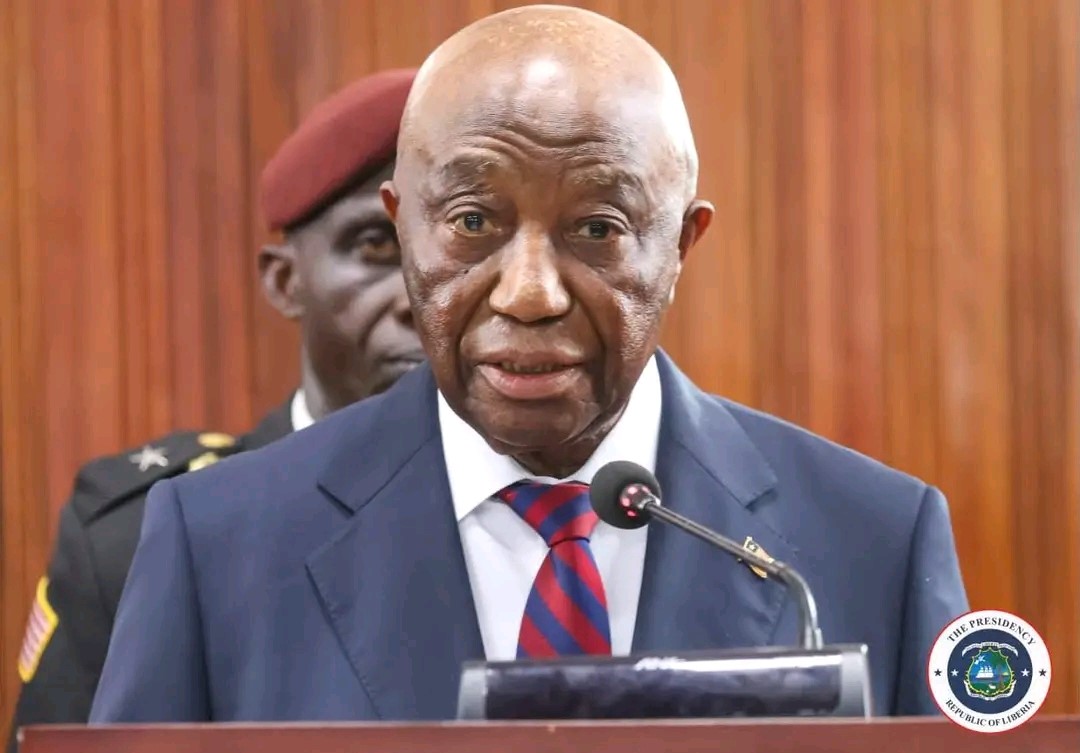
MONROVIA – President Joseph Nyuma Boakai has placed his administration’s credibility squarely on two promises under public examination: that Liberia’s drug crackdown will spare no powerful person, and that former Vice President Jewel Howard-Taylor will receive every protection guaranteed by law. His national address sought to steady a country divided between those who see her arrest as proof of a “no sacred cow” policy and those who fear political prosecution dressed in the language of national security. Boakai offered neither evidence against Taylor nor a verdict; he defended the process, assigned guilt to the courts and warned political, religious and public actors against intimidation, misinformation and violence as investigators pursue the country’s narcotics networks. THE ANALYST reports.
Justice without Fear
President Joseph Nyuma Boakai has reaffirmed that his administration will enforce Liberia’s laws without fear or favor while protecting the constitutional rights of every person, amid mounting controversy over the arrest and detention of former Vice President Jewel Howard-Taylor.
Addressing the nation Wednesday evening, August 26, 2026, President Boakai acknowledged that recent developments had generated widespread public discussion, concern and what he described as misinformation. He said the moment required him to speak directly to Liberians, offer reassurance and clarify the principles guiding the government’s actions.
The President declared that justice must be pursued firmly, fairly and independently. He reminded Liberians that his election carried a public expectation that he would uphold the Constitution, govern with integrity, strengthen state institutions and ensure that no person remains beyond the reach of the law.
Boakai placed the rule of law at the foundation of his administration’s development program. He argued that progress under the ARREST Agenda for Inclusive Development cannot be sustained if the country’s economy, education system, infrastructure and public institutions operate without equal accountability.
“None of our work in the economy, education, infrastructure, or public institutions can succeed unless it is anchored in one fundamental principle: the rule of law,” the President said.
Drugs Threaten National Survival
President Boakai described illicit drugs and organized crime as two of the gravest threats confronting Liberia. He said narcotics are destroying young people, weakening families, fuelling violence and endangering the country’s future.
The President rejected any narrow treatment of the drug crisis as an ordinary police matter. According to him, Liberia now faces a national-security and moral emergency requiring coordinated action across government and society.
His address came as the country continues to absorb the shock of massive cocaine seizures and allegations that drug-trafficking networks penetrated sections of Liberia’s security system. The resulting arrests, suspensions and public accusations have intensified demands for accountability while raising difficult questions about the credibility and independence of the institutions conducting the investigation.
Boakai said his administration had strengthened its campaign against narcotics trafficking, money laundering and organized crime. Security institutions, he disclosed, have been instructed to work professionally and independently with Liberian and international partners to prevent the country from becoming a transit point or sanctuary for criminal networks.
“This campaign is deliberate, coordinated, and unrelenting,” he declared. The effort, he said, is intended to defend Liberians, protect the country’s character and safeguard its future.
Campaign Not Political
President Boakai denied suggestions that the drug campaign was being directed against any person, political party or movement. He maintained that the government’s target is criminal conduct that threatens Liberia’s safety and stability.
“This national campaign against drugs and organized crime is not directed at any individual, party, or political movement,” he said. “It is directed at conduct that threatens the safety, stability, and future of Liberia.”
The distinction lies at the heart of the controversy surrounding former Vice President Taylor. Her arrest has produced sharply divided reactions, with some Liberians presenting the action as evidence that political status can no longer shield anyone from investigation, while others suspect that the government is using the drug crisis to weaken a prominent opposition figure.
Boakai did not address the evidence underlying the charges or attempt to argue the prosecution’s case in his national statement. Instead, he defended the legal process and insisted that political arguments must not replace judicial determination.
Taylor Presumed Innocent
The President acknowledged that the arrest and detention of former Vice President Taylor had attracted national and international attention. He assured Liberians, regional governments and international partners that authorities were treating her according to the Constitution and laws of Liberia.
Boakai stressed that Taylor remains presumed innocent, has access to legal counsel and is entitled to due process. Those protections, he promised, would be upheld throughout the proceedings.
“The former Vice President has been arrested and charged in accordance with our legal procedures,” he said. “It is not the President’s role to determine guilt or innocence. That responsibility belongs to our independent justice system.”
The President’s statement effectively placed responsibility for the case upon investigators, prosecutors and the courts. It also created a standard against which the government’s conduct will be judged: whether the prosecution produces credible evidence, respects Taylor’s rights and permits the judiciary to reach its decision without executive or political interference.
Boakai said Liberia’s democracy would not be measured by how the country treats people who agree with those in power. Its true test, he argued, would be how faithfully the state protects the rights of every person brought before the law.
Courts Must Determine Guilt
Addressing those who have questioned Taylor’s treatment, President Boakai conceded that concern over the case is legitimate in a democracy. He nevertheless warned that guilt or innocence cannot be decided through partisan politics, rumors, conjecture or public pressure.
The courts must determine the former Vice President’s legal responsibility based upon evidence, he said. That position requires the government to withstand pressure for premature conviction while also rejecting demands that political standing should prevent prosecution.
“My Administration will neither persecute nor shield anyone because of political affiliation, office, status, or influence,” Boakai declared. He said the law must apply equally to former officials, business leaders, public servants and ordinary citizens.
The President’s promise carries particular importance because former Vice President Taylor is one of the most senior political figures ever arrested under Liberia’s current drug investigation. The administration will therefore face scrutiny from supporters and critics watching whether equal justice is demonstrated through transparent, consistent and lawful conduct.
Security Officers Commended
President Boakai praised members of the Joint Security for what he described as their professionalism, courage and devotion to duty. He said officers had continued working despite pressure, attempted intimidation and calculated misinformation.
He urged security personnel to remain steadfast and impartial while respecting the dignity and constitutional rights of all citizens. The commendation came amid public debate over allegations involving some security officials and demands that compromised officers should not investigate themselves.
The President did not use the address to answer those institutional concerns in detail. His insistence upon professional and independent action, however, places an obligation on the government to demonstrate that investigators are free from the very interests and networks they have been assigned to uncover.
Public confidence will depend on more than arrests and official assurances. Investigators will be expected to preserve evidence, follow the money, identify financiers and facilitators, and distinguish credible leads from political accusations.
Public Cooperation Requested
Boakai said the government cannot defeat drug trafficking and organized crime alone. He called upon parents, schools, communities, religious institutions, traditional leaders and young people to participate in the national response.
The President urged citizens to reject misinformation, support drug-prevention efforts and report suspected criminal activity through lawful channels. He also asked the public to allow due process to proceed without obstruction.
Political and religious leaders, civil-society actors and public commentators were challenged to speak responsibly. Boakai acknowledged that disagreement is healthy in a democracy but warned against rhetoric and actions that could incite violence, weaken institutions or intimidate law-enforcement personnel.
The appeal did not remove the public’s right to question government conduct or demand evidence. It placed that democratic scrutiny alongside an obligation to avoid turning unverified allegations into verdicts or political disagreements into threats against public peace.
President Warns Against Intimidation
President Boakai warned that Liberia had travelled too far from its years of conflict to return to a system where justice bends under fear, political power or public pressure. The country’s difficult experience with war and division, he said, should compel citizens to protect the peace.
He called for the Constitution and democratic institutions to remain the controlling authorities throughout the drug investigation. That demand applies equally to government officials seeking prosecution and political actors defending those accused.
Liberia’s peace, the President suggested, cannot be preserved by abandoning accountability. Neither can accountability be credible if officials disregard constitutional safeguards in the name of fighting drugs.
The administration must therefore navigate a demanding course. It must pursue criminal networks aggressively, protect witnesses and investigators, prosecute cases supported by evidence and ensure that political identity neither creates immunity nor becomes proof of guilt.
Promise Faces Public Test
Boakai concluded by renewing his government’s commitment to justice, fairness, accountability and peace. He promised to protect citizens’ rights and build a Liberia where justice remains impartial and accountability applies equally to all.
“We will govern without fear or favor, protect every citizen’s rights, and build a Liberia where peace is preserved, justice is impartial, and accountability applies equally to all,” the President assured the nation.
That commitment will now be tested beyond the language of a presidential address. The courts must operate independently, prosecutors must disclose evidence through lawful proceedings, investigators must pursue every credible link and the government must accept the outcome produced by due process.
For former Vice President Taylor, the presumption of innocence remains a constitutional protection, not a political favor. For the Boakai administration, the case has become a defining test of whether its “no sacred cow” declaration can punish proven wrongdoing without turning justice into a weapon of political convenience.
President Boakai ended his address with a prayer that God would continue to bless Liberians, preserve the nation’s peace and save the Republic.
See more Liberia News Network stories in Google Search by adding LNN as one of your Preferred Sources.
★ Add LNN as a Preferred Source