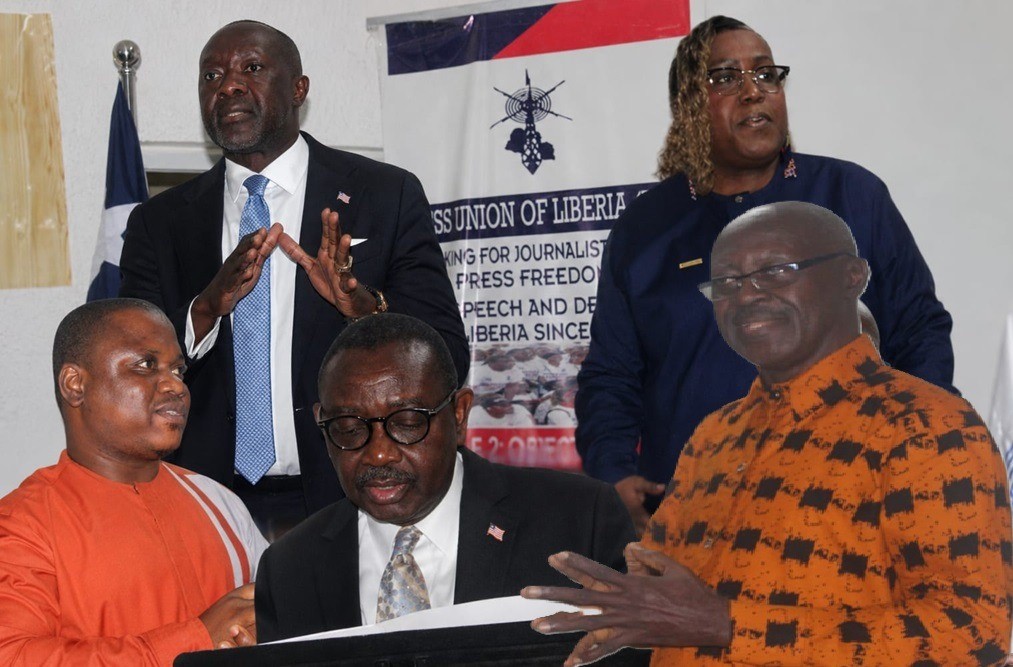
MONROVIA – Liberia’s drug investigation has reached the point where arrests alone can no longer secure confidence, especially when state institutions and security actors have themselves appeared in allegations surrounding the trafficking network. At the revived Edward Wilmot Blyden Intellectual Discourse, three voices argued that government cannot credibly investigate itself and demanded an independent panel capable of following evidence without institutional restraint. Justice Minister Oswald Tweh resisted abandoning the process, pointing to arrests, prosecutions and the involvement of American agencies as proof of credibility. Between those positions lies the national question: whether international participation is sufficient to cure domestic suspicion, or whether only an investigation structurally separated from accused institutions can command public trust. THE ANALYST reports.
Credibility Takes Centre Stage
MONROVIA: Calls for an independent investigation into Liberia’s expanding drug scandal intensified Wednesday when Senator Amara Konneh, CENTAL Executive Director Anderson Miamen and veteran journalist Aaron Kollie warned that institutions and officials allegedly connected to the controversy cannot credibly investigate themselves.
The three panelists spoke during the formal relaunch of the Edward Wilmot Blyden Intellectual Discourse, the flagship public-policy forum of the Press Union of Liberia. The discussion was held under the theme, “Confronting Drug Trafficking: Strengthening Institutions, Advancing Accountability, and Safeguarding the Rule of Law.”
The forum brought together representatives of government, the legal profession, civil society and the media at a time when public attention remains fixed on the country’s unprecedented cocaine seizures and allegations of security-sector involvement.
Although the speakers agreed that drug trafficking poses an existential threat to Liberia, they differed sharply over whether the government’s current investigative structure possesses sufficient independence to uncover the entire network.
Justice Minister and Attorney General Cllr. N. Oswald Tweh defended the ongoing investigation, saying the government had made progress through arrests, prosecutions and cooperation with international law-enforcement partners. He said the administration does not oppose an independent panel as a matter of principle but sees no justification for abandoning the present investigation.
Experts Demand Independent Panel
Senator Konneh, Miamen and Kollie argued that the country’s investigation risks a serious credibility deficit if agencies or individuals facing allegations retain control over inquiries into the same network.
Their concern went beyond the professional competence of individual investigators. It centered on an institutional conflict: whether agencies that may have been penetrated, compromised or publicly accused can independently determine the full extent of that penetration.
The panelists maintained that an independent body would give the investigation distance from political and institutional interests. Such a panel, they suggested, would be better placed to examine financiers, facilitators, security personnel and influential actors without appearing to protect the institutions from which some of those persons emerged.
The argument reflected growing public suspicion that Liberia’s drug crisis extends beyond arrested couriers and warehouse operators. Questions have persisted over how enormous quantities of cocaine entered the country, moved through security-controlled spaces and remained concealed without the protection, negligence or participation of people possessing influence.
For the panelists, the size and sophistication of the trafficking operation make institutional independence essential. An inquiry that appears compromised, even before it concludes, may struggle to persuade Liberians that its findings are complete.
Tweh Defends Existing Investigation
Justice Minister Tweh rejected the suggestion that the current investigation lacks credibility merely because it is being conducted through established state institutions. He pointed to the involvement of United States agencies as evidence that the process has been open to external examination.
According to the Attorney General, the United States Drug Enforcement Administration, Homeland Security and the Federal Bureau of Investigation have participated in the investigative effort. He said international partners received access to evidence and leads and responded positively to Liberia’s handling of the matter.
“Independent investigation, yes, that might come later. But right now, we don’t see it,” Tweh said. “Everything was open to our partners—all the evidence, all the leads—and they applauded us.”
The Justice Minister’s position rested on continuity. He argued that existing investigations cannot simply be discarded after producing arrests, charges and evidence that must now be tested through the courts.
His defence also raised a distinction between international cooperation and institutional independence. Foreign participation may strengthen technical credibility, but critics remain concerned about whether Liberian agencies can pursue allegations involving their senior personnel without interference or self-protection.
Institutions Must Confront Failure
Tweh acknowledged that the movement of narcotics through several stages of handling, screening and transportation exposed weaknesses that must be investigated and corrected.
“If narcotics can move through a chain of handling, screening or transportation, then that chain must be examined and strengthened,” he said. The government’s response, he added, cannot end with the celebration of a seizure.
The Justice Minister called for the identification of institutional weaknesses, investigation of possible facilitation and corruption, stronger screening and intelligence, improved cooperation among law-enforcement bodies and the dismantling of criminal networks.
He warned against treating the interception of drugs as the final achievement. Unless authorities uncover the systems and individuals that enabled the cocaine to travel, the criminal operation may suffer only a temporary interruption while retaining the capacity to reorganize.
“Strong institutions are not institutions that claim perfection,” Tweh said. “Strong institutions are institutions that can detect failure, correct it, investigate wrongdoing and continue to improve.”
That admission was significant because the demand for an independent panel has grown from allegations that Liberia’s security architecture did not merely fail to detect trafficking but may have included personnel who facilitated or protected it.
Konneh Warns Against Selective Justice
Gbarpolu County Senator Amara Konneh said Liberia’s response must produce a national victory rather than deepen distrust between citizens and their institutions. He described equal justice as the foundation of public confidence.
“Selective justice kills trust. Full, equal justice for everyone builds trust,” Konneh told the gathering. He urged authorities to apply the same legal standard to every suspect, whether civilian or uniformed.
Konneh called for speedy prosecution, proposing that the government aim to bring the principal cases to trial within 90 days. He suggested that the Legislature would support a presidential request for special financing if additional resources were needed to accelerate the process.
The Senator said a swift and public trial would protect honest security officers as much as it would expose compromised ones. Officers wrongly accused could be cleared, while those proven to have participated in the network could be permanently removed and prosecuted.
“A swift public trial clears innocent officers and permanently removes compromised ones,” he said. “It tells the honest police officers, the system will protect you.”
Konneh framed credibility as a condition for successful prosecution. “Make the investigators more credible than the suspect,” he advised, stressing that allegations against investigators could weaken both public confidence and the government’s case in court.
Bar Association Demands Coordination
Liberia National Bar Association President Cllr. F. Juah Lawson said the national response must remain firm, coordinated, evidence-based, sustained and lawful.
She called for the Liberia Drug Enforcement Agency, Liberia National Police, Ministry of Justice, Financial Intelligence Agency, Customs and Immigration authorities, and the Judiciary to receive adequate resources and professional personnel.
Cllr. Lawson also stressed that those institutions must operate independently and coordinate their activities effectively. Weak institutions, poor investigations and porous borders, she warned, create the conditions in which drug traffickers prosper.
“Drug trafficking thrives where institutions are weak, investigations are compromised, borders are porous, evidence disappears, prosecutions fail, and criminal networks are able to purchase influence,” she said.
Her intervention placed responsibility beyond investigators alone. Prosecutors, border authorities, financial-intelligence personnel and the courts must function as a connected chain if Liberia is to trace narcotics, preserve evidence, follow illicit money and secure convictions.
Any broken point in that chain could undermine the entire case. Missing evidence, political interference or poor coordination could allow powerful actors to escape while low-level operatives absorb the punishment.
CENTAL Seeks Structural Reform
CENTAL Executive Director Anderson Miamen said the government must continue providing resources, logistics and technology to security institutions. He warned, however, that institutional reform cannot be reduced to vehicles and equipment.
Miamen called for open, participatory and comprehensive reforms addressing recruitment, professionalism and institutional independence. He said Liberia must examine how security personnel are selected and whether those systems sufficiently protect agencies from corruption and criminal infiltration.
“We need to amend the law creating the LDEA so that the processes around recruiting people to that institution are inclusive, transparent and participatory,” he said.
The CENTAL executive also supported the establishment of an independent panel comparable to arrangements previously used in matters involving integrity institutions.
His argument addressed the longer institutional problem beneath the current scandal. Even a successful prosecution will not prevent future penetration if recruitment remains vulnerable, internal accountability is weak and officers lack professional protection from political or financial pressure.
Miamen’s recommendations therefore combined immediate investigation with structural reform. Liberia must determine what happened in the present case while correcting the conditions that could enable another cartel to penetrate the system.
Kollie Warns Development Could Fail
Veteran journalist Aaron Kollie said Liberia’s investments in roads, markets and other public projects would lose their meaning if the country failed to confront the drug epidemic threatening its young population.
“You can construct all the roads, all the market buildings, and all the political projects,” Kollie said. “If you do not address the fundamental problem and the root cause of the drugs problem affecting the foundation of our country, the young people, it will all be meaningless.”
He called for serious investment in the construction or reconstruction of a drug-rehabilitation centre. Enforcement against traffickers, he argued, must be accompanied by treatment and recovery opportunities for those already harmed by narcotics.
Kollie also advocated better resources for the LDEA and other agencies connected to the drug fight. He said the country must vet personnel carefully and provide officers with sufficient incentives to resist corruption and protect Liberia’s domestic and international image.
His remarks widened the debate beyond seizures and prosecution. Liberia faces both a trafficking crisis and a public-health emergency involving young people whose addiction cannot be solved through arrest alone.
A Question Beyond Arrests
The contrasting positions at the forum exposed a difficult reality: the government’s investigation may produce arrests and still fail the test of public credibility.
International cooperation can provide technical assistance, intelligence and external scrutiny. It does not automatically settle domestic concerns about conflicts of interest, the scope of the inquiry or whether politically connected persons will face the same treatment as lower-level suspects.
An independent panel, meanwhile, would not become credible merely by bearing the word “independent.” Its membership, legal authority, access to evidence, funding, reporting obligations and protection from political interference would determine whether it offers a genuine solution or another layer of bureaucracy.
The government and advocates of an independent investigation therefore carry separate burdens. Tweh must demonstrate that the current process can follow evidence into the highest reaches of state and society, while proponents must explain how a new panel would operate without disrupting prosecutions already before the courts.
PUL Revives Blyden Forum
Former PUL President Gabriel Williams formally relaunched the Edward Wilmot Blyden Intellectual Discourse. He called for collective national action against illicit drug trafficking and emphasized the importance of sustained public engagement.
The forum takes its name from Edward Wilmot Blyden, the distinguished Liberian scholar, diplomat, journalist, educator and Pan-Africanist whose intellectual work challenged entrenched beliefs and defended Africa’s right to determine its future.
PUL President Julius Kanubah praised the panelists for what he described as their expertise and fact-based analyses. He said their contributions would deepen public understanding, promote transparency and accountability, and strengthen reform efforts in Liberia’s campaign against illicit drugs.
The relaunch restored a platform intended to bring public officials, specialists, civil society and journalists into direct discussion on matters of national consequence. Its first major subject could hardly have been more urgent.
Liberia is confronting drug seizures of historic proportions, allegations of corruption within the security sector and growing public fear that criminal money can buy influence. Whether the country answers that threat through the current investigation, an independent panel or a combination of both, the final process must be capable of reaching beyond expendable couriers to the people who financed, facilitated and protected the operation.
The central demand emerging from the Blyden forum was therefore larger than the creation of another committee. Liberia must establish an investigative process whose evidence can withstand the courts and whose independence can withstand the judgment of the public.
See more Liberia News Network stories in Google Search by adding LNN as one of your Preferred Sources.
★ Add LNN as a Preferred Source