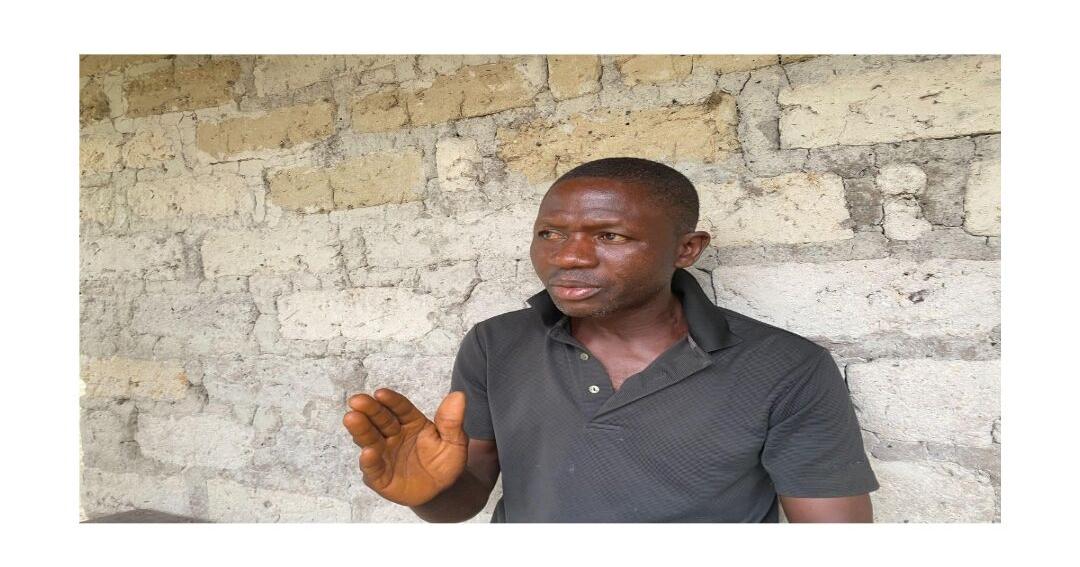
S. Woyea T. Samah walked down the dirt path to his mud house after harvesting peanuts on his farm. As a town chief, he had spent the entire day supervising men brushing grass on their football field, preparing for a football friendly match between a team from Guinea and the Dorzenilor town for July 26, Liberia’s Independence Day celebration.
His town, like many in Lofa County, shares a border with the Republic of Guinea, a French-speaking nation that was recently in a standoff with Liberia over border disputes in Lofa. But Samah is not happy. The boundary line drawn to establish the Wonegizi forest as a national park, which stretches into the Guinea-Ziama Clan, has left Samah and his people hopeless.
“We are grieving,” he said, leaning on the mud-patch house he shared with his family. “Lot of people’s farms left in the boundary line.”
Covering more than 27,000 hectares, the Wonegizi Proposed Protected Area is a transboundary forest that has been identified by the Liberian government to be set aside as a national park, working with seventeen communities, including Dorzenilor.
Beyond culture and tradition, farming has been a way of life for Samah and his peers in Dorzenilor. Their forest, now up for conservation, has been a source of income, food, and medicine. Farming has been an alternative to formal school and other modern formalities. Everyone here is a farmer. They eat from their farms and sell produce.
Two decades ago, the Forestry Development Authority (FDA) and Flora and Fauna, a UK-based NGO, engaged Dorzenilor and neighboring towns through a REDD+ pilot project. Years on, the call for the park establishment came. The boundary line is a demarcation between the existing towns and the park.
With the boundary line drawn, capturing Samah and his fellow townspeople’s farms, they would not be allowed to refarm. Samah says they have complained and asked for reconsideration, but their plight was ignored. Beyond the boundary, Dlimena, Samah, and his peers have long complained about benefits such as schools, hand pumps, roads, and cattle.
The project implementers, including the FDA, officially registered the REDD+ on the Verra Registry—the global standard for carbon certification and approval. The initiative aims to protect 27,614 hectares of forest. But communities are yet to know how proceeds will be shared from the carbon credit sales. Liberia has also established the Carbon Market Authority to regulate the sales of carbon credits and spearhead benefit-sharing. A draft carbon market policy is underway.
In an email, FFI stated that the policy will largely determine how the carbon market process for Wonegizi will develop, including revenue and benefit-sharing mechanisms for local communities.
FF added the Carbon Market Authority is now the lead agency responsible for implementing the policy and developing the process going forward, including how revenues and benefits will be divided.
Carbon credit, a renewed hope for communities
When the park is established, Dorzenilor and participating towns are set to benefit an estimated US$2.5 million in carbon trade, according to Daylight quoting FF Country Director at a consultation meeting.
Dr. Mary Molokwu-Odozi, FF’s Country: “I am very pleased that we have finally come to this stage. It took a long process. “It will now be a smooth process going forward.”
The Wonegizi is one of the oldest conservation projects still standing, supported by donors in partnership with seventeen local communities, including Dorzenilor. An MoU among the parties promised to improve local livelihoods through community engagement and various surveys on wildlife, carbon, and trees. Since 2013, communities have been engaged to preserve their forest for their benefit.
“No benefit [monetary] yet,” said Korpo Forkpa, a farmer and elder from Vetesu.
Despite townspeople not receiving financial benefits from keeping their trees standing, hunters were trained in GPS and biomonitoring, camera capturing, and wildlife footprints to serve as forest guides, earning US$75 per 15-day patrol or US$50 for a 10-day patrol. Farmer Field Schools and Village Saving Loan Associations (VSLAs) were established in some communities with seed funding, while others did not.
The project has been donor-funded since it began. The latest grant provided by France was implemented by GRET in partnership with FF.
“There is no revenue from the REDD+ project yet, and so no further benefits yet to be shared; however, our objective is to ensure both communities and nature can benefit in the long run, and the delivery of sustainable livelihood initiatives supports this goal.
The forest has been a provider
Farming has been a part of their survival. Their annual harvest has been dwindling due to a shift in weather pattern due to climate change, which has been another challenging battle. Dorzenilor is a town with damaged bridges that prevent vehicles from entering, leaving many to rely on motorbikes and foot for mobility and transportation of their goods and services.
“The forest is the supermarket,” said Mohammed Fofana, youth representative in Medina town.
Fofana believed that the forest here hovering over his town is important to the world, but often they are not given any benefit to leave their forest. “If you say leave the forest, you give something to replace it,” Fofana said.
This shift has introduced major hardships, particularly due to new, restrictive land demarcations. While officials preach the long-term benefits of forest preservation, the immediate reality for local residents is increasing hardship. Fofana stresses that these conservation initiatives affect the entire region—specifically the 17 surrounding communities near the Wonegizi area—yet the local population receives little to no support. Promised agricultural assistance, such as cattle, has failed to materialize, and attempts at distributing cocoa crops have been minimal.
The boundary demarcation was followed by a Free, Prior, and Informed Consent (FPIC) process—an international human rights standard Liberia has agreed to uphold. During consultations, communities were asked to state their desired benefits. Most requested livestock like cattle, goats, and chickens, along with cocoa and coffee seeds, oil palm seedlings, rice processing machines, bridge construction to connect isolated towns, electricity, and skills training.
“We hope that this time around they will give us the names we asked them for,” said Korpo Fallah, chairlady, Luagma. “We hope they will give them to us.”
In Liberia, FPIC is a requirement found in the Community Rights Law of 2009. It is also found in various international best practices standards relating to Liberia, such as the UN Food and Agriculture Organisation’s Voluntary Guidelines on Land Tenure and the Principles and Criteria of the Roundtable on Sustainable Palm Oil (RSPO).
Some towns refused to sign the FPIC forms, arguing that the new boundary lines cut through their farmlands, while others cited a complete lack of tangible benefits since the project’s launch. Residents were later summoned to a meeting in Zorzor, where they allege the Lofa County Superintendent intimidated them into signing the agreement. The superintendent ultimately rejected a request for an interview, backing out of a prior agreement to speak following the launch of an annex of the Lofa Community College in Zorzor district.
See more Liberia News Network stories in Google Search by adding LNN as one of your Preferred Sources.
★ Add LNN as a Preferred Source