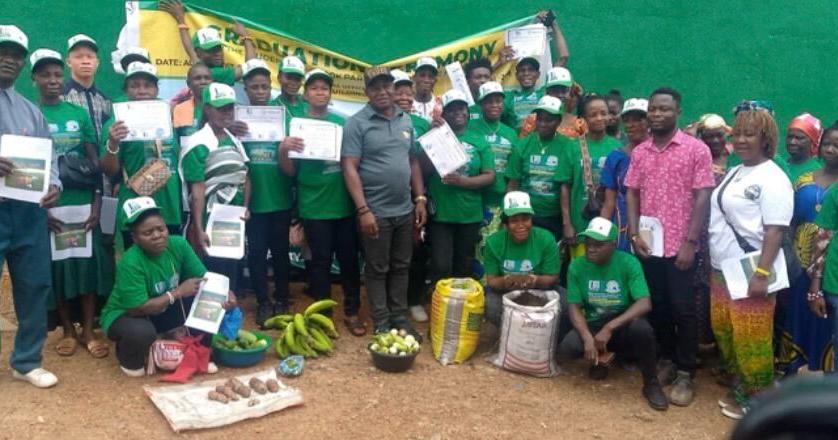
About 50 women in Nimba County have completed a three-month practical training in the production and use of homemade organic fertilizers and pest-control chemicals, gaining skills aimed at reducing farming costs, improving food production and creating potential income-generating opportunities.
The training was organized by the Liberia United Youth for Community Safety and Development (LUYCSD) to strengthen the capacity of smallholder farmers and promote sustainable agricultural practices.
At the certification ceremony, LUYCSD Program Manager and lead facilitator Patience N. Williams said the initiative was designed to help farmers overcome the high cost and limited availability of commercial fertilizers and agricultural chemicals.
Williams said the organization sought to equip farmers with practical skills that would improve productivity while reducing dependence on imported agricultural inputs.
“We are proud to celebrate our farmers who successfully underwent three months of practical training in homemade organic pest and disease control, sustainable farming practices and compost production for smallholder farmers,” Williams said.
She said empowering farmers with locally available techniques could contribute to stronger household incomes and national food security.
“When Liberia farmers succeed and produce together, we will prosper together, and when the nation’s dream becomes everyone’s dream, we will build the Liberia we want,” she said.
For the beneficiaries, the training has provided an opportunity to reduce the financial burden associated with farming.
Fifty-six-year-old Nohn Guanue said the skills acquired during the training would help her support her household as a single parent.
“I am very happy to be part of the training, where today, I am able to prepare my fertilizers and organic pest control compost,” Guanue said.
She said the knowledge would help her sustain her family and keep her children in school.
“Based on the training, as a single parent, I am able to sustain my family and also send my children to school,” she said.
Guanue appealed to the government and development partners to provide the women with resources and equipment to expand production and make organic fertilizers available to more farmers.
Another beneficiary, Esther Prato, said the training had relieved her of the burden of purchasing expensive NPK fertilizer and commercial chemicals before cultivating her garden.
Speaking in Kpelle, Prato expressed appreciation to Williams for teaching her how to produce farm inputs locally.
“Where do I have money to buy NPK or chemicals before making a garden, but now I am making my garden with my home fertilizers,” she said.
Vivian Dakin also said rising agricultural input prices have made farming increasingly difficult for smallholder farmers.
“This training really helps me a lot, because we are gardening under constraints. Buying NPK and artificial chemicals every day makes us get nothing,” Dakin said.
She said producing fertilizer locally could allow farmers to retain more of their earnings.
Mr. Africanu Dolo described organic farming as a practice rooted in Liberia’s traditional agricultural practices, noting that the country’s forefathers cultivated crops without synthetic fertilizers and pesticides.
“Our forefathers didn’t have the skill to produce more for marketing. Today, in modern agriculture, organic fertilizer is considered the best,” Dolo said.
He encouraged farmers to combine traditional knowledge with modern agricultural practices to improve productivity and protect the environment.
Plenser Martor, coordinator of Community-Based Organizations in Nimba, urged beneficiaries to remain committed to applying their new skills and gradually develop markets for their products.
“Don’t worry about the market. We will connect you with others, so don’t be discouraged,” Martor told the trainees.
Williams, who facilitated the training, holds a Bachelor’s degree in Education from ABC University in Yekepa and received specialized agronomy training in Zimbabwe and Uganda, including instruction in organic fertilizer production and sustainable farm management.
Trainee Yei Siple credited Williams’ practical approach for helping participants understand how locally available materials could be converted into useful agricultural inputs.
“It is Patience who trained us to prepare organic fertilizer, which is good for plants and also our health and has no side effects when we eat the plant,” Siple said.
Another participant, Zortaowon P. Deakei, said the training had already changed his farming practices.
“I cultivate rice without using NPK, only organic fertilizer or compost,” Deakei said.
See more Liberia News Network stories in Google Search by adding LNN as one of your Preferred Sources.
★ Add LNN as a Preferred Source