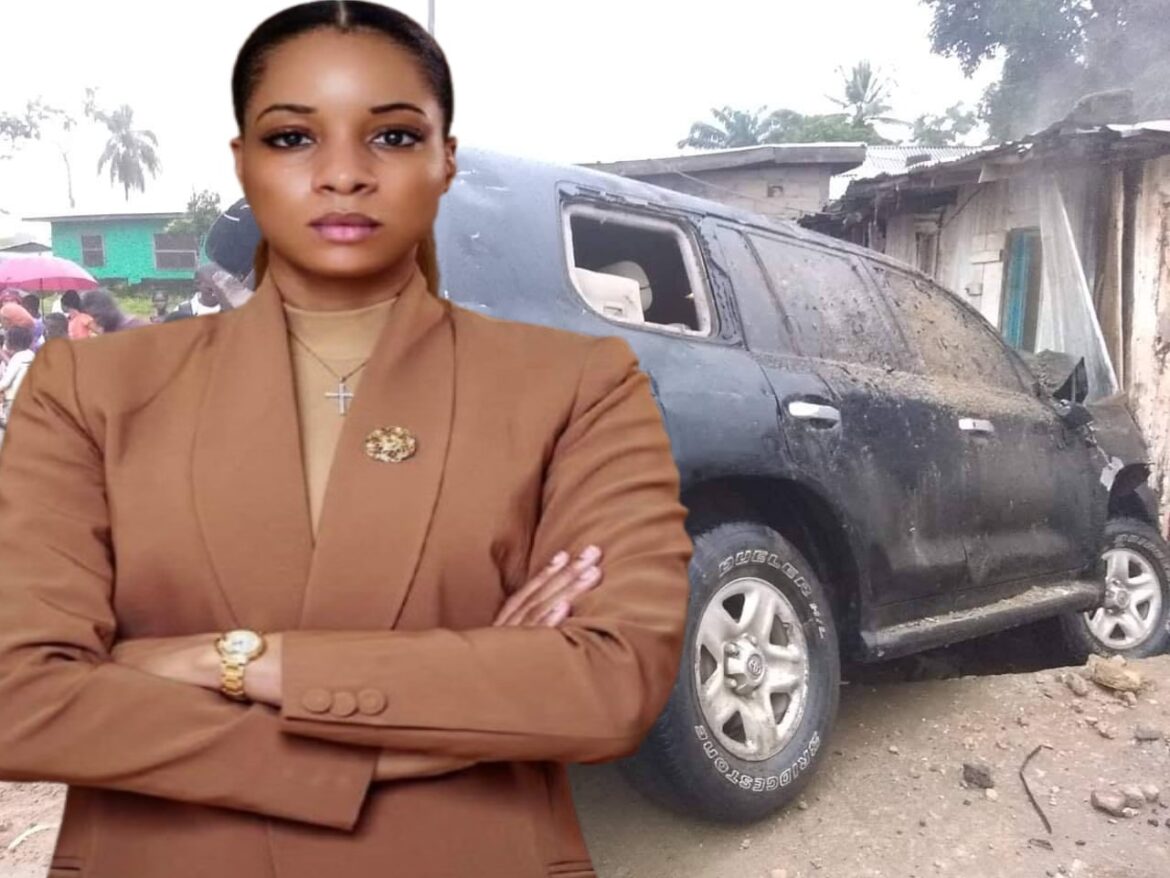
August 17, 2019, should be etched in the minds of Liberians as one of the most unsettling days in our political history—a day when the ballot box was overshadowed by stones, gasoline, a knife, and the terrifying reality that a candidate’s life could be at risk simply for participating in an election.
Certain days in this nation’s political journey are significant not because they declare a victor, but because they highlight how perilously close, we came to losing something far more precious than a mere election.
August 17, 2019, was undeniably one of those days. Telia Urey entered Logan Town as a political contender but nearly left as a casualty of political violence.
The backdrop was the fiercely contested Montserrado County District #15 by-election. Urey, representing the opposition, had contested the results of the July 29 election, prompting the National Elections Commission to call for a rerun in six precincts due to irregularities found at 20 polling places.
The political climate was already alarmingly tense. Then came August 17. Urey had arrived to meet with the campaign team of Kelvin Bayoh, another candidate embroiled in the contentious election. While inside the building, she and her companions were startled by the commotion outside.
Suddenly, stones were hurled. The roof came under attack. The windows shattered. And, as Urey recounted, the unthinkable occurred: gasoline was brought to the scene.
“When I smelled the gasoline, I didn’t think we were going to make it,” she recounted to FrontPageAfrica. That statement should resonate deeply in Liberia. Politics should revolve around persuasion. Elections should hinge on ballots. Rivals ought to be defeated at polling stations, not trapped inside buildings.
However, on that Saturday, Urey mentioned that there was only one exit from the building—and the assailants had effectively blocked it. For over an hour, as she described, she and others were stuck inside. At one moment, she recalled, an attacker burst into the building wielding a knife and nearly stabbed her.
Outside, her bulletproof vehicle was being assaulted. Her driver fled after an assailant shattered the rear window, and the vehicle ultimately crashed while trying to escape the chaos. Urey reported that she suffered a leg injury, and 15 others were hurt, with 12 needing hospitalization.
Consider this for a moment: a woman campaigning for public office found herself trapped inside a building while a mob allegedly attempted to break in. Gasoline was brought to the scene, and a knife reportedly came alarmingly close to her.
This is not just a typical campaign disturbance; it marks a point where political rivalry starts to resemble outright warfare. Liberia, of all places, should understand the gravity of this situation.
The nation has already endured an immense toll from political violence, with thousands losing their lives during the civil war, families torn apart, and communities devastated.
The collective national consciousness has been deeply affected by the notion that political disagreements can justify violence. The post-war Republic was meant to have learned from this painful history.
Yet, the events in Logan Town on that day serve as a troubling reminder of how quickly political fervor can escalate into violence.
Perhaps the most concerning aspect of this incident was not just what Urey experienced, but whether the state was adequately prepared—or even willing—to ensure her safety.
Urey claimed that police were present but did not take decisive action, despite being close by. She mentioned that people were begging the police to assist in her evacuation. While the police condemned the violence and the confrontation, authorities later charged four individuals related to the incident.
However, Liberia must confront a more difficult question: what might have transpired if the rescuers had arrived just five minutes later?
What if the gasoline had ignited? What if the knife had hit its mark? What if the building had turned into a furnace? What if Telia Urey had perished inside that structure?
Would Liberia had labeled it a regrettable campaign incident? Would political parties have expressed their condolences? Would politicians have taken to the airwaves to denounce the violence after it occurred? And would anyone had taken responsibility for failing to avert it?
These questions are significant because democracy cannot simply be gauged by whether an election is held. Democracy is also about whether a candidate can enter a community without fear. Whether an opposition supporter can campaign without being pursued. Whether political opponents can disagree without resorting to violence. Whether the police can safeguard citizens, regardless of their party affiliation. And whether the state recognizes that the life of an opposition politician holds equal value to that of a government supporter.
There was another troubling aspect to the violence in Logan Town. The contest in District #15 had transcended its local boundaries. It had become a reflection of Liberia’s political culture. The language surrounding the election had become increasingly volatile. Opposition leaders accused supporters of the ruling party of intimidation, while those in the ruling party dismissed these claims. President George Weah later condemned the violence and urged dialogue between Urey and her opponent, Abu Kamara.
But condemning violence after it occurs is a simple task. The real challenge lies in preventing that violence from happening in the first place.
This is certainly a crucial lesson that Liberia must remember. Urey managed to survive, the elections went on, and the rerun took place. Politics continued as usual.
However, the images and memories from that August day should not just be categorized as “electoral violence.” Inside that building was a woman who smelled gasoline and truly feared for her life. Around her were people who had been injured, a vehicle that was wrecked in the turmoil, a knife, and an atmosphere filled with fear.
The nation was witnessing its democratic experiment teetering on the brink of a deadly clash. Telia Urey didn’t come close to losing her life because Liberia had an excess of democracy; she faced danger because political rivalry had strayed dangerously far from democratic principles.
Liberia needs more than politicians who can win elections; it requires leaders who can rein in their supporters when tensions rise. It needs political parties that recognize that an opponent is not an enemy. It also needs security forces that act decisively before violence erupts, ensuring that the state maintains control.
And ultimately, Liberia needs citizens who recognize that no election—whether it’s for the presidency, a Senate seat, a representative position, or even a single legislative district—is worth sacrificing a single Liberian life.
On August 17, 2019, the country nearly faced this harsh reality. Telia Urey survived, but Liberia must remember how close it was to losing her.
More crucially, Liberia must not forget how nearly it came to losing something even more significant: the conviction that political disputes in this country can still be resolved through voting rather than violence.
See more Liberia News Network stories in Google Search by adding LNN as one of your Preferred Sources.
★ Add LNN as a Preferred Source