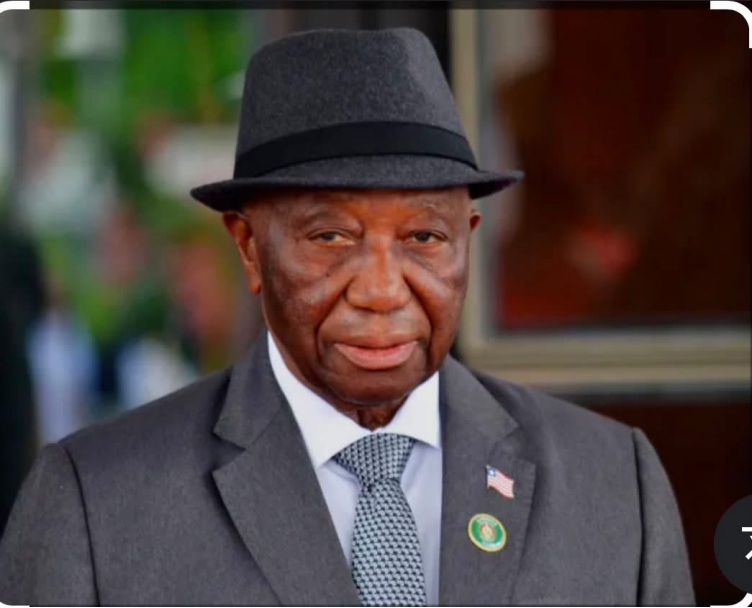
Monrovia — Renowned Liberian lawyer Cllr. Tiawan Saye Gongloe has challenged President Joseph Nyuma Boakai to publicly disclose his salary, raising questions about the legal basis, implementation, and transparency surrounding the President’s reported 40 percent voluntary pay reduction.
President Boakai pledged during his campaign and upon assuming office to reduce his salary by 40 percent as part of his commitment to responsible governance and fiscal discipline. The Executive Mansion has subsequently maintained that the President is honoring that commitment.
However, the actual amount President Boakai receives monthly or annually has not been publicly disclosed, prompting Cllr. Gongloe to demand clarity on what he describes as a fundamental transparency issue.
In his latest “Question for the Weekend” commentary, titled “Mr. President, What Exactly Is Your Salary?”, Gongloe said the reported 40 percent reduction raises a basic question: 40 percent of what?
“Liberians were told that President Joseph Nyuma Boakai voluntarily reduced his salary by 40%. But 40% of what?” Gongloe asked.
He pointed to Article 60 of the Liberian Constitution, which provides that the salaries of the President and Vice President are determined by the Legislature and shall neither be increased nor diminished during the term for which they were elected.
Against that constitutional provision, Gongloe is asking the administration to explain the exact salary legally established for the President and how the announced voluntary reduction is being applied.
He posed four specific questions: What salary did the Legislature legally fix for the President? What was President Boakai’s gross annual salary when he assumed office? How much does he actually receive after the announced 40 percent voluntary reduction? How is the voluntary reduction being implemented consistently with Article 60 of the Constitution?
Gongloe also invoked Article 15(c) of the Constitution, which guarantees citizens the right to be informed about the government and its functionaries.
He argued that disclosure of the President’s compensation should not be viewed through a partisan or personal lens, but rather as an issue of public accountability.
“This is not a personal question. It is not a partisan question. It is a transparency question,” Gongloe stated.
The lawyer stressed that the President’s compensation is ultimately financed by Liberian taxpayers and therefore, in his view, the public has a legitimate interest in knowing precisely how much the country’s chief executive is receiving.
“Mr. President, the Liberian people pay the President’s salary,” Gongloe said. “How much are they paying you?”
The call comes amid broader public debates over government spending, executive accountability and the need for greater transparency in the management of public resources.
Gongloe ran on the presidential ticket of the Liberian People’s Party in the 2023 presidential and legislative elections. He and the LPP subsequently threw their support behind then-presidential candidate Joseph Nyuma Boakai during the 2023 runoff election between Boakai and incumbent President George Manneh Weah.
Although Gongloe was offered a cabinet position in the Boakai-Koung administration, he declined the appointment. His vice-presidential running mate, Dr. Emmanuel Urey Yarkpawolo, was later appointed Executive Director of the Environmental Protection Agency.
Gongloe has, however, maintained an independent public posture toward the administration. While applauding the government for what he considers notable achievements, he has also consistently criticized policies and decisions he believes require greater transparency and accountability.
He said his latest inquiry into President Boakai’s salary should therefore not be viewed through a partisan lens, emphasizing that his concern is rooted in the broader principles of transparency, accountability and the public’s right to know.
According to Gongloe, his past political support for Boakai does not prevent him from questioning the administration when issues of public interest arise. His call for disclosure of the President’s salary, he stressed, is intended to promote openness in government and ensure that public officials remain accountable to the Liberian people.
While the Executive Mansion has maintained that President Boakai has fulfilled his pledge to cut his salary by 40 percent, the renewed challenge from Gongloe puts the spotlight on the actual monetary value of the reduction and the mechanism through which it is being implemented.
The questions now place the administration under pressure to provide a clear public accounting of the President’s legally established compensation, the amount he receives, and how the reported salary reduction squares with the constitutional provisions governing presidential remuneration.
For Gongloe, the issue is straightforward: if the public pays the President’s salary, the public should know exactly how much it is.
See more Liberia News Network stories in Google Search by adding LNN as one of your Preferred Sources.
★ Add LNN as a Preferred Source