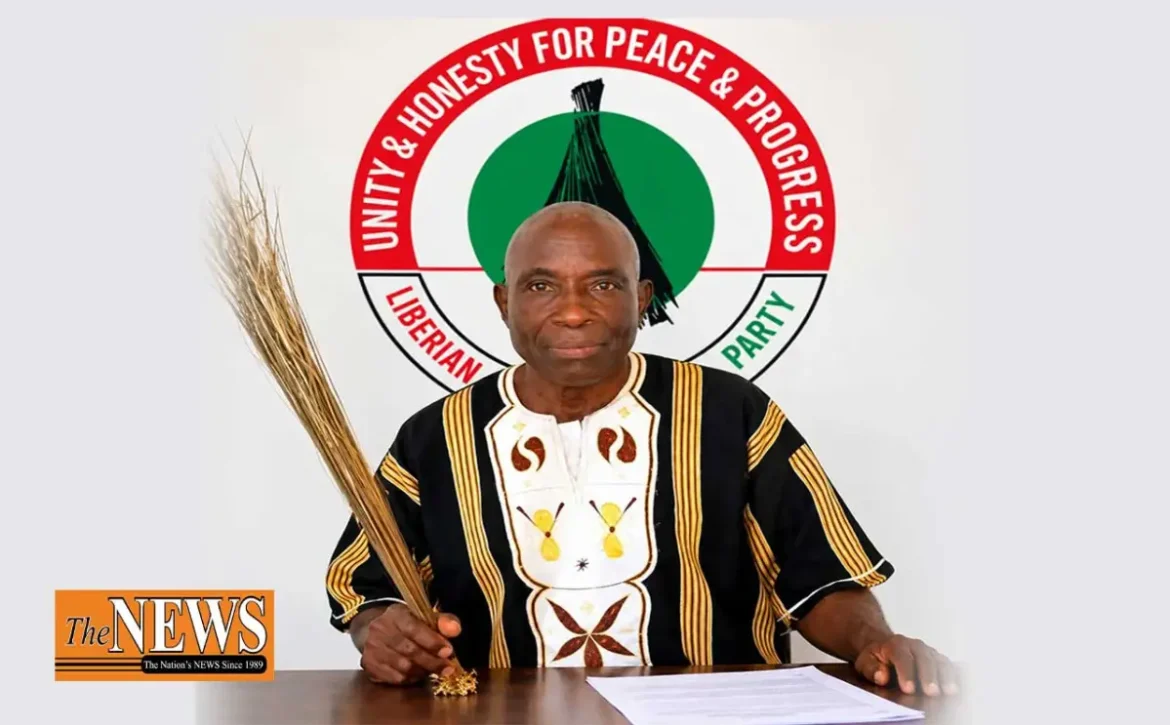
The National Elections Commission (NEC) has dealt a significant blow to rival factions within the Liberian People’s Party (LPP) that sought to remove each other from leadership positions. The NEC declared the competing suspensions and expulsions ineffective and ordered the party to be restored to its previous status, prior to the onset of the leadership crisis.
The ruling, handed down Monday by NEC Hearing Officer Atty. Fomba A.M. Swaray, effectively wipes away the disciplinary actions at the heart of a bitter power struggle involving embattled National Chairman J. Yanqui Zaza, Major Tamba Samukai and forces aligned with prominent LPP figure Cllr. Tiawan Gongloe.
But the ruling has failed to end the political warfare.
Zaza’s legal team immediately took exception and announced plans to appeal to the NEC Board of Commissioners, opening another potentially decisive legal battle over control, authority and internal governance of one of Liberia’s longstanding political parties.
At the heart of the dispute was whether the rival camps complied with the LPP Constitution and exhausted the party’s internal dispute-resolution procedures before suspending, removing or expelling officials.
Hearing Officer Swaray concluded that they did not.
The NEC found that neither side sufficiently demonstrated that the party’s established internal mechanisms had been exhausted before disciplinary actions were taken and subsequently brought before the Commission.
The ruling relied heavily on Section 9.0 of the NEC’s Regulations and Procedures Relating to Political Parties, Coalitions, Alliances and Independent Candidates, which requires political parties to establish impartial mechanisms for resolving internal disputes and exhaust those procedures before seeking external intervention.
It also cited Article 18 of the LPP Constitution, which empowers the party’s National Executive Committee to suspend, expel, or remove members and officers, but only through the required procedures and due process.
“Whatever the authority within a political party, it is not sufficient to write to the National Elections Commission formalizing a decision of the party in taking disciplinary action(s) against a member,” the ruling stated.
“What is cardinal here is that said member be subjected to the pre-existing dispute resolution mechanism within the party in keeping with due process.” The LPP leadership crisis traces back to a series of conflicting communications submitted to the NEC beginning in November 2024.
One faction reported the suspension of Major Samukai from his position as Vice Chairman for Recruitment and Mobilization and sought the Commission’s recognition of the decision. Samukai later emerged as Acting Chairman and became involved in actions that resulted in Zaza’s indefinite suspension as National Chairman.
Zaza rejected Samukai’s authority, insisting that Samukai had already been suspended and subsequently expelled and therefore had no legal authority to postpone the party’s national congress or conduct business on behalf of the LPP. As accusations and counteraccusations intensified, both factions accused each other of violating the party constitution and exercising powers they did not legally possess.
The conflict eventually reached the NEC after efforts by the Commission’s Political Affairs section to resolve the dispute proved unsuccessful. During the hearing, Samukai and witnesses supporting his position accused Zaza of running the LPP unilaterally, removing county officials and failing to account for funds allegedly received during the 2021 elections. Samukai testified that an extraordinary sitting of the LPP National Executive Committee resulted in Zaza’s indefinite suspension, with members and county chairpersons signing a resolution supporting the action.
Zaza rejected the accusations and launched his own attack on Samukai’s authority. Testifying in his defense, Zaza accused Samukai and his allies of disrupting party meetings and making threatening remarks. He further questioned whether Samukai’s position as Vice Chairman for Recruitment and Mobilization was properly established under the LPP’s governing documents.
Zaza also challenged the legality of a November 15, 2024 meeting relied upon by Samukai’s faction, arguing that it was improperly constituted and therefore incapable of authorizing disciplinary actions against the party’s leadership. His witness, Mohammed Deygbo, accused Samukai of misconduct and testified that the matter had been referred to the LPP’s Grievance and Ethics Committee.
But the NEC Hearing Officer refused to reduce the dispute to the rival factions’ competing accusations. Instead, Swaray focused on a more fundamental issue: whether the party followed its own constitution and afforded due process before attempting to remove its officials. The ruling identified gaps in the evidence showing whether Samukai had been formally served, investigated, and subjected to proceedings before the LPP’s Grievance and Ethics Committee.
Similar questions surrounded the action against Zaza, with the Hearing Officer finding insufficient evidence that his referral to a grievance committee resulted in a formal investigation, hearing and final determination.
Those procedural failures proved decisive.
The Hearing Officer ultimately ruled that the evidence failed to establish that the LPP’s internal dispute-resolution procedures had been exhausted, rendering the competing suspensions and expulsions legally ineffective.
“WHEREFORE AND IN VIEW OF THE FOREGOING, the suspensions/expulsions are of no legal effect and the parties are hereby ordered to return to the status quo ante that existed before the said contentions,” the ruling declared. The decision effectively resets the LPP’s leadership battle but does not resolve the deeper political struggle over who ultimately controls the party.
With Zaza’s lawyers already signaling an appeal, the fight now shifts to the NEC Board of Commissioners, which could uphold, modify or overturn the Hearing Officer’s decision.
Beyond the personalities involved, the dispute has raised broader questions about internal democracy, leadership accountability, constitutional compliance and the ability of Liberian political parties to resolve disputes through their own established institutions.
For the LPP, the crisis has evolved from an internal disagreement into a major test of whether party leaders can subject themselves to the same constitutional rules and due-process standards they seek to enforce against their rivals. And with another legal showdown now looming before the NEC Board of Commissioners, the battle for control of the LPP appears far from finished.
See more Liberia News Network stories in Google Search by adding LNN as one of your Preferred Sources.
★ Add LNN as a Preferred Source