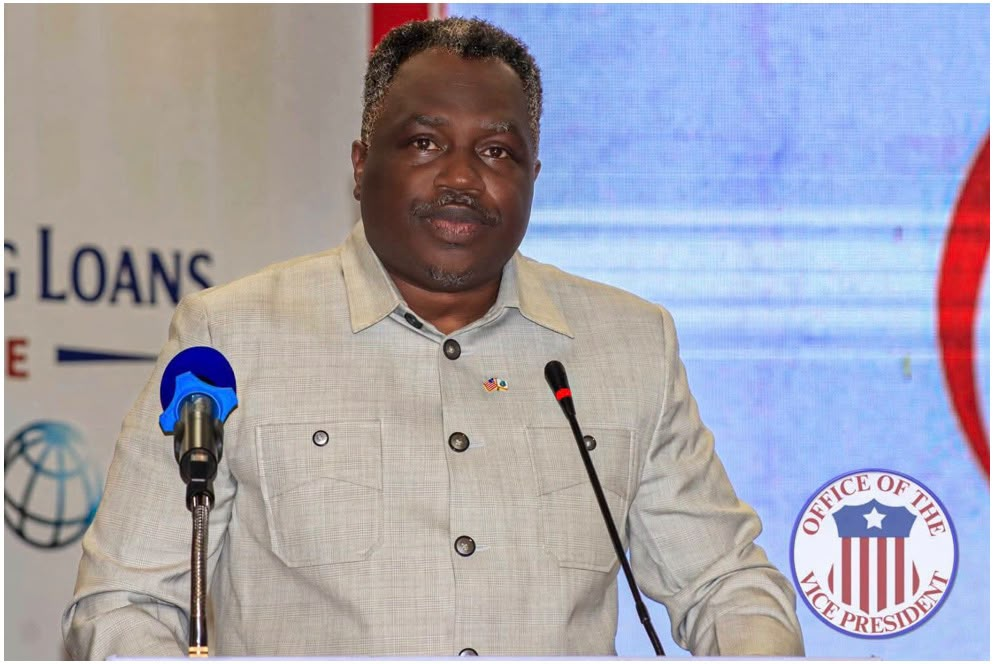
MONROVIA — The Liberian government is moving to confront the country’s non-performing loans (NPLs) problem with the establishment of a National Non-Performing Loans Task Force, in a bid to unlock credit, strengthen banking stability and expand financing for businesses and entrepreneurs.
Vice President Jeremiah Kpan Koung Sr. announced the task force at the close of a national conference on non-performing loans, saying the accumulation of bad debts has become more than a banking-sector problem and is now a broader economic constraint.
“What has emerged from these discussions is a clear consensus: resolving non-performing loans is not simply about improving commercial bank balance sheets; it is about unlocking economic opportunity, expanding access to finance, encouraging investment, supporting entrepreneurship, and creating jobs for the Liberian people,” Koung said.
The conference brought together policymakers, financial regulators, commercial banks, development partners and other experts to examine the causes of non-performing loans and identify reforms to strengthen Liberia’s financial system.
According to Koung, participants identified weaknesses in credit systems, delays in legal proceedings, governance concerns, limited enforcement mechanisms and broader economic pressures on borrowers and lenders as key factors contributing to the problem.
He warned that elevated levels of bad loans are restricting credit growth, limiting private-sector expansion and increasing the cost of borrowing.
“The conference materials have reminded us that elevated levels of non-performing loans constrain lending, restrict private sector expansion, increase the cost of credit, and ultimately undermine economic growth,” he said.
Task Force to Coordinate National Response
The National Non-Performing Loans Task Force is expected to bring together the Central Bank of Liberia, the Ministry of Finance and Development Planning, the Ministry of Justice, financial institutions and other relevant stakeholders.
Koung said the task force will provide a coordinated framework for addressing the NPL problem while strengthening the resilience of the financial sector and restoring confidence in Liberia’s banking system.
“I am pleased to announce on behalf of His Excellency, Joseph Nyuma Boakai, Sr., President of the Republic of Liberia, the establishment of a National Non-Performing Loans Task Force,” he said.
The Vice President disclosed that President Boakai has instructed relevant institutions to move quickly to finalize the task force’s composition, terms of reference and implementation action plan.
The plan, he said, should include clear responsibilities, timelines, monitoring mechanisms and reporting requirements.
“By directive of the President, the relevant institutions are requested to move expeditiously to finalize the Task Force’s composition, terms of reference, and implementation action plan, with clear responsibilities, timelines, and mechanisms for monitoring and reporting progress,” Koung said.
Government Targets Lending Constraints
The government’s intervention comes as Liberia continues to grapple with limited access to affordable financing, particularly for small businesses, farmers, women entrepreneurs and youth-led enterprises.
Koung said reforms must go beyond addressing existing bad loans and focus on preventing future accumulation of distressed credit.
He said the government supports measures to strengthen prudential supervision, improve credit-risk management, modernize credit infrastructure and make debt recovery more effective.
“We support efforts to strengthen prudential supervision and credit risk management. We support reforms aimed at modernizing Liberia’s credit infrastructure. We support initiatives that improve debt recovery, insolvency administration, collateral enforcement, and commercial dispute resolution,” he said.
The Vice President also emphasized the need to improve financing opportunities for small enterprises and agricultural value chains, arguing that access to sustainable credit is essential to broad-based economic growth.
“No country can sustain economic transformation without an efficient financial system,” Koung said. “And no nation can achieve broad-based prosperity if businesses, farmers, women entrepreneurs, young innovators, and small enterprises lack access to affordable and sustainable financing.”
Beyond the Banks
Koung stressed that resolving Liberia’s NPL crisis cannot be left solely to the Central Bank or commercial banks.
He called for coordinated action among the Executive Branch, Legislature, Judiciary, financial institutions, borrowers and development partners.
“The responsibility for implementation does not rest with any single institution. It belongs to all of us,” he said.
He specifically pointed to the Legislature’s role in supporting legal reforms and the Judiciary’s responsibility in strengthening contract enforcement and commercial justice.
Delays in debt recovery and commercial dispute resolution, he noted, can weaken lenders’ willingness to extend credit and increase the risks associated with borrowing.
From Conference to Implementation
While acknowledging the challenges confronting Liberia’s financial sector, Koung said the country has the expertise and institutional capacity to address them.
“The policy options have been identified. The reform priorities have been articulated. The responsibilities of stakeholders have been clarified. What remains is implementation,” he said.
That implementation, he suggested, will ultimately determine whether the conference produces meaningful economic results.
“History will not judge this conference by the quality of the presentations delivered in this hall. History will judge it by the reforms implemented after we leave,” Koung said.
He said the real measure of success would be the amount of credit unlocked for productive sectors, the number of businesses able to expand, jobs created and confidence restored in Liberia’s financial system.
The Vice President concluded by urging stakeholders to move beyond resolutions and recommendations toward measurable action.
“Our commitment extends beyond today’s closing ceremony. Our commitment is to implementation of the outcome, the recommendations and the commitments from all stakeholders. Our commitment is to reform. And our commitment is to delivering tangible benefits for the Liberian people,” he said.
“As we depart this conference, let us move forward not merely with resolutions, but with resolve. Not merely with recommendations, but with responsibility. Not merely with aspirations, but with action.”
See more Liberia News Network stories in Google Search by adding LNN as one of your Preferred Sources.
★ Add LNN as a Preferred Source