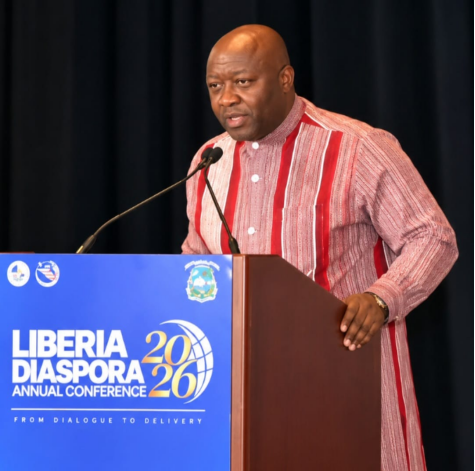
Washington, D.C – Liberia has had one of the darkest past – a long range of civil war that stretched all the way to 14 years; however, Finance and Development Planning Minister, Augustine Kpehe Ngafuan has presented a case to convince diaspora Liberians and investors why the country remains one of the best destinations for investment.
By Emmanuel Weedee-Conway
Held under the theme: “Making an Investment Case for Liberia – Betting on Liberia, which is being held in Washington, D.C in the United States of America (USA), is a key event that strengthens the bond between Liberians abroad and their homeland.
The theme before us is direct: Making an Investment Case for Liberia—Betting on Liberia.
So let me begin with an equally direct question: if you are deciding where to place your capital, your technology, your networks and your trust, why should you bet on Liberia?
Because Liberia offers a rare combination: growing stability and unfinished opportunity; improving institutions and first-mover advantage; abundant resources and a government determined to convert them into jobs and shared prosperity.
Dark Days Gone
Driving through the ugly past, Minister Ngafuan says the dark days that saw the shells of bullets in different street corners, destruction of major infrastructure, economic collapse and rule of law displaced are over, and Liberia is on the path of tangibles.
Since the cessation of political brouhaha some 23 years ago, the MFDP Minister points out that Liberia has been moving strong and placed in the global headlines most often for good reasons – has sustained peace for more than two decades, conducted competitive elections, transferred presidential power peacefully, rebuilt democratic institutions; and earned the confidence to serve today as a non-permanent member of the United Nations Security Council.
“A nation once defined in global headlines by conflict is now helping to deliberate on peace and security for the world. That is not only diplomatic progress. It is evidence of national recovery, institutional credibility and political risk moving in the right direction,” Mr. Ngafuan told the gathering of dominant Liberians and investors.
Advancing With Purpose
Accordingly, the Minister used the platform to inform the world that Liberia is no longer merely a country emerging from crisis, rather it is a country advancing with purpose.
Why Bet On Liberia?
The MFDP boss craved the world’s attention to bet on Liberia as the country continues to restore macroeconomic credibility and strengthening fiscal discipline.
“Our economy grew by about 5.1 percent in 2025. The latest assessment by the International Monetary Fund projects growth of approximately 5.5 percent in 2026, driven especially by mining, construction and manufacturing. Inflation averaged about 4.5 percent during the first half of this year, despite turbulence in the global economy, and the Liberian dollar has remained broadly stable.”
He said that fiscal performance is also improving, referencing the International Monetary Fund (IMF) that projects the primary fiscal surplus, excluding grants, at approximately 2.4 percent of GDP in 2026.
He cited the passage of the national budgets before the beginning of the fiscal year in two consecutive years as reason for Budget execution rate improvement. This means that spending entities who meet all the commitment and procurement control requirements of government are more assured today of receiving their budgeted funds as compared to the past.
“Those figures may sound technical. Their meaning is not: when government makes a commitment to a school, clinic, road, contractor or community, there is now certainty that it will move from paper to reality. They mean we are working to pay civil servants on time; to pay vendors and contractors on time; to service our lawful debts; and to honor legitimate government contracts and obligations.”
“Payment discipline is not a favor from government. It is part of the infrastructure of trust. When government pays on time, firms can pay workers, banks can lend with greater confidence, projects can remain on schedule and the entire economy functions better,” he furthered.
Crossing The One Billion Mark
For the very first time in the nation’s history, domestic revenue collections exceeded one billion United States dollars in a single year.
That achievement, Minister Ngafuan reported, belongs to every Liberian; both at home and abroad, who continue to contribute to the ‘common future.’
“We have moved from roughly US$612 million in domestic revenue in 2023, to about US$699 million in 2024, to about US$848 million in 2025 – and now beyond the billion-dollar mark by mid-September 2026.”
All Problems Not Solved Yet
In a clearer economic tone, Ngafuan explained to the gathering that collecting one billion dollars does not mean Liberia has no more problems, noting that even five billion dollars in revenue cannot solve all the country’s problems.
“Rasing one billion in revenue from January 1 to September 14 of this year does not mean every road is paved, every school is repaired, or every hospital is fully equipped. Revenue is not the same as uncommitted cash. Revenue fund salaries, education, healthcare, security, infrastructure, county development, debt service and many other national obligations.”
But while this does not absolutely solve all the problems, he points out that the billion-dollar threshold is not a finish line, but a proof of capacity and a summon to greater responsibility.
“It tells our citizens that Liberia can increasingly finance its development; it tells our partners that we will do our share; and it tells investors that the state is becoming more capable of honoring obligations and providing the public goods enterprise needs. That is what we mean by development sovereignty.”
‘A Clear National Plan’
The Minister encourages Liberians and nations of the world to invest in Liberia based on a responsible stewardship anchored in a clear national plan.
He cited the ARREST Agenda for Inclusive Development – Agriculture, Roads, Rule of Law, Education, Sanitation and Health, and Tourism as a framework for changing the economy and improving lives.
“We do not want growth that exists only in a statistical table. We want growth that creates jobs; expands agriculture and industry; improves power, roads and digital connectivity; strengthens the rule of law; and reaches all fifteen counties. Liberia today looks, in many places, like a construction site. That is because the work of rebuilding and connecting our country is under way.”
Highlights Of Key Development
Along the western corridor, Minister Ngafuan reported that work has begun on a 255-kilometer road network that includes the St. Paul Bridge–Klay–Bo Waterside route and the Voinjama–Kolahun– Foya -Mendikorma corridor, an infrastructure that strengthen Liberia’s links with sisterly nation Sierra Leone.
Also across the Cavalla River, he revealed ongoing construction works of a new bridge to connect Liberia and Côte d’Ivoire, with completion targeted for March 2028. This would end the sometimes deadly adventure of crossing the river in ferry or canoes, as the Minister maintains that a modern bridge will facilitate movement of people and trade.”
“We have procured earth-moving equipment to help keep roads passable year-round in all fifteen counties. We are advancing an overpass to ease congestion in Monrovia, and constructing and renovating schools and hospitals, including C. H. Rennie Hospital in Margibi, three schools in the Monrovia Consolidated School System (MCSS), and facilities at the University of Liberia,” the Minister emphasized on development projects and initiatives.
At the same time, the Minister told the diaspora conference that the government is currently expanding electricity access from about 32 percent in 2024 toward 40 percent today, adding that more communities are seeing reliable public power, some for the first time since the civil war.
“Buchanan has been energized. Voinjama and other areas are seeing progress. The Liberia Electricity Corporation is connecting more homes and businesses in Montserrado and beyond.”
In the agriculture sector, disclosed that tractors are arriving to support food production.
He tells the conference that construction of the Special Agro-Industrial Processing Zone in Buchanan is under way, and at completion, it will create a platform to process rice, cocoa, oil palm, fisheries and other products closer to source.
“Our aim is straightforward: Liberia must not remain a country that exports raw potential and imports finished prosperity. We must add value at home.”
Building The Systems
The third reason to bet on Liberia, Minister Ngafuan indicated, is that government is building the systems that make investment easier, faster and more profitable.
“For too long, too much of the Liberian economy has effectively shut down at five o’clock. A business owner may need two phones and two mobile-money accounts because the systems do not speak to one another.”
He asserted that the old narrative is changing, pointing to the launch of the Inclusive Instant Payment System, connecting Lonestar Cell MTN and Orange Money as the first phase of the National Electronic Payment Switch.
In its first three months, the system processed more than 1.5 million transactions, worth over L$1.4 billion and US$9 million.
When the full National Electronic Payment Switch comes online, targeted for March 2027, he explained that commercial banks, mobile-money platforms, government-payment channels and other financial institutions will be interoperable.
“For a market woman in Ganta, it means receiving money instantly. For government, it means easier tax collection, fewer leakages and a traceable audit trail. For an investor, it means paying suppliers and employees in seconds instead of days, with lower risk and greater transparency.”
“We are moving from a cash-heavy economy to a connected economy—from an economy that slows after business hours to a true 24-hour economy.”
Furthermore, the MFDP Minister narrated that government is also strengthening the environment for public-private partnerships, stressing that the 2026 Public Procurement and Concessions Act provides an improved legal foundation for PPPs, concessions management and electronic government procurement.
National Ownership
With several reason to bet on Liberia for investment, one of several put forward by the Finance Minister is owing to the fact that international cooperation is backed by national ownership.
According to him, the country’s partnership with the IMF under the Extended Credit Facility supports macroeconomic stability and reform; hence, the governance diagnostic helps in identifying institutional weaknesses honestly and address them.
“Cooperation with the World Bank, African Development Bank, European Union, Millennium Challenge Corporation, the UN and other partners brings financing, technical knowledge and independent validation.”
However, he reckoned that partnership must not become dependency, noting that the strongest international cooperation begins when a country has a plan, mobilizes its own resources, improves its systems and invites partners to reinforce and not replace national effort.
“That is the approach we are taking. We are strengthening anti-corruption institutions, expanding competitive electronic procurement, improving asset-declaration compliance, digitizing public services and making it easier to register and operate a business,” he added.
See more Liberia News Network stories in Google Search by adding LNN as one of your Preferred Sources.
★ Add LNN as a Preferred Source