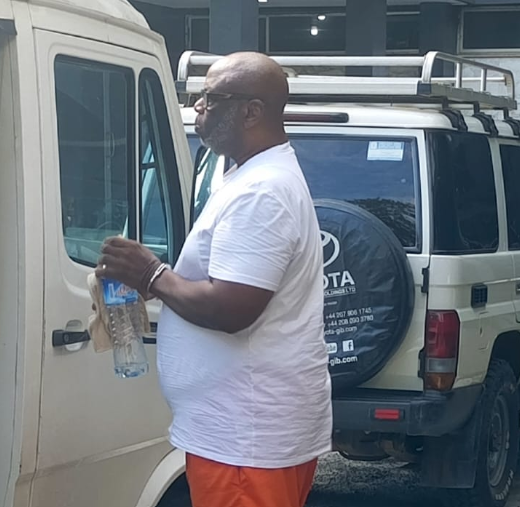
Monrovia – Peter Bon Jallah, on trial for alleged gang rape, statutory rape and kidnapping involving a 16-year-old boy, took the witness stand Thursday and accused investigators of deliberately placing his DNA on the teenager’s clothing to implicate him in the case. Jallah denied the charges, said he was elsewhere when the alleged assaults occurred, and insisted he did not know the teenager.
Jallah told Criminal Court “E” that police had obtained his saliva sample during the investigation and used it to connect him to clothing recovered from the alleged survivor.
“Why is my saliva DNA profile on the white T-shirt and boxer?” Jallah asked the court, directing attention to the Liberia National Police, which he said had custody of his DNA sample.
He went further, alleging that investigators intentionally placed his saliva on the clothing.
“They intentionally placed my saliva DNA on the white T-shirt and the boxer. Obviously, it was a means to an end,” he testified.
Jallah did not present evidence during his testimony to substantiate the allegation, and the court has made no finding that police manipulated or planted the DNA evidence.
What the Forensic Report Says
The DNA evidence is a significant component of the prosecution’s case.
Clothing recovered during the investigation was submitted to the Rwanda Forensic Institute for examination. According to the forensic report, a male DNA profile recovered from a white T-shirt, black T-shirt, shorts and boxer shorts matched Jallah’s DNA profile.
The Judiciary has confirmed that Rwandan forensic examiner Bavugirije Pascal was summoned to testify regarding the findings.
Jallah has not simply disputed the laboratory’s conclusion. His defense is that his DNA could have been placed on the clothing after investigators obtained his saliva sample.
That allegation now puts the handling and chain of custody of the DNA evidence at issue before the court.
Jallah: ‘I Was Somewhere Else’
Jallah also denied being present during any of the alleged assaults.
The teenager has testified that he was assaulted on three occasions—twice at Jallah’s residence in November and December 2025, and again in January 2026 at a building on Camp Johnson Road after he was allegedly taken from the Airfield area and held for several days.
Jallah rejected that account.
He testified that he was in the Mikey Gray Community on Du-Port Road with his partner and her family on the relevant date. He also denied being at his home on November 29 and December 24, 2025, when two of the alleged assaults were said to have occurred.
Jallah questioned the teenager’s description of his residence, telling the court that the boy could not accurately describe the bedroom where the alleged assaults were said to have occurred.
He further pointed to phone records from January 1 to 3, 2026, and around Christmas 2025, which he said could establish his whereabouts.
‘I Never Knew Him’
Jallah also rejected the prosecution’s account of his relationship with the teenager.
Prosecutors have alleged that the boy was familiar with Jallah’s residence and performed chores there, including washing his vehicle.
Jallah denied knowing the teenager.
He told the court that he has an assigned vehicle and a driver who, according to him, washes the vehicle twice daily.
He also denied giving the teenager LD$1,500 to dispose of garbage, describing the allegation as untrue.
Jallah Challenges Medical Evidence
Jallah also challenged the interpretation of the medical evidence presented in the case.
He argued that the medical findings, at most, indicated signs consistent with penetration and ejaculation but did not independently establish that rape occurred.
He similarly questioned the ability of the Rwandan forensic examiner to determine whether a sexual assault had occurred, maintaining that the expert’s role was limited to the scientific examination of evidence.
The statutory rape charge, however, is based on the alleged victim’s age and the applicable provisions of Liberian law.
Testimony Comes After Failed Acquittal Bid
Jallah’s testimony came a day after Criminal Court “E” Judge Wesseh Alphonsus Wesseh Sr. denied his motion for a judgment of acquittal.
In his September 30 ruling, Judge Wesseh found that the prosecution had presented sufficient evidence for the trial to continue.
The defense had asked the court to dismiss the charges after the prosecution rested its case, arguing, among other things, that the teenager’s descriptions of the alleged crime scenes did not correspond with observations made during the court’s visit to the locations.
With the motion denied, Jallah took the stand to present his defense and directly challenge the evidence and testimony presented by the prosecution.
DNA Evidence Now Central to Defense
The prosecution has presented testimony from the alleged survivor, police investigators and medical personnel and has relied, in part, on the forensic findings linking Jallah’s DNA to clothing examined by the Rwanda Forensic Institute.
Jallah disputes the prosecution’s account and maintains that investigators manipulated the DNA evidence.
Whether the DNA evidence was properly collected, handled and preserved—and whether the forensic findings establish the connection alleged by the prosecution—are matters for the court to determine based on the evidence presented at trial.
Jallah faces charges of gang rape, statutory rape and kidnapping. He has pleaded not guilty and remains presumed innocent unless proven guilty.
Two other men allegedly linked to the January incident have not been arrested and were charged in absentia.
See more Liberia News Network stories in Google Search by adding LNN as one of your Preferred Sources.
★ Add LNN as a Preferred Source