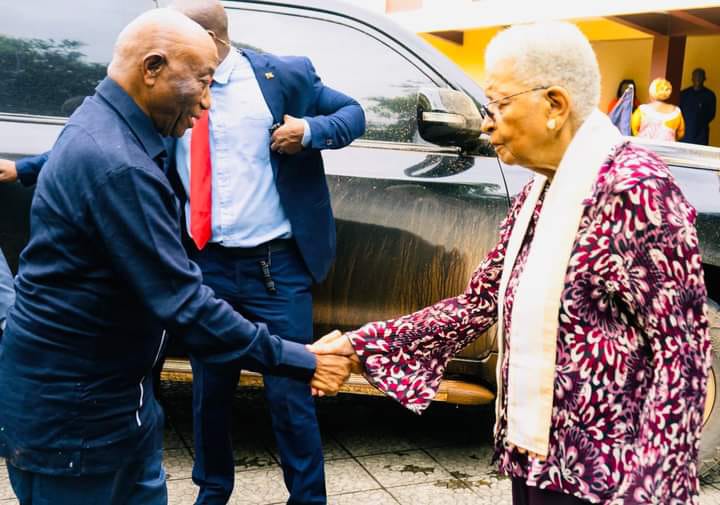
MONROVIA, Liberia, October 9, 2026 — Former President Ellen Johnson Sirleaf has urged Liberia to reduce its dependence on the United States for policy direction and embrace homegrown solutions that reflect the country’s development priorities and national interests.
Sirleaf said Liberia must break away from longstanding patterns of dependency and take greater responsibility for shaping its future through policies, institutions and development strategies suited to its own circumstances.
“We have to stop following the United States of America. Let’s join the new era of sovereignty, respectability,” the former president declared.
Her remarks signal a call for greater national ownership of Liberia’s development agenda, particularly in a changing global environment where countries are increasingly reassessing their political and economic relationships.
Sirleaf made the statement during a brief interview with journalists on Tuesday, October 6, 2026, following her participation in a one-day symposium organized by the Governance Commission on 3rd Street in Monrovia.
The symposium, held as part of activities marking Good Governance Month, was organized under the theme, “Promoting Good Governance Through Accountability and Transparency in Liberia.”
The observance was established by presidential proclamation in keeping with the Governance Commission’s founding Act of October 9, 2007.
Speaking to journalists, Sirleaf emphasized the need for Liberia to rethink traditional approaches to governance and development, arguing that the country must adapt to changing global realities rather than continue relying on policies and systems developed elsewhere.
Her comments come against the backdrop of Liberia’s longstanding diplomatic, historical and development relationship with the United States, a partnership that remained particularly strong during her 12-year presidency.
Sirleaf, who served from January 2006 to January 2018, became Africa’s first elected female head of state after defeating George Manneh Weah in Liberia’s 2005 presidential runoff election.
Her administration inherited a country devastated by years of civil conflict and prioritized post-war reconstruction, international debt relief, infrastructure development, institutional reforms and the restoration of Liberia’s international standing.
During her presidency, the United States remained one of Liberia’s major development and diplomatic partners, providing substantial assistance in governance, economic recovery, health, education and security-sector reform.
Sirleaf also maintained close relationships with successive American administrations.
In March 2006, shortly after assuming office, she addressed a joint session of the United States Congress, highlighting Liberia’s recovery efforts and appealing for continued international support.
Then-U.S. President George W. Bush visited Liberia in February 2008, while his successor, Barack Obama, hosted Sirleaf at the White House in 2010 and 2015.
The relationship became particularly significant during the 2014–2016 Ebola epidemic, when the United States provided major emergency assistance to Liberia, including medical personnel, logistical support and resources to help contain the outbreak.
Her administration also secured substantial international debt relief and development assistance as part of efforts to rebuild Liberia’s economy and strengthen public institutions.
Against this historical background, Sirleaf’s latest remarks represent a notable emphasis on national self-reliance by a former president whose administration benefited significantly from close American cooperation.
However, her statement did not explicitly call for Liberia to abandon its diplomatic relationship with Washington or reject international partnerships.
Rather, her comments focused on the need for Liberia to exercise greater independence in determining its national priorities and developing solutions to its governance and economic challenges.
The former president did not outline specific policy changes or identify particular American-supported programs that Liberia should reconsider.
Nevertheless, her remarks raise broader questions about how Liberia can balance its longstanding relationship with the United States against the need to strengthen domestic institutions, promote economic self-reliance and exercise greater control over its development agenda.
For a country whose reconstruction and development efforts have depended heavily on international assistance, Sirleaf’s message places renewed attention on the distinction between maintaining strategic partnerships and relying on external powers to shape national policy.
Her central argument is that Liberia must increasingly take ownership of its future while engaging international partners on terms that reflect its own priorities and interests. – The New Dawn
See more Liberia News Network stories in Google Search by adding LNN as one of your Preferred Sources.
★ Add LNN as a Preferred Source