
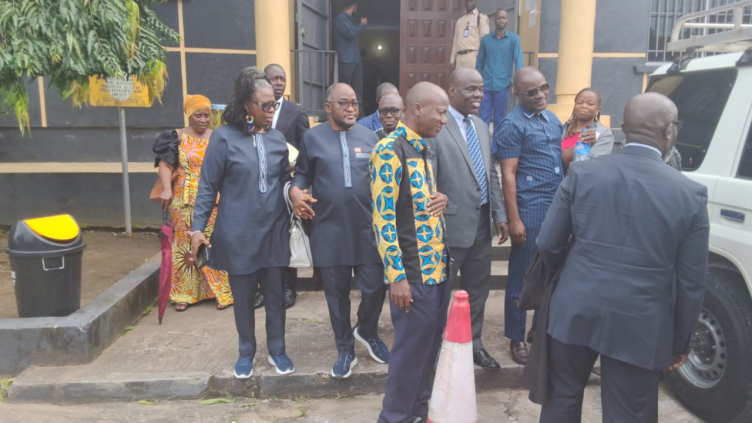
Judge Ousman Feika Rejects Defense Submission Before Closing Arguments; His Prediction of a Supreme Court Challenge Raises Courtroom Questions
Monrovia- A jury at Criminal Court “C” in Monrovia has returned a series of guilty, not-guilty and inconclusive verdicts in the high-profile Saudi-donated rice trial, marking a dramatic development in a case involving former senior government officials accused of criminal wrongdoing in the handling of humanitarian rice donated to Liberia by the Kingdom of Saudi Arabia.
The verdicts followed the final arguments by prosecution and defense lawyers on Friday, bringing the trial to a critical juncture in a case that has attracted national attention because of the identities of the defendants and the humanitarian purpose of the donated commodity.
Among the defendants reported guilty on the principal charges were former Foreign Affairs Minister Dee-Maxwell Saah Kemayah, former Internal Affairs Minister Varney A. Sirleaf, National Disaster Management Agency (NDMA) disaster-victim official Augustine Kollie, and former General Services Agency (GSA) Deputy Director Edris Idris Bility.
Other defendants, including former NDMA Executive Director Henry O. Williams and former GSA official Memmie Davie Larmie, were reported not guilty on all five charges in the information supplied from the proceedings.
However, the jury’s decisions were not uniform across all defendants. Some individuals received mixed verdicts, while other charges ended in inconclusive or hung verdicts because jurors did not reach the necessary agreement.
The results, as reported from the courtroom, underscore the jury’s differing assessments of the allegations against the various defendants.
Feika Rejects Defense Lawyer’s Submission Before Final Arguments
Before the commencement of final arguments, Criminal Court “C” Judge Ousman F. Feika reportedly denied an attempt by defense counsel Cllr. Jimmy Saah Bombo to make a submission to the court.
Judge Feika indicated that the submission was not appropriate at that stage of the proceedings and should have been made earlier.
The ruling placed the defense lawyer’s request outside the court’s preferred procedural timeline immediately before the parties presented their final arguments to the jury.
What reportedly astonished observers was Judge Feika’s assertion, made even before the conclusion of final arguments and the jury’s deliberations, that the lawyer would take the matter to the Supreme Court.
That statement, as described by courtroom observers, raised questions about the timing and context of the judge’s remarks, particularly because the jury had yet to deliberate and return its decisions.
Whether the exchange will become the subject of a formal challenge remains to be established. Any assessment of the judge’s conduct or the legal significance of the denied submission would require the precise wording of the request, the court’s ruling, and the applicable procedural rules.
Nevertheless, the episode added another point of contention to an already consequential trial, with the defense and prosecution preparing to conclude their presentations in a case carrying significant public interest.
Jurors Deliberate Behind Masks As High-Profile Defendants Await Outcome
Before the trial proceedings began, jurors were reportedly observed wearing masks intended to conceal their identities.
The arrangement underscored the sensitivity surrounding a prosecution involving former government officials and allegations concerning the handling of humanitarian assistance.
The jury was tasked with evaluating charges that included theft of property, economic sabotage, misapplication of entrusted property, abuse of office and criminal conspiracy.
At the heart of the prosecution’s case was the handling of 29,412 bags of rice donated by Saudi Arabia, reportedly valued at approximately US$500,000 and intended to assist disaster-affected and vulnerable Liberians.
The prosecution alleged that substantial quantities of the donated rice were improperly handled, diverted or misapplied. The defense, however, challenged aspects of the prosecution’s account, including the circumstances surrounding transfers between government institutions and the evidence linking individual defendants to criminal conduct.
The competing accounts placed the jury in the position of determining whether the evidence established each charge against each defendant.
Kemayah Reported Guilty Despite Dissenting Jurors
Former Foreign Affairs Minister Dee-Maxwell Saah Kemayah was reported guilty on all five charges: theft of property, economic sabotage, misapplication of entrusted property, abuse of office and criminal conspiracy.
The reported vote breakdown indicates that four of the 12 jurors voted not guilty on theft of property, four opposed a guilty finding on economic sabotage, three voted not guilty on misapplication of entrusted property, and four voted not guilty on criminal conspiracy. All 12 reportedly voted guilty on abuse of office.
These figures suggest substantial disagreement within the jury despite the reported guilty outcomes.
The precise legal status of each finding, including whether the verdicts satisfied the applicable requirements for a valid jury verdict, should be confirmed against the official court record.
Kemayah had maintained his defense during the trial, with the proceedings examining his role in facilitating the Saudi donation and the subsequent movement and distribution of the rice.
The outcome, if confirmed by the court record, would represent a major development for a former senior diplomat whose involvement in securing the donation placed him at the center of the controversy.
Sirleaf And Kollie Reported Guilty On All Five Charges
Former Internal Affairs Minister Varney A. Sirleaf was reported guilty on all five charges.
Augustine Kollie, identified in the proceedings as an NDMA official responsible for disaster victims, was likewise reported guilty on all five charges.
The findings against the two officials are particularly significant because the NDMA was central to the management of the donated commodity and the humanitarian response for which it was intended.
During the trial, Sirleaf disputed allegations concerning Kemayah’s role in directing the transfer of rice from the NDMA to the GSA. He maintained that the movement of the commodity resulted from an inter-agency decision and cited storage and inventory concerns.
The jury’s reported decision indicates that the prosecution’s allegations against Sirleaf resulted in guilty findings on each of the five listed charges. The court record will be necessary to establish the precise verdict language and any associated vote counts.
Kollie’s reported guilty verdicts similarly place the NDMA’s handling of the donated rice at the center of the case’s outcome.
Henry Williams And Memmie Larmie Reported Not Guilty
Former NDMA Executive Director Henry O. Williams was reported not guilty on all five charges.
The charges were theft of property, economic sabotage, misapplication of entrusted property, abuse of office and criminal conspiracy.
Memmie Davie Larmie was also reported not guilty on all five charges.
The outcomes demonstrate that the jury did not reach identical conclusions about all the officials whose names were associated with the handling of the Saudi donation.
Williams’ reported acquittals are particularly notable given his position at the NDMA, the agency central to the custody and distribution of the rice.
His defense had to be considered against allegations involving the movement of the commodity, institutional responsibilities and the conduct attributed to individual officials.
The reported not-guilty findings should not be conflated with the outcomes for other defendants. Each accused person’s criminal responsibility must be assessed separately according to the verdicts entered in the record.
Bility Reported Guilty; Siafa Receives Mixed Findings
Former GSA Deputy Director Edris Idris Bility was reported guilty on all five charges.
Bility had previously presented gate passes that he said documented the release of 5,000 bags of rice intended for Gbarnga, arguing that the commodity left the GSA warehouse through a documented process rather than being secretly removed.
The jury’s reported findings mark a significant development in the allegations surrounding the movement and documentation of the rice.
Wayne Siafa, identified in the supplied notes as a former chief executive, received a different set of reported outcomes.
He was reported not guilty of theft of property, economic sabotage and criminal conspiracy, but guilty of misapplication of entrusted property. The abuse-of-office charge reportedly ended in a hung verdict.
That mixed result illustrates the importance of distinguishing individual charges rather than describing every defendant as either wholly guilty or wholly acquitted.
A hung verdict does not constitute a finding of guilt or innocence on the unresolved charge. Its legal consequences depend on the court’s subsequent proceedings and applicable law.
Achievgo Doe And Thelma Duncan Sawyer: Inconclusive Votes On Some Charges
Achievgo Doe and former Deputy Foreign Affairs Minister Thelma Duncan Sawyer were reported not guilty on several charges, with inconclusive voting on others.
According to the supplied courtroom notes, the theft charge against Doe was recorded as not guilty, although one juror reportedly favored a guilty finding. On economic sabotage and misapplication of entrusted property, two jurors reportedly voted guilty in each instance, while the recorded outcome was not guilty.
The abuse-of-office charge ended without a conclusive verdict, with five jurors reportedly voting guilty and six voting not guilty. On criminal conspiracy, four reportedly voted guilty and eight not guilty.
The notes supplied for Sawyer contain a similar breakdown: not-guilty outcomes on theft, economic sabotage, misapplication of entrusted property and criminal conspiracy, alongside a hung verdict on abuse of office.
These counts require confirmation because the reported totals do not always account for all 12 jurors. The exact verdicts should therefore be checked against the official record before publication as definitive legal findings.
Other Defendants: Mixed And Unresolved Outcomes
The supplied notes also identify Rosetta Goah as having been found guilty of theft of property, economic sabotage, misapplication of entrusted property and criminal conspiracy, while the abuse-of-office charge reportedly ended in a hung verdict.
Everlyn Gbee was reported not guilty on the listed charges, although one juror reportedly voted guilty on theft of property.
Momolu Johnson was reported guilty on all five charges.
The opening summary also lists former officials and other defendants whose individual verdicts require further verification, including Edward Konneh and Momolu Duckly. The available notes do not provide a consistent, complete charge-by-charge breakdown for every named individual.
Consequently, the final list of convictions, acquittals and unresolved counts should be established from the court’s official verdict sheets rather than inferred from the preliminary information.
The Bigger Question: What Happened To The Saudi-Donated Rice?
Beyond the individual verdicts, the trial has centered on a fundamental question: whether the movement and distribution of humanitarian rice intended for vulnerable Liberians involved criminal conduct, administrative decisions, or a combination of disputed actions and failures of oversight.
The donation comprised 29,412 bags of rice, valued at approximately US$500,000. Prosecutors alleged that thousands of bags were stolen, diverted or improperly handled. Defense witnesses disputed aspects of that account and described transfers between government agencies as institutional decisions.
The jury’s reported decisions appear to distinguish between defendants and, in some cases, between individual charges. That distinction matters because allegations involving a shared government operation do not automatically establish the criminal responsibility of every person connected to it.
The verdicts also leave important questions concerning the unresolved counts and the precise legal consequences of the jury’s findings.
For Liberians concerned about accountability, the case is about more than the fate of former officials. It is also about whether humanitarian assistance intended for disaster victims reached its intended beneficiaries and whether public institutions can account for the resources entrusted to them.
A Consequential Day For Liberia’s Justice System
Friday’s proceedings at Criminal Court “C” brought the Saudi Rice Trial to a decisive point after weeks of testimony, documentary evidence and competing explanations of the rice’s movement through government institutions.
The reported outcomes include guilty findings against several prominent officials, complete acquittals for others, and unresolved charges where the jury reportedly failed to reach agreement.
Judge Feika’s reported rejection of Cllr. Bombo’s submission before final arguments, together with the judge’s reported prediction of a Supreme Court challenge, also warrants careful examination against the courtroom record.
The next critical step is confirmation of the formal verdicts, clarification of the hung counts and any subsequent rulings or sentencing proceedings.
For now, the central message from the courtroom is that the jury’s reported findings were mixed: several defendants face guilty verdicts, others were cleared of the listed charges, and some allegations remain unresolved. The official court record must determine the final legal position of each defendant.
See more Liberia News Network stories in Google Search by adding LNN as one of your Preferred Sources.
★ Add LNN as a Preferred Source