
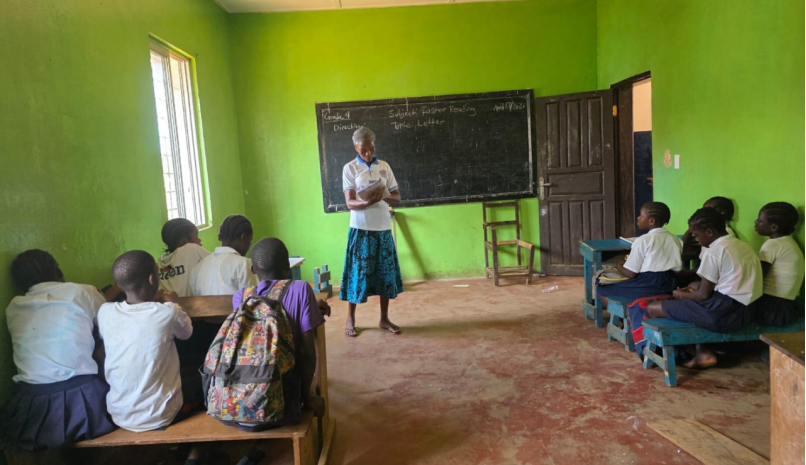
Elaine Duowai teaches at Euphemia Barclay Elementary School in Bensonville, where low pay, missing pupils and limited resources shape the school day. Photo: New Narratives
Summary:
- A global study found nearly three in every four workers in Sub-Saharan Africa are “struggling,” not “thriving.” In Liberia, that struggle is visible in classrooms and clinics where public servants work through low pay, stress, and poor conditions.
- Teachers and midwives interviewed for this story described low take-home pay, delayed payroll placement, overcrowded classrooms, understaffed clinics, and salary bureaucracy that leaves many exhausted and others walking away.
- Economists and labor advocates warn the cost hurts everyone: weak classrooms and clinics mean weaker learning, poorer health, lower productivity, and a future workforce Liberia may not be preparing.
BENSONVILLE, Montserrado County – Before sunrise, Elaine Duowai prepares lesson notes in a house where electricity is not reliable. By morning, she is walking to Euphemia Barclay Elementary School, where some pupils are already missing from the rows of benches before the day begins.
Some stay home because families cannot afford transport, food, or school materials. Others are sent to help parents sell or work on nearby farms. Duowai teaches the children who come. She worries about the ones who do not.
“Sometimes I look at the empty benches and feel weak,” Duowai said. “The children are not lazy. Their families are just struggling.”
The work is also hard inside the classroom: too few materials, absent pupils, children carrying adult burdens, and teachers expected to supply patience when the system supplies little else.
Then there is the pay. After one trip to central Monrovia to correct a salary problem, Duowai said she was told she needed money she did not have to open a new bank account. She returned to school with the problem unresolved and her strength nearly gone. Her husband, also a teacher, died in 2024. She is still fighting bureaucracy to access his benefits. She makes soap at night to feed her family and then gets up at sunrise to begin the school day.
Hers is the face of a wider warning for Liberia. In the latest State of the Global Workplace: 2026 Report produced by U.S. based polling company Gallup, nearly three in every four workers in Sub-Saharan Africa are “struggling” rather than “thriving.” The annual employee study, based on more than 141,000 employed respondents worldwide, also found high daily stress across the region.
Larwuo B. Walker, a registered nurse and midwife, works at Johnsonville Public Clinic, where staffing shortages stretch workers across long shifts
In Liberia, that finding shows up in public schools and clinics where workers continue to report for duty while low pay, delayed payroll placement, crowded facilities and weak systems drain the very people expected to keep the country moving. Interviews with teachers, midwives and economists describe a labor crisis that is not only about salaries, but about morale, working conditions and the cost of asking essential workers to survive on purpose alone. Especially when the country’s lawmakers take home as much as $US15,000 a month, more than most lawmakers in wealthy countries.
Duowai is clear about why the issue matters: the classroom is where Liberia’s future nurses, doctors, accountants, farmers, engineers and public officials begin. If the government forgets the classroom, she said, it forgets the people who will one day run the country.
Mary W. Mulbah-Nyumah, president of the National Teachers Association of Liberia, said the Gallup finding sounds familiar. She says low pay and repeated administrative frustration are weakening teachers before they even reach the classroom.
Nyumah taught in Liberia’s public school system for two decades before leading the association. She remembers years when teachers received salaries only twice a year, and only for one month at a time. She survived by trading, relying on food support and taking extra work. She says that old pattern has not fully ended; it has only changed form.
Today, some teachers still wait years to be placed on the payroll. Others are paid but say what reaches them after deductions cannot cover transport, rent, food, children’s needs and the small classroom expenses they often absorb themselves. In schools with too few books, desks or teaching materials, the emotional cost builds alongside the financial one.
Nyumah said the country is relying on teachers’ sacrifice to keep schools open. If too many leave, children lose more than lessons. They lose time, preparation, and the chance to move into adulthood with the skills needed to escape the poverty their parents are fighting.
Public-sector pay in Liberia has long lagged the cost of living. Successive governments have promised to address the problem. The Boakai administration has pointed to payroll verification, a promised $US150 gross monthly salary floor, and civil-service testing as steps toward cleaning up the payroll and reducing “no-show” jobs awarded in corrupt deals. Some of that is happening.
The Civil Service Agency said it integrated 3,406 essential workers in education, MCSS, and health into the national payroll in 2025, including 2,148 teachers and technical workers and 1,050 health workers. But the government’s own 2025 budget said fully absorbing all volunteer workers would cost about $US15 million, far more than the $US2.6 million allocated that year to begin the process.
Nearly two years into the administration, workers interviewed for this story said the reform is still uneven.
Maxim Bleeten and Augustus Walker, public relations officers at the ministries of education and health, did not respond to requests for comment by the deadline.
Jerry Barclay, assistant coordinator and instructor in the Department of Economics at the University of Liberia, said wages are among the strongest signals a government sends to its workforce. When workers are underpaid, unpaid or emotionally exhausted, he said, absenteeism rises, errors increase, service quality falls and productivity declines.
A weak health sector means sick workers may not recover quickly enough to return to farms, offices or classrooms. A weak education sector sends less-prepared students into the labor force. When schools and clinics struggle, Barclay says, agriculture, finance and other parts of the economy eventually feel it.
Duowai writes on a classroom board at Euphemia Barclay Elementary School. Teachers interviewed for this story described low pay as one burden among many, including limited materials and pupils kept home by poverty. Photo: New Narratives
At Johnsonville Public Clinic, Larwuo B. Walker, a registered nurse and midwife, sees the same pressure from the health side. Six midwives cover shifts that stretch from morning into night for a community of thousands. On some nights, she says, midwives sleep in chairs because there are not enough people to cover the work. Some women arrive in critical condition after delaying care because they were afraid or could not afford to come. Unnecessary birth injuries to mothers and babies that result in lifelong hardships often follow.
Walker holds a Bachelor of Science in Midwifery, but her monthly take-home pay is less than $US200. She has stayed in the clinic because she knows she is often all the stands between patients’ life and death.
Barclay said that is the breaking point policymakers often miss. Purpose can keep people in service for a time, but it cannot pay transport fare, rent, school fees or market prices. When a worker’s income stays fixed while prices rise – as they are now – living standards fall. Eventually, he says, productivity falls too.
Barclay said Liberia should treat spending on teachers and health workers as an economic investment, not only a social cost. If the government says it cannot afford better support for them, he said, it should also count the cost of weak schools, exhausted clinics and skilled workers leaving essential sectors for jobs that offer more dignity.
Nyumah said the teachers’ association will keep pushing salary complaints, payroll delays and volunteer-teacher cases to the ministries. Until then, teacher Douwai will prepare soap at night, wake before daylight, and walk back to school where her students, and the country’s future, depend on her.
This story was produced in collaboration with New Narratives as part of the Investigating Liberia project. Funding was provided by a private donor and the Swedish International Development Cooperation Agency. The donors had no say in the story’s content.
See more Liberia News Network stories in Google Search by adding LNN as one of your Preferred Sources.
★ Add LNN as a Preferred Source