
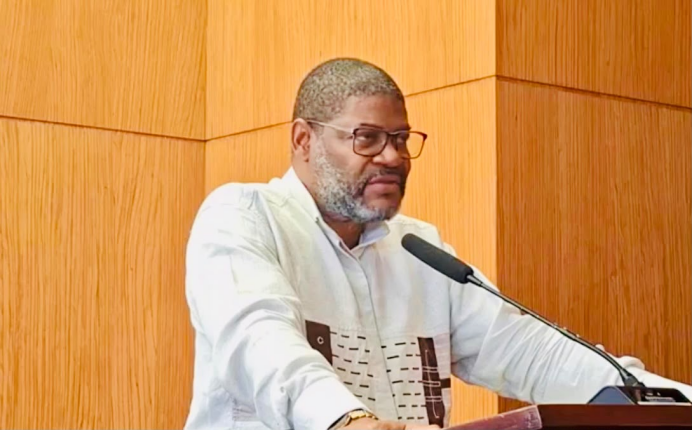
Monrovia — Senate Revenue Committee Chairman Gbehnzohngar Findley has called on the government and telecommunications companies to explain rising mobile money transaction fees and the expiration of unused scratch cards, warning that the practices are placing an unnecessary financial burden on Liberian consumers.
\n
By Obediah Johnson
\n
Findley, speaking during a regular session of the Liberian Senate on Tuesday, October 20, questioned the increase in mobile money transfer charges from 1% to 2%, arguing that the higher fees could discourage the growing use of digital financial services.
\n
He cited the charges imposed by major telecommunications operators, including MTN Liberia and Orange Liberia, saying customers are required to pay significant fees even when withdrawing salaries and transferring money through mobile money platforms.
\n
“If you notice, lots of our transactions are going digital now; there is a contingency on mobile money. What is the charge for transferring mobile money? It used to be 1%, but it’s 2% now,” Findley said.
\n
“Imagine that when you take your salary via mobile money, they tax you. Every time you send US$100, you pay US$2 for transfer to somebody.”
\n
The senator called for greater transparency regarding the charges, including how much revenue is generated from mobile money transactions and how the proceeds are distributed among telecommunications companies and the government.
\n
He specifically urged the Central Bank of Liberia (CBL) to account for the portion it receives from mobile money transactions and other related services.
\n
“What is happening to the US$2 being collected? What is the amount that is being generated? The Central Bank of Liberia doesn’t contribute to the budget, but they receive a portion of the US$2,” Findley said.
\n
He described the 2% charge as excessive, warning that it could undermine public confidence in digital financial services at a time when Liberia is increasingly relying on electronic transactions.
\n
“I believe this is high and it is a disincentive to the digital platform we are beginning to rely more on,” he added.
\n
Findley also questioned the apparent imbalance between the costs associated with cash-based and digital transactions. He noted that the government continues to spend millions of United States dollars printing additional Liberian dollar banknotes, while telecommunications companies collect substantial sums through digital transactions without incurring the same printing costs.
\n
He urged the CBL to examine the situation and ensure that mobile money charges are reasonable and transparent to consumers.
\n
Findley Questions Scratch Card Expiration
\n
Beyond mobile money fees, the senator criticized telecommunications companies for imposing expiration periods on unused prepaid scratch cards sold to consumers.
\n
He argued that customers should be allowed to use the airtime they purchase without being subjected to restrictive deadlines, particularly when they have already paid for the cards.
\n
Findley said the grace period provided by telecommunications companies in Liberia is too short, limiting consumers’ ability to use purchased airtime at their convenience.
\n
He contrasted the practice with what he described as a system in which customers who purchase multiple US$1 scratch cards should be able to use them over a period of their choosing, whether within a month or over a longer period.
\n
“In other jurisdictions, when you buy five packs of US$1 cards—whether you want to use it for one or two years or one month, it’s up to you. But in Liberia, it’s less than a 30-day period,” he said.
\n
The senator accused telecommunications companies of prioritizing profits at the expense of consumers and called for the practice to be reviewed.
\n
His remarks raise broader questions about consumer protection and the regulation of telecommunications services, particularly as mobile money and prepaid airtime remain important components of everyday financial and communication activities in Liberia.
\n
Calls For Stronger Prosecution Of Drug Offenders
\n
Findley also called for stronger prosecution of individuals involved in drug trafficking and dealing, saying the government must do more to address the spread of illegal drugs in Liberian communities.
\n
He expressed concern that some individuals arrested for drug-related offenses return to their communities after detention and allegedly intimidate peaceful residents.
\n
The senator urged the government to increase budgetary allocations for the investigation and prosecution of drug-related offenses, arguing that enforcement efforts must extend beyond arrests to ensure that offenders are brought to justice.
\n
“We need to start looking in the communities because we know that the drug dealers live with us; the kush, marijuana are right in our communities, and as they are arrested, they reappear into the communities again,” Findley said.
\n
He stressed that the continued presence of substances such as kush and marijuana in communities requires a more coordinated response involving law enforcement agencies, the justice system and local authorities.
\n
Findley also called for the establishment of additional rehabilitation centers across Liberia to help people struggling with substance use.
\n
He said the government should support individuals and organizations working to rehabilitate and reintegrate disadvantaged youths into society, emphasizing that enforcement alone would not adequately address the problem.
\n
The senator’s comments underscore the need for a comprehensive approach that combines effective prosecution, rehabilitation services and community-based interventions to tackle drug-related challenges.
\n
His concerns over mobile money charges, prepaid scratch card expiration and drug enforcement place consumer protection, financial transparency and public safety among the issues requiring greater government attention.
See more Liberia News Network stories in Google Search by adding LNN as one of your Preferred Sources.
★ Add LNN as a Preferred Source