
Published: October 29, 2026
MONROVIA — Liberia will require gold to be refined domestically before export, President Joseph Nyuma Boakai said Wednesday. He also announced a sovereign wealth fund funded by a fixed share of mineral revenues and a state mining company that will take ownership stakes in projects rather than relying solely on royalties.
Boakai said the government’s policy requires gold extracted in Liberia to undergo primary and secondary refining at licensed domestic facilities to internationally recognized purity standards before export. He said Liberia aims to establish a gold processing facility within two years. He told mining companies that new entrants must comply first.
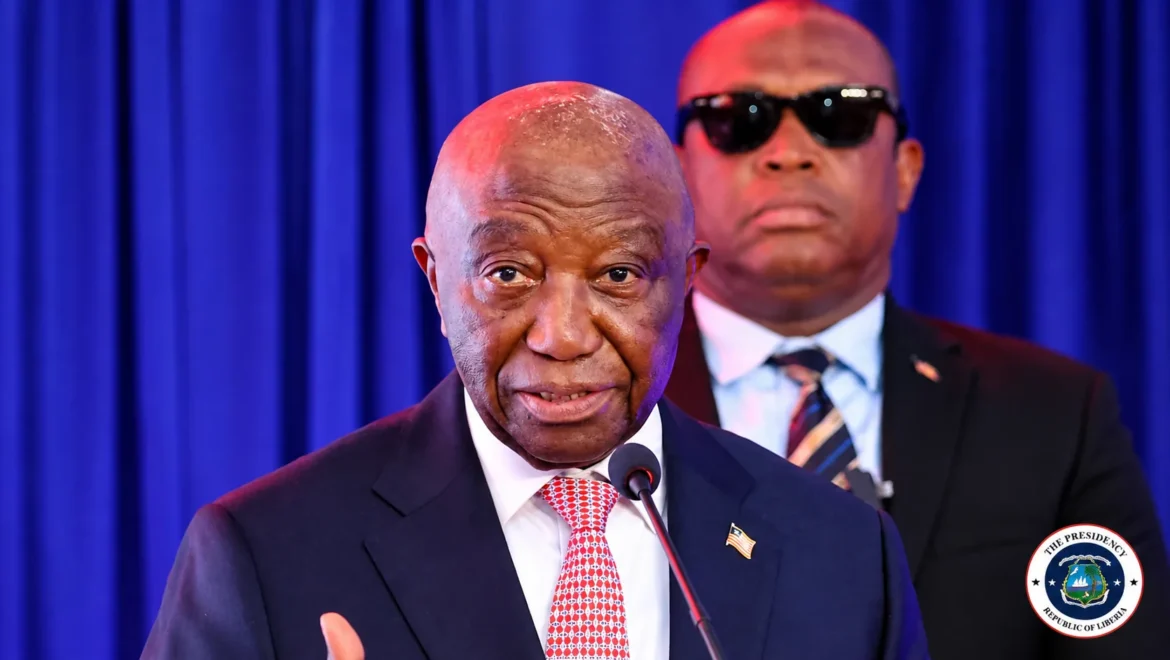
“This is going on in other countries, and it should happen here,” Boakai said in his keynote address opening the Liberia International Mining and Energy Conference and Exhibition at the Farmington Hotel.
He said the sovereign wealth fund is intended to operate as an independent investment vehicle in line with the Santiago Principles, the international standards for such funds. It would invest a fixed percentage of mineral revenues in diversified domestic and global assets, converting finite mineral wealth into long-term savings for future generations and reducing exposure to swings in commodity markets. He did not specify what percentage of revenue would go into the fund or when it would be established.
The National Mining Company of Liberia, he said, will move the country toward greater state participation in mining through equity and strategic ownership rather than collecting royalties alone. Mines and Energy Minister Matenokay Tingban said the company is subject to legal and institutional approval. He said its commercial activities must remain separate from the ministry’s regulatory role to avoid conflicts of interest.
Boakai also pledged that mining towns will not be abandoned once the minerals are gone. He pointed to what he called “ghost cities,” including Yekepa, Mano River and Bong Mines.
“I have said over and again to our officials and to investors that there will be no more area where mining or any investment of that nature has taken place and will be left lifeless as we have seen in the past,” he said.
He warned investors to deal honestly with the country. “People who want to be good friends of Liberia, who want to be investors, must come with clean hands and with genuine interest to make profit, but also to make sure that Liberians get the benefit of their resources,” he said.
Boakai said the government will review its minerals and mining laws and regulations, strengthen licensing and oversight, and expand digital licensing and access to official fee schedules. “I know some of you say we’ve been talking about it for a long time, but we’re not just going to talk. We’re going to act,” he said.
Mining remains a pillar of the economy, Boakai said. He said the sector grew 17% and accounted for 18.4% of real gross domestic product in 2025. He said mining contributed about US$124 million directly to national revenue in 2024 and US$432 million to domestic revenue so far this year. He said that supports a projected US$1.1 billion in domestic revenue this year, up from US$699 million in 2024.
He said a US$30 million airborne geophysical survey is planned under the Millennium Challenge Corporation compact to improve knowledge of the country’s critical and strategic minerals.
Tingban said about 80% of Liberia remains unexplored. He said the government will not sign mineral agreements without first knowing what lies in the ground. “No data, no deal,” he said.
According to Min. Tingban, the government is seeking technically capable and financially credible partners for a gold refinery. He said a domestic refinery would keep more value in Liberia, improve traceability and revenue collection, and give small-scale miners, brokers and dealers a credible local market. He also launched an initiative to formalize artisanal and small-scale mining. Under it, licensing and registration would be easier, miners would be helped to form cooperatives, and training would be offered in safety and environmental protection, with attention to women and young people.
U.S. and Chinese diplomats both pitched their governments as partners in the sector.
U.S. Chargé d’Affaires to Liberia, Kristin Gilmore, said the Millennium Challenge Corporation’s second compact for Liberia, now under development, focuses on mining and electricity reform. She said the U.S. Trade and Development Agency is finalizing a grant to assess Liberia’s rail infrastructure capacity to support Boakai’s goal of an open, multi-user railway. She urged the timely passage of legislation establishing a transparent, independently regulated multi-user rail system.
“The question is no longer whether American businesses are considering Liberia. They are,” she said. “The question is whether Liberia can attract them and give them the confidence to stay, invest, and grow.”
Chinese Ambassador Yin Chengwu said a China-funded mineral survey, analyzed by the Ministry of Mines and Energy, found signs of lithium, neodymium, nickel, cobalt, copper, uranium and other minerals besides iron ore, gold and diamonds. He said China rejects “the weaponization of critical mineral resources as leverage in geopolitical gains.” He said Chinese companies working on the Bomi and Bomi East iron ore projects have created more than 500 jobs.
On electricity, the managing director of the Liberia Electricity Corporation, Mr. Mohammed Sheriff, said installed generation capacity has grown from 22 megawatts more than a decade ago to 148 megawatts. He said about 70% of it comes from renewable sources. He said national electricity access rose from 27% in 2023 to about 39%, and residential tariffs fell from 52 U.S. cents per kilowatt-hour to 22 cents. He said losses from theft and billing failures fell from 41.3% in 2022 to 23.1%. He said projects now underway are expected to lift capacity to about 472 megawatts by 2029.
ArcelorMittal Liberia Chief Executive Michiel van der Merwe said the company’s investment in Liberia is nearly US$4 billion. He said its exports will rise from under 5 million tons of iron ore in 2024 to more than 20 million tons in 2027. Amara Kamara, president of the Liberia Chamber of Mines, called local content a national priority and urged investors to partner with Liberian businesses.
The two-day conference is organized by the Ministry of Mines and Energy, the Liberia Chamber of Mines and AME Trade Ltd. of London.
See more Liberia News Network stories in Google Search by adding LNN as one of your Preferred Sources.
★ Add LNN as a Preferred Source