
Published: November 3, 2026
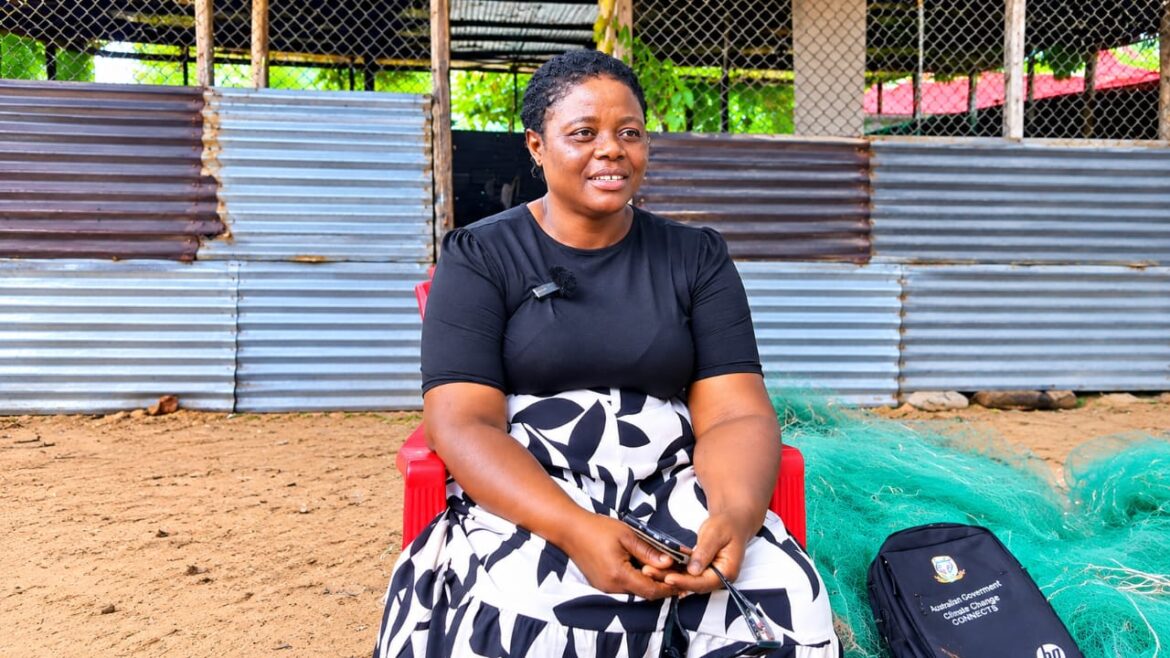
Kumba Boakai-Kulu began selling fish alongside her mother at age 10. She says a fisheries grant helped her replace a broken engine and stock fuel that crews can buy on credit before heading out to fish.
A US$2 million World Bank-supported grant is helping women make strides in the fishing industry, competing with their male counterparts.
On June 20, 2023, the Government of Liberia, through NaFAA and Conservation International (CI), signed a $2 million grant management agreement to enhance women’s participation in the fisheries sector under the World Bank-financed Liberia Sustainable Management of Fisheries Project (LSMFP). The grant, which was officially launched in March 2025, is being implemented by CI, with technical support from NaFAA and the LSMFP team.
Three of the large-grant beneficiaries, two in Robertsport, Grand Cape Mount County, and another in Buchanan, Grand Bassa County, shared what the money meant to them.
Kumba Boakai-Kulu, a recipient in Robertsport, Grand Cape Mount County, who urged the National Fisheries and Aquaculture Authority and the World Bank to keep investing in Liberian women, noted that the initiative is building the capacity of her fellow women to do bigger things.
The 48-year-old woman who now runs three 15-horsepower engines and two paddle-powered canoes began selling fish at ten, alongside her mother, and kept at it after her father died and her mother could no longer afford to pay for school. Fish sales carried her from fifth grade through high school, where she graduated around 2001.
After graduation, she spent 15 years working as a cash officer at LBDI; then, in June 2025, she resigned to give her full attention to fishing and her other ventures. “I saw a bigger picture,” she says. “I decided to take the risk in a Liberia that is not so easy.”
As CEO of the “Glory Be to Yaweh Service Centre” in Robertsport, she applied for the women empowerment grant through her business. Her business (Glory Be to Yaweh Service Centre) was selected for the grant. This happens at a critical moment when one of her engines had broken down completely. According to her, she added US$950 of her own money to her first installment and bought a replacement.
She used the next portion of the grant to stock fuel, a persistent challenge in Robertsport, so fishermen are not stranded on shore. They buy from her and repay after their catch, sometimes in exchange for fish.
Kumba says the grant helped her clear the debts her business had accumulated. Ten to twelve people now work with her, and none pay rent for the structures she built. Her expenses have fallen, and she is planning a modern freezing and drying facility.
“The grant gave us a push,” she says. “We expected more, but we know that where there is life, there is hope.”
Another resident, Musu T. Musah, a mother of five, narrated that she first heard about the grant from her daughter. She took advantage, applied, and was successful. She received US$5,000 in three installments. Through the grant initiative, she supplies fishermen with fuel in large quantities, and they repay her in fish. Before the grant, she could buy about two drums of fuel at a time. Now she buys 500 gallons or more.
The impact of the grant has become visible in her home and the community. She has finished her kitchen and fish drying area, moved her children into private primary school, and supported laborers who work with her.
With no bank nearby, Musu joined a savings club and puts in L$10,000 every Sunday, and she hasn’t missed a week since the money came. “It is improving our lives,” she says. In five years, she hopes to import fuel and own her own fishing boat.
A loan scheme that keeps giving
For Elizabeth Bonwin of the Big Fanti Town Fishing and Processing Center in Buchanan City, the grant has multiplied. Her organization has more than 100 women who meet twice a month, pay dues, and take part in a revolving loan scheme built on the grant.
Members are placed in groups of five, and the loans carry 10 percent interest, so repayments allow other members to borrow in turn. Her group has put out more than L$800,000 to support members’ businesses with interest expected in return.
“The grant is improving our lives and helping to do away with the struggle we undergo with loans and banking institutions,” she says. The funding is intended to provide women with alternative sources of livelihood, particularly during periods when fishing activities become difficult.
Madam Bonwin has expressed optimism that the initiative would enable the women to become financially independent and self-reliant in the coming years.
“In the next five years, we hope to see ourselves as independent and self-reliant,” she said.
What the women want next
The grant beneficiaries want the program to continue. Musu welcomed the monitoring visits that come with the grant by NaFAA. “It makes us serious,” she says. “When people give money and just leave, nobody is watching us, it is not good.” Kumba urged NaFAA and the World Bank to keep investing in Liberian women. “We are building up our capacity to do bigger things,” she says. “At first we were thinking low, but now we are getting out of the box.”
See more Liberia News Network stories in Google Search by adding LNN as one of your Preferred Sources.
★ Add LNN as a Preferred Source