
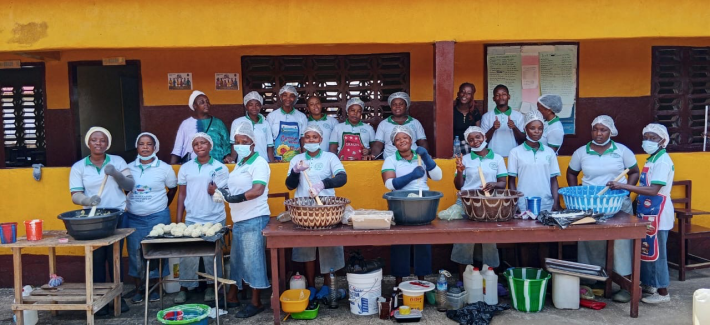
MONROVIA — For years, Marie Marlesa Gaye watched her daughter acquire practical skills through vocational training, but rather than continue relying on her child to build a better future, she decided it was time to invest in herself.
Today, Gaye is learning soap-making at the Youth Education and Humanity Liberia (YEAH Liberia), a decision she says has opened new opportunities for personal development, economic independence, and the ability to empower other women in her community.
Her story reflects a growing determination among Liberian women to move beyond economic dependence and take greater control of their livelihoods through vocational education and skills development.
Gaye is among several women participating in YEAH Liberia’s vocational skills training programme, which provides practical training in pastry, soap-making, tie-dye, hairdressing, catering, and other income-generating activities.
The programme is supported by the Women’s NGO Secretariat of Liberia (WONGOSOL), ActionAid Liberia, and Medica Liberia.
Speaking with FrontPage Africa during the students’ final practical examinations on Saturday at the James W. Ferguson School Campus, ELWA Junction, opposite the Samuel Kanyon Doe Sports Complex, participants described how the three-month training programme has transformed their skills, confidence, and outlook on life.
For Gaye, the decision to join the programme was inspired by her daughter’s achievements.
She explained that her daughter had previously benefited from YEAH Liberia’s pastry training, and watching her acquire skills and become capable of baking different products motivated her to pursue vocational education herself.
“My daughter never knew how to do anything better than flower arranging when she first came here. But today, she can bake different types of bread. Seeing her doing these things motivated me to come and learn a trade myself,” Gaye said.
She initially enrolled in hairdressing, despite having little knowledge of the profession. Through the training, she learned how to braid hair, including natural cornrows, and has since started practicing her skills and encouraging other women in her community to patronize her services.
She later enrolled in soap-making, explaining that soap is an essential household product with opportunities for small-scale businesses.
Gaye said the training has already enabled her to produce and sell liquid soap, giving her an opportunity to earn income while pursuing her dream of establishing a vocational training school where she can teach others.
“I started selling. I started making liquid soap and selling it. I am so grateful to God because I never knew I could do these things before,” she said.
For her, empowerment should not end with the individual who receives the opportunity. Instead, women who acquire skills must extend the benefits to others who may not have the privilege of accessing formal education or vocational training.
“YEAH Liberia will not reach everybody. So, as much as they empower us, we too should be able to reach those in our communities and empower them,” she added.
From Learning to Earning
Diamond Walker, a participant in the pastry and soap-making departments, said the programme has given her an opportunity to develop skills she can use to generate income.
Walker explained that she learned about the programme through a friend who shared a recruitment flyer with her. After reviewing the different courses offered, she decided to enroll in pastry and soap-making.
During her final practical examination, she demonstrated her baking skills by preparing doughnuts and shortbread.
She said the training has already enabled her to produce and sell baked goods within her community, providing her with an opportunity to make money from her own efforts.
“This is development for me because I am able to make my own money from all the baking and other things. The programme has been very helpful to me,” Walker said.
She expressed appreciation to the programme’s sponsors for creating an opportunity for young women to acquire practical skills that can improve their livelihoods.
Walker also described herself as an empowered young woman and said she was prepared to encourage others to take advantage of similar opportunities.
Another participant, Becky M. Samuels, who is enrolled in the tie-dye department, said her experience at YEAH Liberia has been rewarding.
Samuels explained that she initially visited the institution to support her daughter’s participation but became interested in the programme after observing the training opportunities available.
She has since acquired tie-dye skills and started teaching other people while still attending classes.
Her message to other women was simple: they must believe in their abilities and recognize that their hands can become instruments of economic transformation.
“Women should put strength in themselves and believe that they can do something with their hands. Not only men should be the ones supporting women. Women can also use their skills to make a difference,” she said.
For Mabel Y. Queedeh, who resides in Oldest Congo Town, Parker Island Community, District Five, the programme represents an opportunity to become a more capable and independent woman.
Queedeh said her daughter introduced her to YEAH Liberia after completing her own training, encouraging her mother to stop postponing her dreams and invest in herself.
Before joining the tie-dye department, Queedeh said she had no practical experience in the skill.
However, through the guidance of her instructor, she has gradually developed the ability to produce tie-dye materials.
Reflecting on her transformation, she expressed gratitude for the opportunity, describing the experience as a turning point in her life.
“I was nobody. God has made me somebody through YEAH Liberia,” Queedeh said.
She urged other women to enroll in vocational programmes, arguing that acquiring practical skills can help women become financially capable and contribute meaningfully to their families.
“Women, you all can join me. We need to become capable women for our children and ourselves. Every day, I am learning something, and I want other women to come and learn too,” she added.
Young Women Embrace Opportunities
The programme is also attracting young women seeking alternatives to unemployment and economic dependence.
Satta Tambah, a soap-making student, said she was encouraged by the opportunity to acquire vocational skills without having to purchase training materials for every class.
She explained that the institution provides most of the materials required for practical lessons, allowing students to concentrate on learning.
Tambah demonstrated her knowledge of soap production during the examination, explaining the ingredients and measurements required to prepare different types of soap.
She said she had already started practicing what she learned at home and sharing her products with neighbours.
“I feel happy and impressed. I also encourage my friends to take advantage of this opportunity because we don’t know what tomorrow will bring. When an opportunity is available, we should work with it,” she said.
Similarly, Praise P. Pawon, a student in the decoration department, said he enrolled after graduating from high school and realizing that remaining at home without acquiring additional skills would not help he achieve his ambitions.
Pawon said his aunt introduced he to the institution and encouraged her to take advantage of the opportunity.
Although he initially wanted to study catering, he enrolled in decoration because the catering class was already underway.
He said the training has given him a new sense of direction and motivated he to encourage other young people to participate in the next training cycle.
Pawon added that he hopes to pursue catering in the future, with ambitions of becoming both a teacher and a professional chef.
Building Women Through Vocational Education
Speaking to FrontPage Africa, Angel Jamesetta Cooper, Programme Officer at YEAH Liberia, said the institution’s vocational initiative was established to promote education, practical skills, and economic opportunities for women and girls.
Cooper, who has worked with the organization for nearly three years, said the programme has continued to create opportunities for young people and older women to acquire skills that can help them become economically independent.
She described her experience working with women and young people as rewarding, particularly because it allows her to listen to their challenges, understand their experiences, and help them identify opportunities for improvement.
According to her, the programme has gone through several training cycles, with the latest examination marking the completion of a three-month learning period.
She disclosed that YEAH Liberia provides essential materials for practical lessons, particularly in the pastry and soap-making departments, to prevent students from abandoning the programme because of financial difficulties.
“For the pastry department, we provide flour, sugar, baking powder, and all the necessary materials. For soap-making, we provide the materials needed for producing different types of soap because we don’t want anyone to drop out because they cannot afford materials,” Cooper explained.
She acknowledged WONGOSOL, Medica Liberia, and ActionAid Liberia for supporting the institution’s efforts to provide vocational opportunities to women and young people.
Cooper also praised the organization’s founder and chief executive, whom she credited with creating an environment where women and young people can learn, develop their abilities, and work toward their ambitions.
She encouraged women and young people, particularly those who are unemployed or unable to pursue formal education, to consider vocational training as a pathway to economic independence.
“Don’t just sit down. Try to do something with your hands. Not everybody is good at going to school or learning in a classroom, but there are many things we can do with our hands to make money,” she said.
Cooper disclosed that the institution plans to open another training cycle in the third week of November 2026.
She said classes are conducted on Saturdays, with pastry and hairdressing sessions running from 7 a.m. to noon, while soap-making and tie-dye classes begin at noon and continue until approximately 2 or 3 p.m., depending on the practical activities.
Participants are required to purchase an institutional T-shirt for L$15 and pay L$100 for registration and record-keeping, while the organization provides the necessary training materials.
As the students demonstrated their skills during the final practical examinations, their testimonies reflected a common message: vocational education can provide women with more than technical knowledge; it can restore confidence, create economic opportunities, and inspire them to become agents of change in their communities.
For women like Gaye, Walker, Samuels, and Queedeh, the programme represents a step toward a future in which they can earn from their skills, support their families, and extend opportunities to others.
Their experiences underscore the importance of investing in practical education as a means of strengthening women’s economic participation and reducing dependence on others for basic livelihoods.
See more Liberia News Network stories in Google Search by adding LNN as one of your Preferred Sources.
★ Add LNN as a Preferred Source