
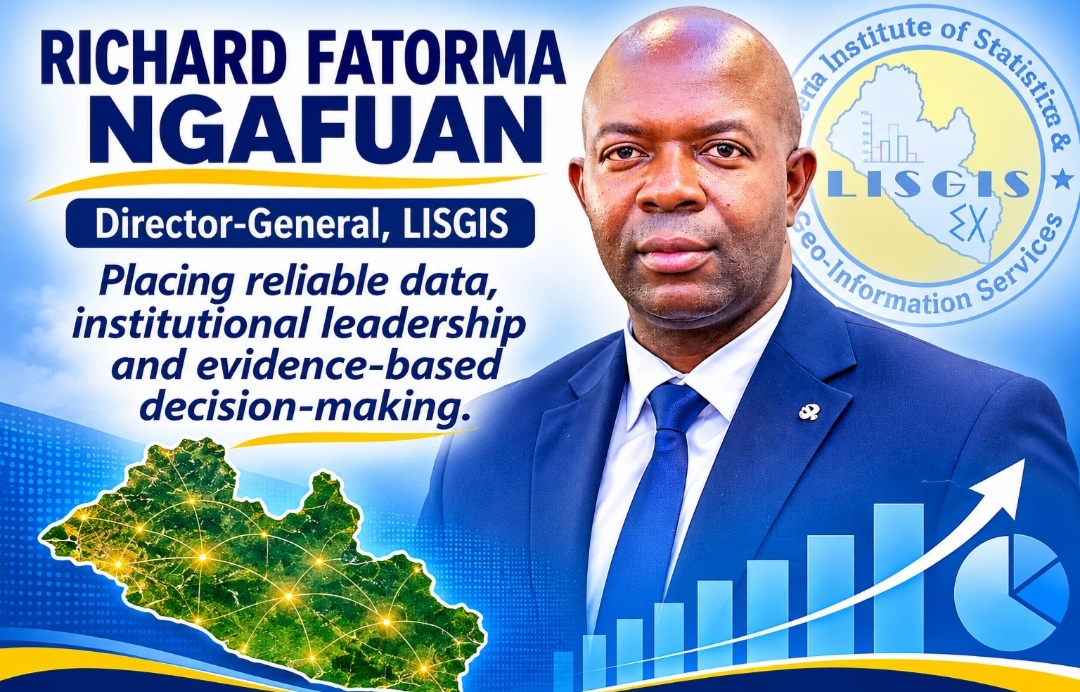
From strengthening national statistical capacity to advancing West African cooperation, the LISGIS Director-General is placing reliable data, institutional leadership and evidence-based decision-making at the center of Liberia’s development agenda.
By Socrates Smythe Saywon
\n
In a country where development decisions must respond to the realities of millions of people, the importance of reliable information cannot be overstated. Governments need accurate figures to understand the size and distribution of their populations, determine the needs of communities, measure economic performance, allocate public resources and assess whether development programmes are delivering the intended results. At the center of this national responsibility stands the Liberia Institute of Statistics and Geo-Information Services (LISGIS), an institution whose work provides an essential foundation for effective governance and national development.
Leading this important institution is Hon. Richard Fatorma Ngafuan, whose recent engagements at national, regional and continental levels have placed renewed attention on the importance of statistical leadership, institutional capacity, professional independence and the responsible use of data. His message is consistent. Statistics must not merely be collected and stored; they must be credible, accessible, properly interpreted and translated into practical decisions that improve people’s lives.
\n
Ngafuan’s leadership has become particularly visible through Liberia’s growing participation in regional statistical initiatives. From hosting ECOWAS statistical programmes in Monrovia to contributing to continental discussions in Addis Ababa, he has used these platforms to advance a development philosophy that recognizes reliable data as an indispensable resource for national progress.
One notable demonstration came during the Second Meeting of the ECOWAS Regional Statistical Coordination Committee for Directors-General of National Statistical Offices, held in Monrovia from November 16 to 20, 2026. The five-day gathering brought together statistical leaders and representatives of regional and international institutions to review progress in statistical harmonization, validate strategic documents, assess methodological frameworks and strengthen cooperation among West African countries.
\n
As the meeting concluded, Ngafuan delivered a message that reflected an important dimension of his leadership philosophy: regional commitments must produce practical results. He cautioned that recommendations without follow-up actions and implementation would accomplish little, urging participants to establish mechanisms through which decisions could be monitored, assessed and translated into measurable improvements.
His position speaks to a fundamental challenge confronting many institutions across the region. Conferences, workshops and policy discussions are useful, but their true value is demonstrated through implementation. By emphasizing measurable results, Ngafuan placed responsibility on participating statistical institutions to move beyond deliberations and strengthen the systems that produce information for public policy and development planning.
\n
The significance of Liberia hosting the meeting also extends beyond the successful organization of a regional gathering. It provided LISGIS with an opportunity to demonstrate its capacity to engage regional partners, contribute to shared statistical priorities and strengthen professional relationships with national statistical offices across West Africa. The participation of ECOWAS, the World Bank, African Development Bank, AFRISTAT and other institutions further highlighted the importance of cooperation in developing statistical systems capable of meeting the information needs of modern economies.
Ngafuan’s regional engagement is not limited to the November meeting. In October 2026, Liberia hosted an ECOWAS Regional Training on Statistical Leadership and Management for managers of National Statistical Systems. Held from October 5 to 9 under the World Bank-funded Harmonization and Improvement of Statistics in West and Central Africa project, the programme brought together statistical professionals from ECOWAS member states and Mauritania.
\n
Ngafuan described Liberia’s hosting of the programme as an important opportunity, noting that the country had not hosted the statistical leadership and management training for 16 years. He encouraged participants to apply the knowledge gained, share their experiences with colleagues and strengthen their respective institutions. The programme addressed strategic leadership, quality assurance, artificial intelligence, data communication and the management capacities required to improve statistical production and dissemination.
His contribution to continental statistical development was also reflected at the 10th Session of the Statistical Commission for Africa in Addis Ababa, Ethiopia, on October 21, 2026. Speaking at the gathering, Ngafuan emphasized the need for stronger statistical institutions, regional cooperation and renewed commitment to professionalism, independence, quality and public trust. The occasion also coincided with the conclusion of his two-year tenure as Chairman of the Bureau of the Statistical Commission for Africa, a continental platform that provides strategic direction for statistical development and promotes common statistical standards.
\n
These engagements demonstrate the value of Liberia’s participation in conversations that shape the future of official statistics. They also provide an opportunity for LISGIS to exchange experiences, learn from other national institutions and contribute to the development of approaches that make statistical information more useful to governments and citizens.
To appreciate the importance of Ngafuan’s responsibility, it is necessary to understand why LISGIS was created and the national role it is expected to perform. The institution was established under the National Statistics and Geo-Information Act, approved on July 22, 2004, and became operational in July 2005 after emerging from the former Statistical Department of the Ministry of Planning and Economic Affairs.
\n
Its establishment was a response to serious weaknesses in Liberia’s statistical system, particularly the damage caused by years of civil conflict. Statistical infrastructure had been destroyed, institutional capacity weakened and the production of essential information disrupted. The shortage of dependable statistics made it difficult for government and development partners to properly assess national conditions, formulate policies and measure reconstruction priorities.
LISGIS was therefore created to serve as Liberia’s principal authority for official statistics and geo-information, with responsibility for coordinating the national statistical system and improving the collection, analysis, management and dissemination of reliable information. Its mandate is to ensure that government institutions, businesses, researchers, development partners and the wider public have access to credible information for planning, research and decision-making.
\n
The institution’s responsibilities cover population and housing censuses, household and economic surveys, national accounts, consumer price statistics, agriculture, employment, demographic and social indicators, as well as geographic information and spatial databases. Through its geo-information services, LISGIS can also help connect statistical information with the physical locations of communities, infrastructure, natural resources and public services.
This combination is particularly important. Population statistics can reveal how many people live in a particular area, while geographic information can help identify where they are located and how communities are distributed. Such information can guide decisions about schools, health facilities, roads, electricity, water systems and other essential services. It can also support environmental planning, disaster preparedness, investment decisions and the monitoring of development programmes.
\n
The National Population and Housing Census illustrates the importance of this mandate. Census information provides a national picture of population size, distribution, demographic characteristics and household conditions. Liberia’s census history includes exercises conducted in 1962, 1974, 1984, 2008 and 2022. These exercises provide important benchmarks for understanding population changes and planning for the needs of present and future generations.
For an institution with such responsibilities, leadership must extend beyond administrative supervision. It requires a commitment to professional standards, institutional independence, staff development, technological advancement, coordination and public confidence. Ngafuan has repeatedly placed these priorities at the center of his public engagements.
\n
His emphasis on professional independence is particularly important because official statistics must be produced according to established methodologies and professional standards, not adjusted to satisfy political or institutional interests. When statistical institutions are trusted, their findings can support informed public debate, credible economic analysis and responsible government planning. When confidence is weakened, the usefulness of the information they produce is also affected.
Equally important is the need to make statistics understandable and accessible. A report containing hundreds of figures has limited public value if the information is difficult to interpret or cannot reach the people who need it. Statistical communication must therefore connect technical findings with practical realities, allowing policymakers, businesses, researchers and ordinary citizens to understand what the numbers mean.
\n
Ngafuan’s attention to technological transformation and artificial intelligence also reflects the changing demands placed on national statistical institutions. Modern technology offers opportunities to improve data collection, processing, analysis and dissemination. However, these innovations must be introduced responsibly, with proper attention to accuracy, confidentiality, professional standards and the protection of sensitive information.
The work ahead for LISGIS remains substantial. Strengthening the national statistical system requires sustained investment in qualified personnel, modern infrastructure, reliable funding, effective coordination with ministries and agencies, and improved access to statistical information. It also requires the consistent implementation of professional standards and the strengthening of public confidence in the institution.
\n
These responsibilities should be understood as part of the country’s wider development priorities. Liberia’s national development programmes, economic reforms and public investment decisions require dependable evidence to establish baselines, identify underserved communities and measure results. Without credible information, it becomes difficult to determine whether resources are reaching intended beneficiaries or whether policies are producing meaningful improvements.
Ngafuan’s leadership therefore carries an institutional responsibility that extends far beyond the walls of LISGIS. The quality of the institution’s work can influence the decisions of government, the confidence of investors, the research of universities, the programmes of development partners and the public’s understanding of national conditions.
\n
His recent regional and continental engagements have helped position LISGIS within important conversations about statistical modernization, cooperation and professional development. The next measure of success, however, will be the extent to which these engagements translate into stronger national systems, improved statistical products, timely publications and wider use of reliable information across Liberia.
As Director-General, Ngafuan has an opportunity to build on these engagements by consolidating institutional reforms, strengthening the professional capacity of LISGIS personnel and ensuring that the institute’s mandate produces visible benefits for the country.
\n
The importance of his leadership lies in the national responsibility he carries: helping Liberia understand itself through accurate information and equipping decision-makers with the evidence required to plan responsibly. A country cannot effectively manage what it does not adequately measure, and it cannot reliably measure development without a strong statistical institution.
For Liberia, LISGIS is more than an agency that publishes figures. It is an essential institution for national planning, public accountability, economic management and sustainable development. Under Richard Fatorma Ngafuan’s leadership, the opportunity is to strengthen that responsibility, deepen regional cooperation and ensure that reliable statistics become an even more practical instrument for improving the lives of Liberians.
See more Liberia News Network stories in Google Search by adding LNN as one of your Preferred Sources.
★ Add LNN as a Preferred Source