
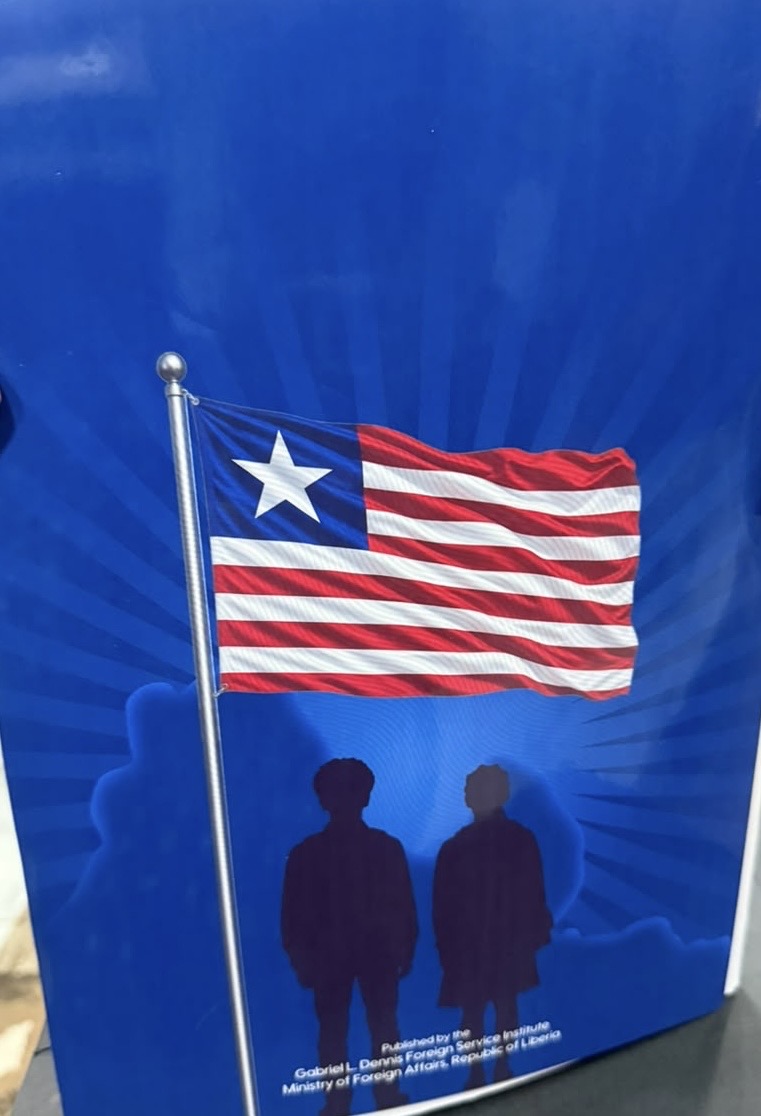
Dr. Aaron Weah Says Publication Preserves Original Documents From 1990–2003, Offers Lessons on Liberia’s Repeated Failed Peace Initiatives
\n
Monrovia – Liberia’s long and difficult journey from civil war to peace has been documented in a new publication that brings together 16 peace agreements negotiated between 1990 and 2003, providing researchers, policymakers, diplomats, and future generations with a consolidated historical record of the country’s peacebuilding efforts.
\n
The publication, titled Negotiating Peace in Liberia, was formally introduced during a presidential dinner and launch ceremony attended by President Joseph Nyuma Boakai, senior government officials, members of the diplomatic corps, and other distinguished guests.
\n
Presenting an overview of the Compendium, Dr. Aaron Weah, a lecturer at the Foreign Service Institute (FSI), said the initiative emerged in 2025 while he was redesigning a course on Introduction to Negotiation and Conflict Resolution.
\n
Weah explained that he proposed using Liberia’s own experience of civil wars, failed peace initiatives, and eventual peace agreement in Accra to help students understand the theories and practical realities of negotiation and conflict resolution.
\n
One central question that shaped the project was why 15 peace agreements failed to produce lasting peace before the 16th agreement, the August 18, 2003, Accra Comprehensive Peace Agreement, helped bring Liberia’s civil wars to an end.
\n
According to Weah, discussions with students revealed a significant gap in Liberia’s historical documentation: the original texts of the country’s 16 peace agreements were not available together in a single volume.
Advertisement
He subsequently challenged students in his class to collaborate on compiling the agreements negotiated between 1990 and 2003.
\n
Nine students volunteered for the initiative, working alongside Weah to locate, retrieve, and consolidate the historical documents.
\n
Preserving Liberia’s Peace History
\n
Weah said the team initially searched the archives of the Ministry of Foreign Affairs but found only a few copies of the agreements, highlighting the impact of Liberia’s civil wars on public institutions and the preservation of official records.
\n
The team eventually located the documents through a United Nations-managed online repository that archives peace agreements from around the world.
\n
He said the Compendium has two principal objectives: to bring all 16 agreements together in one publication and preserve their original wording and form as much as possible.
\n
However, the compilation process presented challenges, particularly when converting the original PDF documents into Microsoft Word files.
\n
The team also discovered spelling errors, inconsistent acronyms for warring factions, and inaccuracies in the names of certain locations and former African leaders.
\n
Among the errors identified were misspellings of the names of former Ivorian President Félix Houphouët-Boigny, former Malian President Amadou Toumani Touré, and former Guinea-Bissau President João Bernardo Vieira.
\n
Despite these inconsistencies, Weah said the team decided against making extensive corrections because doing so could alter the historical documents.
\n
The decision was therefore made to preserve the agreements as originally produced and signed, including errors and inconsistencies.
\n
Four Phases of Liberia’s Peace Negotiations
\n
The Compendium organizes the 16 agreements into four phases: Pre-Cotonou, Cotonou, Post-Cotonou, and the Accra agreements.
\n
The Pre-Cotonou phase represents the first stage of ECOWAS-led diplomatic efforts to end Liberia’s civil war. During this period, the Economic Community of West African States Monitoring Group (ECOMOG) exercised significant authority over the peace process, with emphasis on ceasefires, encampment, disarmament, demobilization, and preparations for elections.
\nThe Compendium organizes the 16 agreements into four phases: Pre-Cotonou, Cotonou, Post-Cotonou, and the Accra agreements.
The nine agreements under this phase include the ECOWAS Peace Plan, also known as the Banjul Communiqué of August 7, 1990; the Bamako Ceasefire of November 28, 1990; the Banjul Joint Statement of December 21, 1990; the Lomé Agreement of February 13, 1991; and the four Yamoussoukro Accords negotiated between June and October 1991.
\n
The Geneva Ceasefire of July 17, 1993, also forms part of this phase.
\n
The second phase, represented by the Cotonou Accord of July 25, 1993, introduced a different approach by making political power-sharing a central incentive for the warring factions to end hostilities and surrender their weapons.
\n
The agreement contained 19 articles addressing issues including ceasefire arrangements, disarmament, demobilization, the formation of a transitional government, elections, and the repatriation of refugees.
\n
However, the arrangement attracted criticism from civil society groups, particularly the Interfaith Mediation Committee, which had contributed to developing the original ECOWAS Peace Plan.
\n
The Post-Cotonou phase followed the collapse of the Cotonou Agreement and sought to address weaknesses in earlier arrangements.
\n
It included the Akosombo Agreement of September 12, 1994; the Accra Clarification of December 21, 1994; the Abuja Accord of August 19, 1995; and the Supplement to the Abuja Accord of August 17, 1996.
\n
According to Weah, these agreements modified earlier power-sharing arrangements and sought to give greater consideration to the relative influence of the principal warring factions.
\n
They also envisaged changes in security management, including the transfer of certain responsibilities from ECOMOG and the United Nations Observer Mission in Liberia to the Liberia National Transitional Government.
\n
Accra Agreement Marked Turning Point
\n
The final phase comprises the June 17, 2003, Agreement on Ceasefire and Cessation of Hostilities and the August 18, 2003, Accra Comprehensive Peace Agreement.
\n
Weah described the Accra process as the culmination of successive peace initiatives and the most far-reaching attempt to establish a comprehensive framework for ending Liberia’s civil wars.
\n
Unlike previous arrangements that largely concentrated political authority among the warring factions, the Accra agreement provided for a civilian transitional government chairperson who was not formally aligned with any of the factions.
\n
At the same time, it accommodated the warring groups through power-sharing arrangements at both ministerial and legislative levels, while incorporating civil society representatives into important oversight positions.
\n
The agreement also established a phased security arrangement under which an ECOWAS Vanguard Force would help create the conditions for the subsequent deployment of United Nations peacekeeping forces.
\n
Weah further highlighted the role of women’s groups and other civil society organizations in the Accra negotiations, describing their participation as an important feature of the peace process.
\n
Another significant development was the introduction of discussions on accountability for atrocities committed during Liberia’s civil wars.
\n
Unlike earlier agreements that largely avoided the question of accountability, the Accra negotiations considered options including the establishment of a war crimes court and a truth commission modeled after South Africa’s Truth and Reconciliation Commission.
\n
Weah said the discussions reflected a compromise between competing approaches, although important questions about the mandate and powers of a proposed truth commission remained unresolved.
\n
He also pointed to developments across West Africa and internationally that influenced the Accra negotiations.
\n
These included the transition from military to civilian rule in countries such as Nigeria and Ghana, developments in transitional justice in South Africa and Sierra Leone, and the indictment of former Liberian President Charles Taylor by the Special Court for Sierra Leone ahead of the Accra negotiations.
\n
The international security environment following the September 11, 2001, terrorist attacks in the United States also contributed to renewed international attention on Liberia, particularly concerns surrounding regional instability, illicit resource networks, and the country’s links to the Sierra Leone conflict.
\n
A Resource for Future Generations
\n
Concluding his presentation, Weah emphasized that the Compendium goes beyond bringing historical documents together, describing it as a documentary record of Liberia’s prolonged search for peace.
\n
He said the publication is intended to support academic research, policy development, diplomatic engagement, and public understanding of the negotiations that eventually ended the country’s civil wars.
\n
“We hope that this work will encourage further research, critical reflection, and public engagement with Liberia’s peacebuilding experience,” Weah said.
\n
He added that the publication should serve as a resource for future generations and a reminder of the lessons that can be drawn from Liberia’s history.
\n
Weah expressed appreciation to the Director General of the Foreign Service Institute for supporting the initiative and to the nine students whose voluntary contributions helped bring the project to completion.
\n
The launch places Liberia’s 16 peace agreements in one volume, offering an opportunity to examine the diplomatic efforts, political compromises, institutional challenges, and international interventions that shaped the country’s transition from years of armed conflict to peace in 2003.
See more Liberia News Network stories in Google Search by adding LNN as one of your Preferred Sources.
★ Add LNN as a Preferred Source