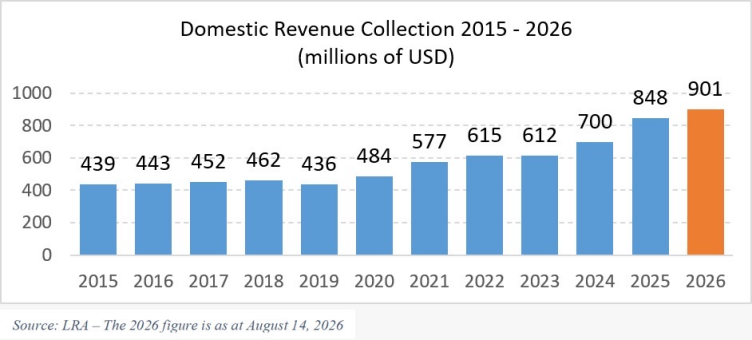
LIBERIA HAS DONE something it has never done before. For the first time in 179 years, the government has raised more than a billion dollars at home in a single year — not borrowed, not donated, but collected from our own people and businesses. That is worth marking. It is proof that when institutions are reformed, digitized, and held to a target, Liberians will pay what they owe and the state can actually collect it.
BUT A NUMBER on a ledger in Monrovia does not, by itself, put medicine on a hospital shelf in Zwedru or keep a teacher in a classroom in Voinjama. Whether this milestone matters will be decided not by how loudly it is announced, but by how visibly it changes daily life for the Liberian at the bottom of the ladder — the market woman, the okada rider, the subsistence farmer, the unemployed graduate. That is the only test that counts.
Why this should matter
LIBERIA HAS spent two decades being told, correctly, that its government could not afford to do very much. Every unpaved road, every unstaffed clinic, every unpaid teacher could be explained, at least in part, by a thin revenue base. That excuse is now smaller than it was. A government collecting over a billion dollars a year has real choices it did not have five years ago — choices about wages, about roads, about whether a farmer can get a loan without traveling to Monrovia and back. For ordinary Liberians, this milestone should matter because it removes an excuse, not because it delivers an outcome on its own. The outcome still has to be built.
Why it might not matter, if nothing changes
AS OUR REPORTING this week has shown, a meaningful share of this year’s total came from a one-time mining signature bonus that shrinks next year, and from a gold price boom that is enriching mining concessions faster than it is enriching the treasury, under royalty terms Liberia has not updated in years. If the government spends this year’s windfall as though it were a permanent baseline — locking in payroll additions and recurring commitments funded partly by non-recurring income — it risks a repeat of a familiar Liberian story: a good year followed by a mid-year scramble to borrow against a shortfall nobody budgeted for. The people who pay for that scramble are always the same people: public workers whose salaries go unpaid, patients whose clinics run out of drugs, students whose school year gets disrupted. The bottom of the ladder feels a revenue shortfall long before the top does.
What government can do to make it matter
Publish the breakdown, not just the total
LIBERIANS SHOULD be able to see, in one public document, how much of the billion dollars came from ordinary tax and customs collection versus one-time concession payments and signature bonuses. A number that cannot be broken down cannot be trusted, and a number that cannot be trusted cannot build the public confidence the President says this milestone represents. The Senate has already asked the Revenue Authority for an importer-by-importer accounting; that kind of disclosure should become routine, not something extracted committee by committee.
Renegotiate royalties while gold prices are high, not after they fall
A FLAT THREE percent royalty on gold made sense when prices were a fraction of today’s. It does not make sense at record highs, when neighboring countries are capturing two to three times the share Liberia collects. Every month this goes unaddressed is revenue that leaves the country for good. This is not a call to punish investment — sliding-scale royalties that rise with price and fall with it are standard practice regionally, and mining companies operating under them elsewhere have not fled.
FUND RECURRING commitments with recurring revenue, and one-time gains with one-time investments
SALARY REVERSALS and new payroll placements are welcome, but they are also permanent obligations. Money from a shrinking mining bonus should go toward the roads, clinics, and equipment the President has already flagged — capital investments made once — while recurring costs like salaries should be sized to what the ordinary, repeatable tax base can sustain in a normal year, not a record one.
Close the leakage before celebrating the collection
INDEPENDENT RESEARCH this year estimated the country may be losing upward of US$90 million annually to underreported mineral exports and unpaid turnover taxes. That is money already owed under existing law — no new tax, no new negotiation, just enforcement. Every dollar recovered there is a dollar that does not need to be squeezed from a market woman’s daily takings or a small trader’s import duty.
Let the Special Purpose Vehicle reach the people it is named for
THE GOVERNMENT’S proposal to set aside a portion of new revenue for affordable financing to Liberian-owned businesses is one of the more promising ideas in the President’s address — provided it is designed to reach the market women and small traders it is meant to serve, rather than concentrating in a handful of well-connected firms, as similar vehicles elsewhere on the continent have sometimes done. Transparent criteria and independent oversight from the start would make the difference.
A BILLION DOLLARS is a milestone worth noting. It is not yet a milestone worth celebrating on behalf of the ordinary Liberian — that will depend entirely on what the government does with it, and how honestly it tells the country where the money actually came from. The measure of this achievement will not be the number the government announced this year. It will be whether the teacher gets paid, the clinic gets its drugs, and the market woman notices the difference — not just this year, but in 2027, when the mining bonus is smaller and the real test of Liberia’s revenue reform finally arrives.
See more Liberia News Network stories in Google Search by adding LNN as one of your Preferred Sources.
★ Add LNN as a Preferred Source